

In Austria’s Bregenzerwald region, a village of barely 1,100 residents has found an unusual way to put itself on the global architectural map. Krumbach, set amid rolling green hills and traditional Alpine settlements, turned an everyday part of rural life into an international design experiment. Its bus stops, locally known as Wartehüsle or waiting houses, were reimagined by seven architecture practices from across the world, transforming ordinary places to wait for public transport into distinctive pieces of contemporary architecture.
The idea was simple but ambitious: invite international architects to spend a week exploring the region in exchange for designing a bus shelter, with local craftspeople bringing their concepts to life. The result was BUS:STOP Krumbach, a project that brought together international design perspectives and the region's established building traditions. Today, walking between these shelters is one of the more unusual ways to discover the village, which has also built a reputation for its heritage, local craftsmanship, nature trails, and culinary culture.
How Krumbach Turned Bus Stops Into Architectural Landmarks


The BUS:STOP Krumbach project emerged from a desire to rethink the village's public spaces and make architecture part of everyday life. Instead of commissioning conventional shelters, the local cultural association, Kultur Krumbach, collaborated with architectural institutions to bring seven international practices to the Bregenzerwald. Architects from Belgium, Spain, Japan, Chile, Russia, China, and Norway were invited to interpret the humble bus stop in their own ways.
The arrangement went beyond importing international design ideas. Each visiting practice worked alongside a local architect or craftspeople from Vorarlberg, including carpenters, builders, and metalworkers. This collaboration ensured that the structures reflected the region's materials, construction techniques, and architectural sensibilities while introducing unfamiliar forms and ideas. The shelters were eventually installed at different points across Krumbach, where residents continue to use them as part of the village's hourly bus network.
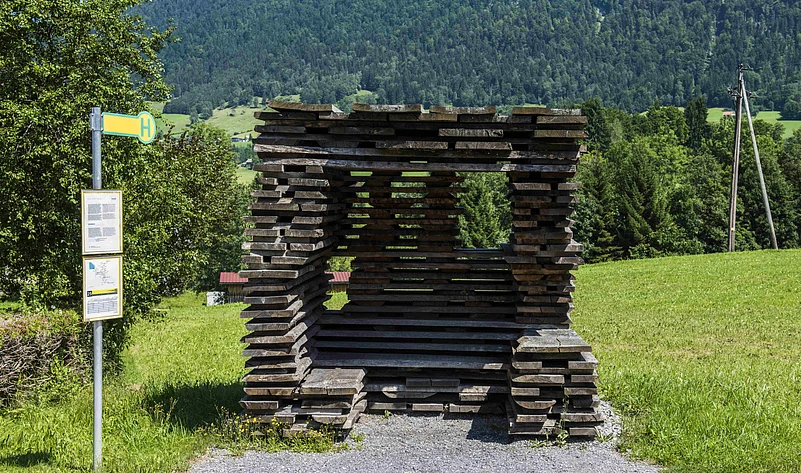
The seven designs offer contrasting interpretations of what a waiting space can be. Japanese architect Sou Fujimoto created an open steel structure at Bränden, made from slender rods and featuring a winding staircase. Rather than functioning as a conventional enclosed shelter, it doubles as a sculptural lookout. Spain's Ensamble Studio, led by Antón García-Abril and Débora Mesa, took inspiration from the timber-drying practices of the Bregenzerwald. Its shelter at Unterkrumbach Nord uses roughly cut oak planks stacked in layers to create an open structure.
Belgian architects Jan de Vylder, Inge Vinck, and Jo Taillieu of Architecten de Vylder Vinck Taillieu designed an angular, folded structure at Unterkrumbach Süd, drawing on geometric forms and the surrounding Alpine landscape. At Glatzegg, China's Amateur Architecture Studio, founded by Pritzker Prize-winning architects Wang Shu and Lu Wenyu, created a conical shelter inspired by the camera obscura. Its opening frames the landscape beyond, turning a routine wait into an opportunity to observe the mountains.
The other designs bring equally distinct ideas to the village. Chilean architect Smiljan Radic created a glass pavilion with a dark, coffered concrete ceiling, furnished with rustic wooden chairs and a birdhouse. Russian architect Alexander Brodsky designed an open wooden tower with a table and bench, while Norway's Rintala Eggertsson Architects created a timber shelter that also functions as a viewing stand for the neighbouring tennis courts. Together, the structures demonstrate how architecture can respond to local surroundings without relying on a uniform design language.
Beyond The Bus Stops: A Village Shaped By Architecture
The architectural experiment is part of a wider story of design-led development in Krumbach and the Bregenzerwald. The village has spent decades incorporating contemporary architecture into its traditional Alpine setting, with public buildings, community spaces, and transport infrastructure contributing to its evolving appearance. Local architects, including Hermann Kaufmann, Bernardo Bader, and the practice Bechter Zaffignani, have played a role in shaping this approach.
The result is a built environment where traditional timber construction sits alongside modern architectural interventions. Visitors interested in understanding this relationship can explore the Umgang Bregenzerwald village walks, which introduce the region's architectural culture through a series of designated routes. Rust-coloured pillars mark the different stations, offering insights into buildings, materials, and the local approach to design. In Krumbach, the BUS:STOP shelters make for an especially interesting extension of this experience, with a walk between the stops revealing how international ideas have been adapted to a small Austrian community.
Discovering Krumbach's Heritage And Local Traditions
Beyond its contemporary architecture, Krumbach offers a glimpse into the region's rural history through its museum village. Here, historic buildings dating largely to the 16th and 17th centuries have been carefully restored and relocated, creating a setting where visitors can explore traditional domestic and agricultural life.
One of its notable structures is the Tannbauer farmhouse, originally built in the 16th century below Krumbach Castle. It was dismantled and reconstructed at the museum village following detailed archaeological and architectural investigations. Its features, including a traditional smoking room and a brick-built granary, offer insights into the lives of its former occupants and the agricultural practices of the period. The museum grounds also house the Bürgerspital, a 16th-century building commissioned under castle lord Erasmus von Puchheim. Today, it accommodates the reception area, a permanent exhibition on rural life in the Bucklige Welt, and a multimedia presentation that explores the relationship between local farmers and the nobility.
A multimedia guide helps visitors navigate the different buildings through archival photographs, expert interviews, and accounts from contemporary witnesses. The museum village also has a historic demonstration brewery, established in 2019. Elsewhere, visitors can take a break at traditional parlour tables, explore local culinary products, or participate in craft workshops covering activities such as basket weaving and broom making.
Moorland Walks, Mountain Trails, And Regional Flavours

Krumbach's appeal extends into the surrounding landscape, with the village situated at approximately 730 metres above sea level amid the rolling hills of the Bregenzerwald. The Krumbach Moor is one of the area's natural highlights, providing a habitat for diverse plant and animal species. Walking trails through the moor offer an opportunity to explore this landscape, while the routes connecting the seven bus shelters provide a different way to experience the village on foot.
The surrounding mountains also offer hiking and cycling opportunities, with routes for mountain biking crisscrossing the region. During winter, the area lends itself to scenic walks, cross-country skiing, and downhill skiing. Nearby options include the Alpenarena Hochhäderich and the Riefensberg-Hochlitten ski areas, while Sulzberg is particularly suited to cross-country skiing.
Food is another part of the Krumbach experience. The region's Moorwirte innkeepers incorporate herbs and plants sourced from the local moor into their kitchens, offering visitors special breakfasts and food-related events. Local producers also contribute to the village's culinary identity. At Ölmanufaktur Krumbach, visitors can discover speciality vegetable oils, including linseed and sesame oil, alongside less common varieties made from tomato and chilli seeds.
The Salgenreute Chapel, opened in 2016, is another architectural stop worth including in an exploration of the village. Designed by Vorarlberg architect Bernardo Bader, the chapel combines stone and timber, with a pointed roof and shingle-clad exterior that draws on regional building traditions.
For a village of its size, Krumbach offers an unusually broad introduction to architecture, history, and the outdoors. Its bus shelters may have brought international attention, but the experience extends well beyond them. From restored farmhouses and mountain trails to local food traditions and contemporary buildings, Krumbach makes a compelling case for looking at rural Austria through the lens of design.
FAQs
1. Where is Krumbach located in Austria?
Krumbach is a small village in the Bregenzerwald region of Vorarlberg, western Austria.
2. Why is Krumbach famous?
Krumbach is known for its BUS:STOP project, which brought seven international architecture practices together to design unique bus shelters.
3. Which architects designed the Krumbach bus stops?
The project involved Sou Fujimoto, Ensamble Studio, Smiljan Radic, Alexander Brodsky, Wang Shu and Lu Wenyu, Rintala Eggertsson Architects, and Architecten de Vylder Vinck Taillieu.
4. What can visitors do in Krumbach besides exploring its bus stops?
Visitors can explore the museum village, walk through the Krumbach Moor, hike, cycle, visit local producers, and discover traditional Alpine architecture.
5. What is the best way to explore the BUS:STOP project?
Walking between the seven bus shelters is a popular way to experience the project and explore Krumbach's architectural landscape.