


I had barely stepped through the stone archway when Sheru appeared. A German Shepherd of considerable size and, it turned out, considerable warmth, he walked up unhurriedly, assessed me, and then simply fell into step beside me as though we had known each other for years. In the trees overhead, parakeets were in the middle of an argument. I had been at Chandelao Garh for approximately three minutes and already had the distinct sense that I had arrived somewhere that was not trying to impress me — and was, as a result, doing exactly that.


Sheru and his companion Pluto, a Labrador considerably more demonstrative in his affections, are among the heritage haveli's more reliable first impressions. The property is pet-friendly, which tells you something about how it is run. There is an ease here that is not managed or manufactured. It is the character of a family home that has learned, over three decades, to welcome strangers without losing itself in the process.
That home was built in 1744 by Rao Puranmal of the Kumpawat Rathore clan as the seat of the Chandelao Thikana, an estate that governed five villages within the kingdom of Jodhpur. Thakur Praduman Singh, the property's owner and 16th descendant in line from Rao Kumpa, one of Marwar's greatest generals, converted it into a boutique heritage hotel in the mid-1990s after years of watching it fall into neglect from his posting in the tea plantations of Assam. The restoration took two years, and not a single new structure has been added since.
The heritage haveli has 20 rooms — eight of them former stables with thick stone walls that manage the Rajasthan heat with a composure no air conditioning could replicate, and twelve spread across the original mardana quarters. A cobblestoned path lined with bougainvillaea and jaal trees leads to the courtyard rooms, each holding old family portraits and a sitting area. On the upper floor, the dalechi — a latticed gallery from which the women of the household once watched proceedings below — is among the most arresting spaces on the property. No televisions, no piped-in music, just considered detail that rewards a slow look around.

"When you stay here, you are staying in our home," Thakur Praduman Singh told me. "Everything you see is part of our family's actual story."
The property runs on solar power, collects rainwater in tankas holding up to six lakh litres, channels grey water back into the land, and uses no single-use plastic. Through the Chandelao Vikas Sansthan, the family planted over 3,000 native trees on surrounding land in 2025 alone. "We call it people, planet and profit," Thakur Praduman Singh said. "In that order."
Beyond The Gate
On our first afternoon, Kunwarani Yashodhara Kumari, Thakur Praduman Singh's daughter-in-law, took us to Sundarraang. The craft centre sits just beside Chandelao Garh, and walking into it feels like stepping into something genuinely at work. Women were cutting, stitching, and embroidering — turning block-printed fabric into bags, cushion covers, garments, and home décor. Each piece begins as handwoven, hand-dyed cloth sourced from Pipar, a town twenty kilometres away, and is tagged with the maker's name. What started with five women is now a collective of thirty-five, with a new training centre taking in ten new women each year since 2025.
"The tag is important," Kunwarani Yashodhara said. "The person who buys it should know who made it. And the woman who made it should get the credit."

The same afternoon, we walked through the village. This is where Chandelao Garh distinguishes itself from every other heritage property I have stayed at. The walkaround is not a curated experience with a fixed script — it is simply a walk through winding lanes, past fields, and small temples and the everyday evidence of a community that has been here for centuries. Women in odhnis called out from doorways. Children appeared and walked alongside us for a stretch. An elderly man insisted we stop and sit for a while. Nobody was performing hospitality. They were simply being hospitable, and there is a significant difference between the two. It felt, more than once, as though we were their guests rather than the other way around.
Pipar And The Art Of Dabu
The activities at Chandelao Garh extend well beyond the property, and the next morning, we drove to Pipar to visit Yasin ji. A dabu printer with deep ties to Chandelao Garh, his workshop was stacked with bolts of cloth in deep indigos, brick reds, and earthy greens. Dabu is a resist-printing technique — a paste of clay and gum blocks out sections of fabric before dyeing, creating patterns like something between a stamp and a watercolour. Walking the bazaars of Pipar and watching the cloth being made from scratch — cloth that will eventually become a bag or a cushion cover at Sundarraang — is one of the experiences the Chandelao Garh offers.

A sunset safari to dessert barbeque was part of the evening experience. That evening, the jeep climbed towards a rocky outcrop overlooking the Thar Desert for the rock barbeque. A fire was lit. The sun went down in the way it only does in the desert — unhurried, enormous, the sky moving through shades no photograph has quite managed. I ate rather a lot and said very little, which felt like the correct response.
The Breakfast Trail And Jodhpur
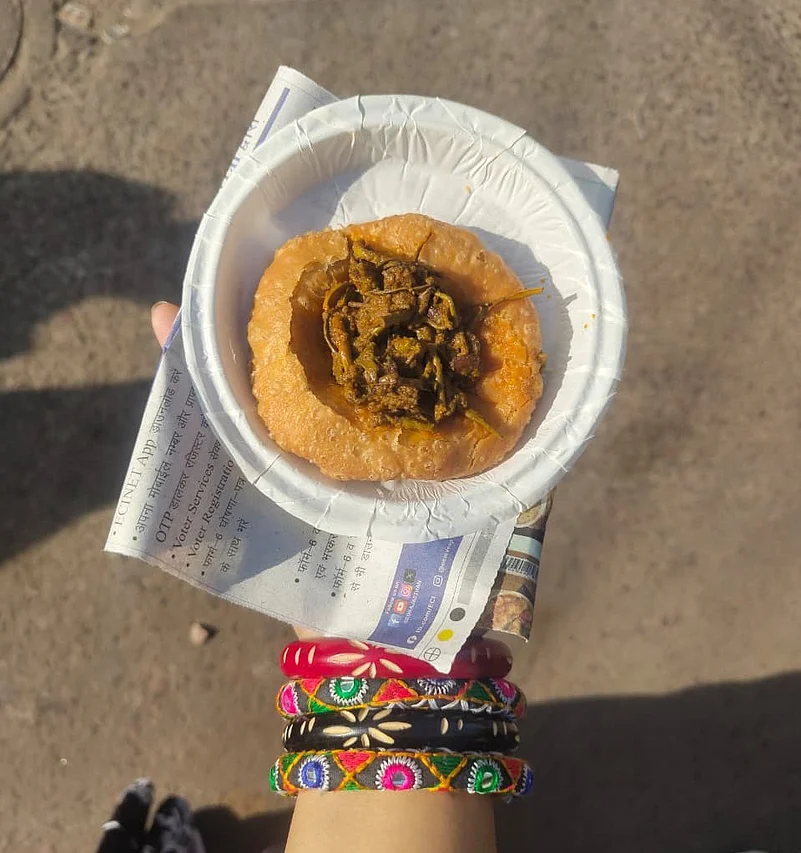
On the last morning, Kunwar Veer Aditya Singh, Thakur Praduman Singh's son, had us up early for the Breakfast Trail. We began in Dangiyawas, just outside Jodhpur, where chai and namkeen shops were already doing serious business — mawa halwa and crisp savouries consumed standing up, in the manner of people with no time to waste. From there, noodle-thin jalebis at the legendary Motu Jalebi in Old City, a walk through the stepwell and ghantaghar, and then more eating — kachori panchkutta (kachori with special kersangri masala) at Solanki Mishtaan Bhandar, khatta-meetha samosas at Shahi Samosa, mirchi bada at Surya Namkeen. No chutneys anywhere. "You eat the snacks as-is to get their flavour," a shopkeeper explained”.
Mehrangarh Fort followed — the great 15th-century citadel rising from a bluff over the Blue City, its views over the blue-washed streets below among the finest in Rajasthan. Lunch was at Shandar Sweet Home: gulab jamun ki sabji, rasmalai sabzi, Kabuli pulao with fruit and cashews, and dahi bada in thick sweet curd. A savoury dish built on what is normally a dessert sounds improbable. It tasted extraordinary.
By late afternoon, driving back to Chandelao, the return felt different from the departure. It felt like going back to somewhere, rather than leaving somewhere.
Dinner With The Family
The meals at Chandelao Garh were the highlight of the stay, but the last evening's dinner was the one I will not forget. Kunwar Veer cooked jangli maas — mutton in a sauce of ghee and Rajasthani chilies, with very little embellishment and absolutely nothing apologetic about it. The family joined the table, the conversation moving from the history of Marwar to the mechanics of rainwater harvesting to Kunwar Veer's plans for new trails at Chandelao Garh. It was not an add-on. It was the experience.
The Information
Getting there: There are direct flights available from major Indian cities to Jodhpur. From Jodhpur airport, Chandelao Garh is about a 40-kilometre drive and can be reached by taxi in approximately one hour.
Address: Chandelao Garh, Village & Post Chandelao, Via Banar, Jodhpur District, Rajasthan 342027
Tariff: From INR 6,000 to INR 7,500 per night (prices vary according to room category and season)


