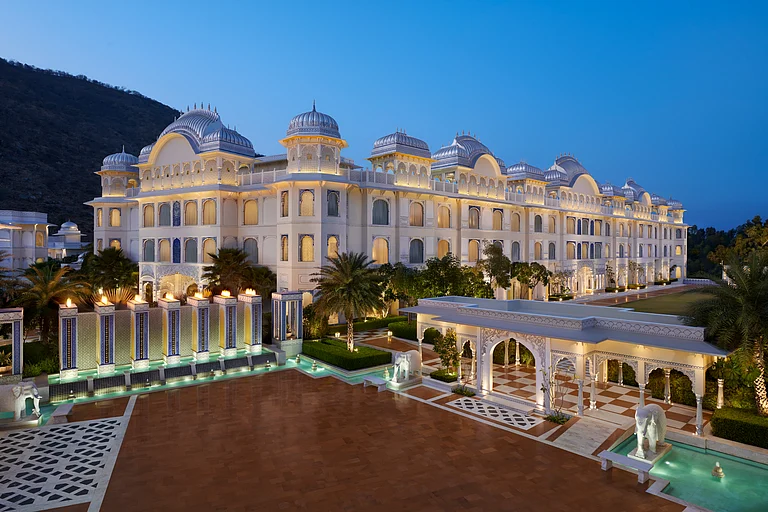
There is a certain audacity to building a palace from scratch, but one can trust Accor’s luxury arm Fairmont to make its India entry come together with a buzzing offering, and this is it. After Jaipur and an art-deco delivery at Mumbai’s Terminal 2, the brand opens up a greenfield palace and makes it feel as though it has always belonged. Fairmont Udaipur Palace leans comfortably into this ambition, positioning itself as an expansive, almost ethereal realm designed for modern-day seekers of royal opulence. Spread across 18 acres on the city’s quieter edges, amid the Aravalli hills, it chooses the language of artful nuances, showcasing the ambitions of global brands in weaving Indian craftsmanship on the premise of sharp hospitality.
The Design Speaks
Arrival at the palace is deliberately theatrical. The Raj Dwar, a fortress-like gateway flanked by cannons, frames the transition between two worlds, on a vintage Willy if you'd like. At the foot of a striking brass leopard(s) installation in the foyer, the property rises in a composition of domes, chhatris, and colonnades that borrow from Mewar’s architectural lexicon, but does not succumb entirely to imitation. The use of stone and marble is generous, grounding the grandeur in material honesty. Inside, the hotel presents a stylised homage to history—palatial, but with a contemporary clarity that keeps it from becoming ornamental excess.
The palace unfolds as a sequence of experiences rather than a single reveal. The lobby, crowned with a soaring dome and an imposing chandelier, opens out to views of Sajjangarh fort on the other fringe of the city. All around the main three-winged structure, terraces, pools and courtyards are layered to maximise the vistas. The three wings—Surya Mahal, Chandra Mahal, and Agni Mahal—anchor the narrative in elemental symbolism, their tonal shifts subtly guiding the mood from light to introspection to warmth.


There is, undeniably, a strong design intelligence at work. Jali screens filter light with precision, original ‘Thikri’ mirror work shimmers across corridors, and handcrafted details sourced from local artists and artisans add depth. The palace succeeds in what many newly built luxury properties attempt but rarely achieve—a sense of cohesion. It feels designed not only for admiration, but also for the rhythms of arrival, gathering, celebration, and retreat. And celebration is, unmistakably, its raison d’être.
Crafted For Weddings
With over 1,40,000 square feet of event space, it is a meticulously crafted stage for destination weddings and large-format celebrations. Venues such as the chandelier-lit Jewel ballroom, the column-lined Mehfil courtyard, and the dramatic stepwell-inspired Chand Baori are all quite scenographic. Lawns like Jashn Bagh and Noor Bagh extend this scale outdoors, while terraces offer more intimate vantage points. It is a property that understands the grammar of Indian weddings—its crescendos and pauses, and accommodates them with assured elegance.

Rooms and suites, numbering 327, echo this balance of scale and intimacy. Categories range from Fairmont Rooms to sprawling signature suites with private pools and terraces. Interiors lean into a softer luxury—muted palettes, tactile fabrics, and a sense of seclusion that offsets the grandeur outside. The larger suites, particularly the Maharani and Maharaja ones, are unapologetically indulgent with marble dining tables, bejewelled roll top tubs and private lap pools.

All Things Beautiful
Service, meanwhile, is where the palace becomes personal. The butler service is intuitive and unobtrusive, anticipating needs with a fluency that reflects both training in high-value hospitality and genuine attentiveness. It tempers the property’s vastness, making it feel navigable and even intimate, as when my butler Thungjano arrived on the terrace restaurant with a soft shawl during dinner, as I sat freezing in my evening dress. F&B service is excellent as one would expect, with servers offering warm smiles and replacing your napkins before you even realise it fell. In all my experience of luxury with Accor, Fairmont’s service feels genuinely superb.
The culinary landscape is expansive, with eight distinct dining concepts that assert a layered identity. At Dastaan, the Irish coffee emerges as a highlight—balanced and precise, embodying the lounge’s ethos of slow, reflective indulgence. The chef’s table experience, centred on Indian cuisine, is perhaps the most compelling offering. I attended an Asian table with sous-Chef Diksha, who presented a nuanced, well-paced exploration of regional flavours with confidence and care. It resists the temptation of excess, favouring clarity over spectacle.

Venues like Zaika and Bahaar ground the experience in familiarity, while spaces such as Sitara and the Ivory Pool Bar extend it into moments of leisure and transition, from sunlit afternoons to languid evenings. High tea setups are accompanied by a local flea market and folk music. The hotel is expected to open two more dining venues in the coming months, aiming to remain dynamic in its offerings.
Choose It For The Right Reasons
Water, in a city defined by its lakes, is interpreted here through abundance. Pools appear across the property, offering different relationships to the landscapes they face. An indulgence, certainly, but it feels aligned with the ethos of leisure the palace promotes.
Yet, amidst this carefully constructed narrative, there are moments where symbolism edges into overstatement. The recurring leopard motif is intended as a tribute to the region’s wildlife, embodying resilience and grace. Its repetition, however, raises a more complex question. In a landscape where such animals are increasingly being displaced, the motif begins to feel like a decorative echo, gesturing toward the wild without fully engaging with its realities. It is a subtle but perceptible dissonance.
What Fairmont Udaipur ultimately achieves is a compelling synthesis of intent and execution. It may not possess inherited history, but it constructs its own with conviction—through architecture, through ritual, and through a deeply considered sense of purpose. This is a palace designed for contemporary celebration, where awe is engineered, luxury is curated, and every detail contributes to a larger, carefully composed experience that, in all likelihood, will be thrilling.
FAQs
1. Where is Fairmont Udaipur Palace located?
Fairmont Udaipur Palace is located on the quieter outskirts of Udaipur, Rajasthan, surrounded by the Aravalli hills.
2. Is Fairmont Udaipur suitable for destination weddings?
Yes, the hotel has over 1,40,000 square feet of event space, including ballrooms, courtyards, gardens and terraces designed for large-scale destination weddings.
3. How many rooms does Fairmont Udaipur Palace have?
The property features 327 rooms and suites, including luxury signature suites with private pools and terraces.
4. What dining options are available at Fairmont Udaipur Palace?
The hotel currently offers eight dining concepts, including Indian, Asian and lounge-style dining experiences, with additional venues expected to open soon.
5. What makes Fairmont Udaipur different from other palace hotels?
Unlike heritage palaces converted into hotels, Fairmont Udaipur is a newly built luxury property that combines contemporary hospitality with Mewar-inspired architecture and handcrafted design elements.