Most children encounter elephants in picture books, at zoos or on family holidays. Parbati Barua encountered them in the forests of Assam. By the time she was 14, she had already brought home her first elephant from the Kochugaon forests of Kokrajhar. What began as a childhood fascination would eventually become a lifelong vocation, taking her deep into forests, across states and into a profession where women were rarely seen.
Today, Barua is recognised as India’s first female elephant mahout, an animal conservationist and one of the country’s most experienced practitioners in elephant management. Affectionately known as "Hasti Kanya," or the Daughter of Elephants, she has trained more than 500 elephants over the course of her career. Her work has also taken her beyond traditional mahout duties, from helping forest officials manage human-elephant conflict to caring for injured elephants and training mahouts and field staff.
A Childhood Spent Around Elephants


Born on March 14, 1953, in the royal family of Gauripur, Assam, Barua grew up surrounded by a world that was rather different from most childhoods. Her father, Prakritish Chandra Barua, popularly known as Lalji, was the last of the Rajahs of Gauripur to hold power and had an extraordinary understanding of elephants. The family's royal stables were reportedly home to around 40 elephants.
Barua studied Political Science at Gauhati University, but academic life could not compete with her fascination with the animals she had grown up watching. Her father frequently took her into the forests, where she observed elephants at close quarters and gradually learnt to understand their behaviour. Those early experiences gave her an instinctive familiarity with the animals and laid the foundation for a career that would have been unconventional even for someone outside the royal family.
From A 14-year-old Mahout To An Elephant Expert
Barua's first elephant capture came when she was just 14. Years later, between 1975 and 1978, she successfully tamed 14 wild elephants using Mela Shikar, a traditional Assamese method of capturing elephants with a lasso rather than a tranquiliser gun.
The work took her through the forests of Assam, including Darrang and Kochugaon, and into North Bengal, including Jalpaiguri and Darjeeling. Working with wild elephants demanded more than physical courage. It required patience, an understanding of animal behaviour and the ability to read situations that could change within seconds.
Over the decades, Barua went on to train more than 500 elephants. Her expertise eventually saw her work with forest departments and mahouts across Assam, Kerala, West Bengal, Uttar Pradesh, and Uttarakhand. She also assisted with the care and herbal treatment of newly captured elephants and helped train field personnel in elephant handling and management.
A Life Devoted To The Herd
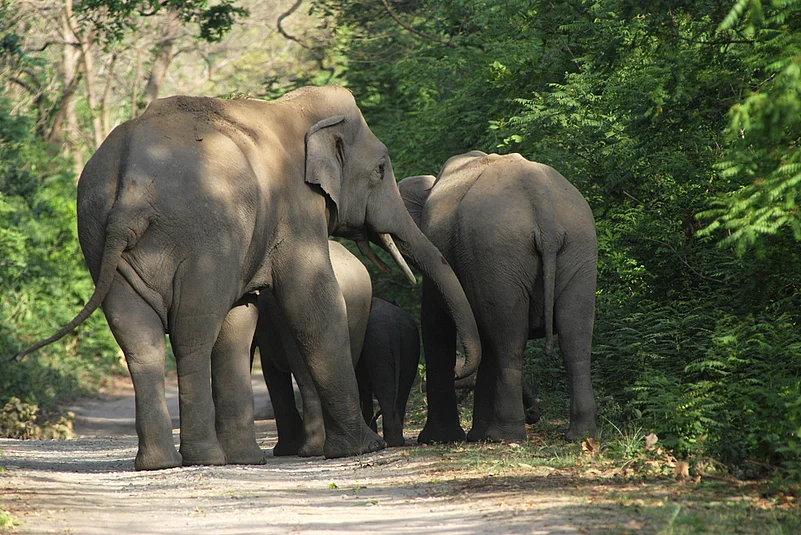
For Barua, working with elephants has never been limited to riding or training them. Her routine has included bathing her elephants, taking them into the forest, caring for them and developing the trust necessary to work with such powerful animals.
Her relationship with the animals is particularly evident in the affection she has for Lakshmimala, Aloka and Kanchanmala, three elephants she considers like daughters. She is also known for preparing hadiya, a traditional fermented rice drink, for her elephants, who have developed a taste for it.
That close relationship has made her a valuable figure in some of India's most difficult human-elephant conflict situations. Governments in Assam, Bihar and West Bengal have sought her assistance in dealing with rogue elephants and caring for animals that are injured or unwell.
When An Entire Herd Needed Help
One of Barua's notable field operations involved a herd of around 50 elephants in West Bengal's Midnapore district. The animals had strayed from their usual migratory route and entered villages, creating conflict with local communities. Barua, accompanied by her own elephants and a team of mahouts, spent nearly two weeks guiding the herd back towards its natural route.
Not every operation ended with a rescue. In March 2003, Barua was involved in an operation in Chhattisgarh concerning an elephant that had gone on a fatal rampage and was eventually put down. The incident remained one of the most difficult episodes of her career, particularly for someone whose life's work has been centred on protecting elephants.
A Legacy Beyond The Forests

Barua's expertise has also taken her to international forums. She attended the International Workshop on Elephants at Jaldapara Sanctuary in West Bengal in 1982, participated in an international seminar on Asiatic elephants at Mudumalai Sanctuary in Tamil Nadu in 1993 and represented India at an FAO workshop on the domesticated Asian elephant in Bangkok in 2001. She was also associated with the IUCN's Asian Elephant Specialist Group.
Her contribution to elephant welfare and conservation has earned her several honours. In 1989, she received the United Nations Environment Programme's Global 500 Roll of Honour. The Government of Assam later appointed her Honorary Chief Elephant Warden of Asom in recognition of her work. She has also received the Asom Gaurav, Assam's highest civilian award, the Lifetime Achievement Award from the Kolkata International Wildlife & Environment Film Festival and the Nature's Warrior Jury Award at Aparajita 2023. In 2024, she was awarded the Padma Shri for her contribution to wildlife conservation.
Her story has travelled beyond India too, with the BBC documentary "Queen of the Elephants" bringing her life and work to an international audience. Yet the heart of Barua's story remains rooted in the forests where it began: a young girl, an elephant and an unusual bond that grew into a lifetime of conservation.
For more than five decades, Parbati Barua has worked in a world that demands patience, courage and an extraordinary understanding of animals. Her legacy is not simply the number of elephants she has trained, but the knowledge she has passed on to generations of mahouts and forest workers, and the reminder that understanding an animal can be as important as mastering it.
FAQs
1. Who is Parbati Barua?
Parbati Barua is India’s first female elephant mahout and a noted elephant conservationist from Assam.
2. How many elephants has Parbati Barua trained?
She has trained more than 500 elephants over the course of her career.
3. Why is Parbati Barua called Hasti Kanya?
She is known as Hasti Kanya, meaning “Daughter of Elephants”, for her lifelong bond with the animals.
4. When did Parbati Barua become a mahout?
She first captured an elephant in the Kochugaon forests of Assam when she was 14.
5. When did Parbati Barua receive the Padma Shri?
She received the Padma Shri in 2024 for her contribution to wildlife conservation.