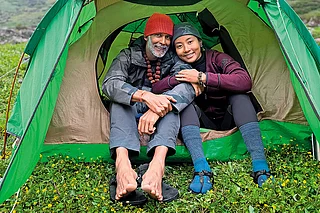


For a considerable time now, I have been an advocate of slow, immersive, experiential travel. I am an explorer and an overlander, and I wanted to share that world with other people, so I did what came naturally. I took a film crew along and turned my travels into shows. As it happens, one of the most effective ways to ensure that you travel slowly is to take a film crew with you.
Distances become elastic. A drive of a few hours can occupy an entire day because cameras must be set up, conversations cannot be hurried, you have a flat tyre, one of the cars in the crew gets lost, and human beings continue to require tea and loo breaks, regardless of the production schedule.
When I created Season 2 of "Off Road with Gul Panag," I did so with the same intent that had taken the first season to Ladakh. I wanted to explore the Northeast, and naturally, that is where I took the show next. The journey began in Guwahati and took us through Assam, Meghalaya and Arunachal Pradesh, but the route matters less to me now than what curiosity, combined with travelling overland, allowed me to notice.
On the drive from Guwahati to Shillong, I stopped at a roadside shop for paan, which I love, and stayed for tea and conversation with the woman running it. She told me that farther along, the highway divided Assam and Meghalaya: one side was in one state, the other in another.
On a map, a state boundary is a firm line. On the ground, it is a road where someone is selling tea and paan.


I also noticed women everywhere. Women running shops, conducting business and occupying public spaces. Women, women, women. What struck me was how unremarkable their presence seemed to everyone else. There was no self-conscious display of empowerment. Women were simply part of the visible economic and social life around us. Curiosity often begins with looking closely at what everyone else considers perfectly ordinary.
Being in Assam in mid-September meant witnessing Vishwakarma Puja, with rituals, processions, and immersion along the banks of the Brahmaputra. It reminded me of Ganesh Visarjan, but was distinctly different. Travelling slowly meant we could stop, watch, ask questions and drink leisurely cups of tea beside the river instead of glimpsing a procession through a car window.
Shillong revealed itself through sound—not as a performance staged for visitors, but as something woven into the fabric of the city’s everyday life. It was in cafés, conversations, and seemingly everywhere one turned. Great food, great music and a completely enthralling vibe; Shillong was not performing its culture for tourists. You simply entered a culture already in progress.
What slow travel has taught me is the value of taking time to scratch the surface. It means making exploration the purpose and allowing curiosity to lead
Elsewhere in Meghalaya, what stayed with me was the intimacy between people and their environment. I had wanted to see Cherrapunji ever since reading about it as a child as the place in India that received the highest rainfall. Curiosity took us on a detour into Mawsmai Cave, through extraordinary limestone formations, with stalactites above us and stalagmites rising below.
In Mawlynnong, often called the cleanest village in Asia, cleanliness did not appear to be a special drive or village panchayat slogan. It was simply how the community lived. There was also an incredibly high bamboo skywalk built among the trees, from which you could see the delta in its full glory and Bangladesh beyond. It was magnificent, and naturally, I climbed it. Apparently, looking at something precariously high and deciding to go up is an occupational hazard when one produces an adventure show.
I thought the skywalk was ingenious. Then I saw a bridge that was alive. A walking path from Mawlynnong led us to a nearby living root bridge. Generations of Khasi people had guided the aerial roots of Indian rubber trees across a stream until they formed a bridge strong enough to walk on. Curiosity led us there, but what we found was local knowledge, science and patience solving a local problem. Most bridges weaken with age. This one grew stronger.
And then there was Dawki.
I had never seen water that clear anywhere in India before. We took a boat onto the river and experienced its serenity, then got an aerial view as we walked across the famous suspension bridge. This was the kind of water I had seen in the Mediterranean, or that one travels to the Maldives for, and here it was in Meghalaya, close to the Bangladesh border.
In Arunachal Pradesh, my understanding of distance changed again. I had visited Tawang before, and its monastery and food were wonderful, but what stayed with me was driving beyond it, to Zemithang. The road was misty, rainy, desolate and spectacular. For long stretches, we encountered no other vehicle. I felt like an explorer, not because Zemithang was waiting to be discovered, but because my curiosity was revealing how much of my own country I still did not know.
More recently, while filming "The Family Man" in Nagaland, I found myself with days off and the same choice: remain in the hotel, or take a car, walk, hike, find a local café and sit over tea. Curiosity won again, and Nagaland became my fourth glimpse into the Seven Sisters.
What slow travel has taught me is the value of taking the time to scratch the surface. It does not mean travelling without purpose. It means making exploration the purpose and allowing your curiosity about a place to lead. When you leave room for the unscheduled, the journey opens itself up to you, and the moments that stay may begin when you stop for paan, take an unnecessary walk, or decide that routine and the mundane can wait.
Looking for more such exciting and meaningful stories? Grab our latest issue on Amazon.