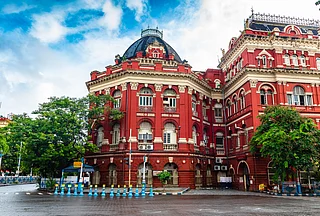
Rabindranath Tagore Jayanti 2026 marks the 165th birth anniversary of the Nobel laureate, observed on May 9, 2026 as Pachishe Boishakh in West Bengal, where his presence is still felt not as history, but as rhythm and memory. Tagore, revered as Kobiguru and Biswokobi, reshaped Bengal’s literary and musical imagination. He remained deeply wary of the rising tide of narrow nationalism and revivalist politics that, in his view, turned identity into exclusion rather than exchange. During the Partition of Bengal in 1905, he was among the most vocal cultural voices resisting militant swadeshi fervour, a concern he later deepened in "Ghare Baire" (The Home and the World), where the idea of the nation is tested against the fragility of human relationships and moral choice. In 1921, he founded Visva-Bharati at Santiniketan not as a conventional university but as an experiment in openness—a place where the world could enter Bengal, and Bengal could speak back to the world without borders of creed or nation.
His songs, known as Rabindra Sangeet, remain woven into Bengali life itself—defining festivals, intimate emotional moments, and even public ceremonies with a shared cultural language that feels both personal and collective. As the first non-European to win the Nobel Prize in Literature in 1913, Tagore also carried Bengali culture onto the global stage, reshaping how the world encountered India’s literary and artistic traditions. It is through this living inheritance that Tagore continues to be experienced, not only in books or archives, but in voice, music, and place. Here are some places in Bengal where one can experience and begin to understand the contours of his philosophy.
Santiniketan
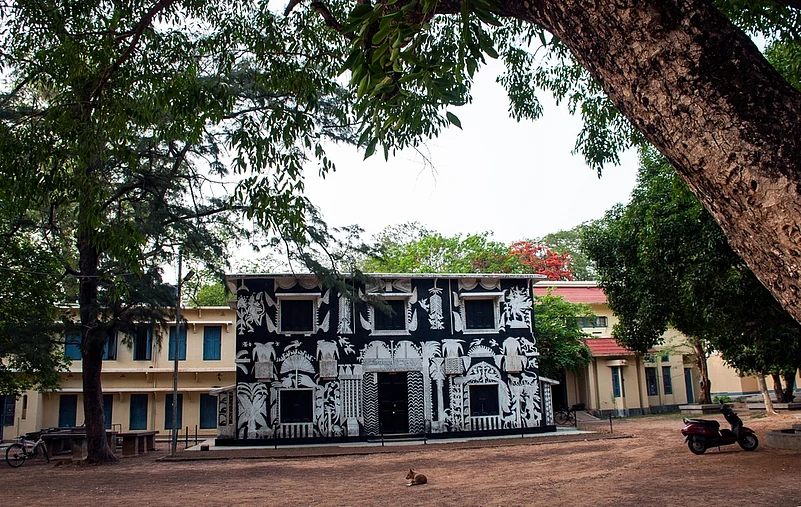

Santiniketan remains the most intimate entry point into Rabindranath Tagore’s world, where his ideas were not merely written but lived. At the heart of it lies the Uttarayana Complex, a quiet cluster of homes—Konark, Udayan, Shyamali, Punashcha and Udichi—where Tagore spent his later years. Today, these residences form part of the Rabindra Bhavan museum, which preserves manuscripts, personal objects, paintings and fragments of a life shaped by art and thought rather than ornament.
A short walk away, the Ashram area of Visva-Bharati carries the original rhythm of Santiniketan. Chatimtala, beneath its old trees, recalls the meditative space associated with Maharshi Debendranath Tagore, while the Upasana Griha—the striking glass prayer hall—reflects Tagore’s vision of quiet, universal devotion without ritual rigidity. Around it, Kala Bhavan and Sangeet Bhavan continue his experiment in education, where painting, music and learning were treated as forms of freedom rather than discipline.
Together, these spaces—now recognised within the Santiniketan UNESCO World Heritage landscape—do not present Tagore as a monument, but as a method.
The Information
Shantiniketan is best visited between October and March, when the weather is mild, and the campus is at its most welcoming. December brings the Poush Mela, and March sees Basanta Utsav, when Tagore’s cultural vision spills into public celebration. It is around 2–3 hours from Kolkata by train to Bolpur.
Bishnupur
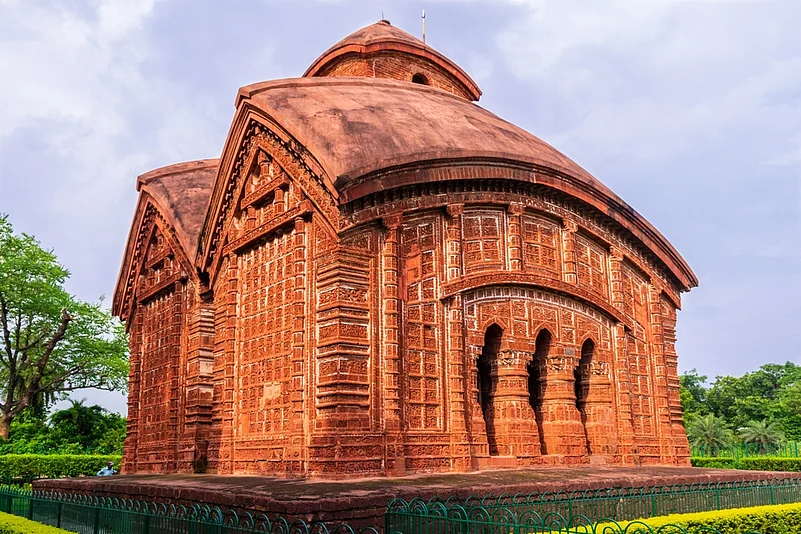
Bishnupur occupies a significant place within the musical and artistic landscape that influenced Tagore. The town is renowned for the Bishnupur Gharana, one of Bengal’s oldest classical music traditions, rooted in Dhrupad. The discipline of this tradition shaped the broader musical environment from which Rabindra Sangeet later emerged, even as Tagore distanced himself from strict classical conventions.
The terracotta temples display weathered reliefs depicting mythological figures, court scenes, and fragments of daily life, all pressed into clay that has endured for centuries. In the vicinity, Baluchari weaving persists in a more subdued manner, with each sari conveying stitched narratives that originated in oral storytelling traditions.
A sense of continuity is evident in Bishnupur, one that Tagore would have recognised. This is not preservation in a formal sense, but rather a living, evolving tradition that is continually used, adapted, and reinterpreted rather than archived.
The Information
Bishnupur is best visited between October and March, when the weather is cool. It is about 4–5 hours from Kolkata by road via NH19, or by train from Howrah or Santragachi (Rupashi Bangla, Aranyak Express). Local travel is by cycle-rickshaw or auto.
Naya Village
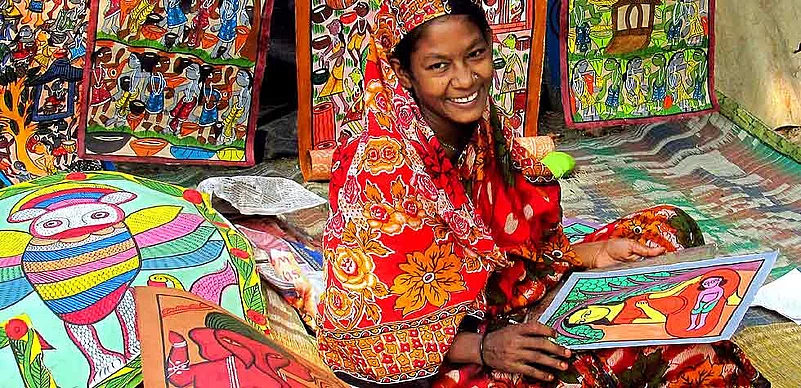
Naya village in Paschim Medinipur is home to the Patua or Chitrakar community, where painting, music, and storytelling come together in the form of Patachitra scrolls. Hindu mythological tales, contemporary themes, and daily life are painted using natural colours, then brought alive through Pater Gaan as the scroll is slowly unrolled.
There is a quiet resonance here with Tagore’s belief in art as a lived, shared practice—one that crosses boundaries of faith and form while remaining rooted in everyday life. In a place where Muslim artists narrate Hindu stories and adapt tradition to changing times, his idea of harmony feels especially present today.
To experience this living tradition is to see Bengal’s culture in motion, not as preservation, but as continuity.
The Information
Naya village lies in Pingla block of Paschim Medinipur, about 120 kilometres from Kolkata. The easiest route is by train to Balichak, followed by a road journey of around 3 to 3.5 hours. It is best visited in December, when the village hosts Pot Maya, a three-day Patachitra festival that turns courtyards into open studios and performance spaces. In 2018, the tradition was awarded the Geographical Indication (GI) tag, recognising its distinct place in Bengal’s folk culture.
Murshidabad

Murshidabad shows up in Tagore’s world only in passing, but it isn’t insignificant. In 1907, he went to the Kashimbazar Rajbari near Berhampore for a literary gathering—one of those aristocratic settings where Bengal’s cultural conversations often took place at the time.
What matters more is the kind of place it was moving through. Murshidabad still carried its older craft economy—its famous silk being woven in homes and workshops, ivory carving, and terracotta work that had outlived its courts. This was the kind of world Tagore kept returning to in different ways: not as nostalgia, but as working culture, still making things, still in use.
In Murshidabad, these practices are not preserved as heritage alone; they continue as working skills, shaping how the region still understands art and memory.
The Information
Murshidabad, the former capital of Bengal, works best as a 1–2 day trip from Kolkata, around 200 km away. The ideal time to visit is between October and March, when the weather suits long walks through its palaces, mosques, and riverside sites. Train travel via the Hazarduari or Bhagirathi Express is the most convenient option, while road journeys on NH12 take roughly 5–6 hours.
Kushmandi

Kushmandi in Dakshin Dinajpur sits close to Tagore’s idea of rural creativity—not through any direct link, but through a shared sense that art grows out of lived ritual rather than standing apart from it. In villages like Mahishbathan, artisans carve Gomira masks from wood, shaping faces of gods, spirits and animals for dances performed as part of local worship.
The masks are hand-painted in bright colours and used in Gomira performances, where craft, belief and storytelling remain tightly bound. They are made to be worn and activated, not displayed, keeping the act of making inseparable from the life of the community.
Threads Of Bengal
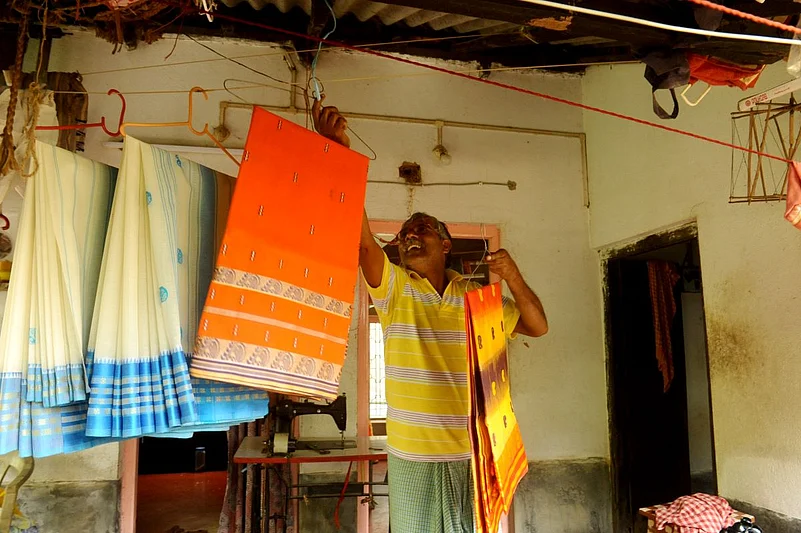
Tagore rarely thought of Bengal’s handloom as an “industry” in the modern sense. It sat closer, for him, to a way of life—tied to rural rhythms, dignity of work, and everyday expression. In Santiniketan, he also worked with Batik printing, exploring how surface, colour, and cloth could become a simple, lived form of art rather than something meant only for display.
That sensibility still runs through Bengal’s textile traditions in visible ways. Baluchari, Jamdani, Tangail, and Dhaniakhali sarees—each comes from working communities where weaving is not separated from daily life. The motifs may carry stories, but the more enduring element is the practice itself: slow, repetitive, learned over time and passed along within families. To find out more about these and where to experience them, check here.
FAQs
What changed in Bengali literature because of Tagore?
He moved Bengali writing away from rigid classical forms and introduced a more natural, colloquial language that shaped modern Bengali prose and poetry.
What is Rabindra Sangeet?
It is the body of over 2,200 songs composed by Tagore, blending classical ragas with Bengali folk traditions, especially Baul music.
Which national anthems did Tagore compose?
He composed Jana Gana Mana (India) and Amar Shonar Bangla (Bangladesh)—the only writer to create two national anthems.
What is unique about his visual art?
Created in his sixties, his paintings are abstract, expressive, and symbolic, often featuring mask-like faces and dreamlike forms.
How did Tagore influence education and society?
Through Visva-Bharati at Santiniketan, he promoted learning rooted in nature, cultural exchange, and universal humanism over narrow nationalism.