

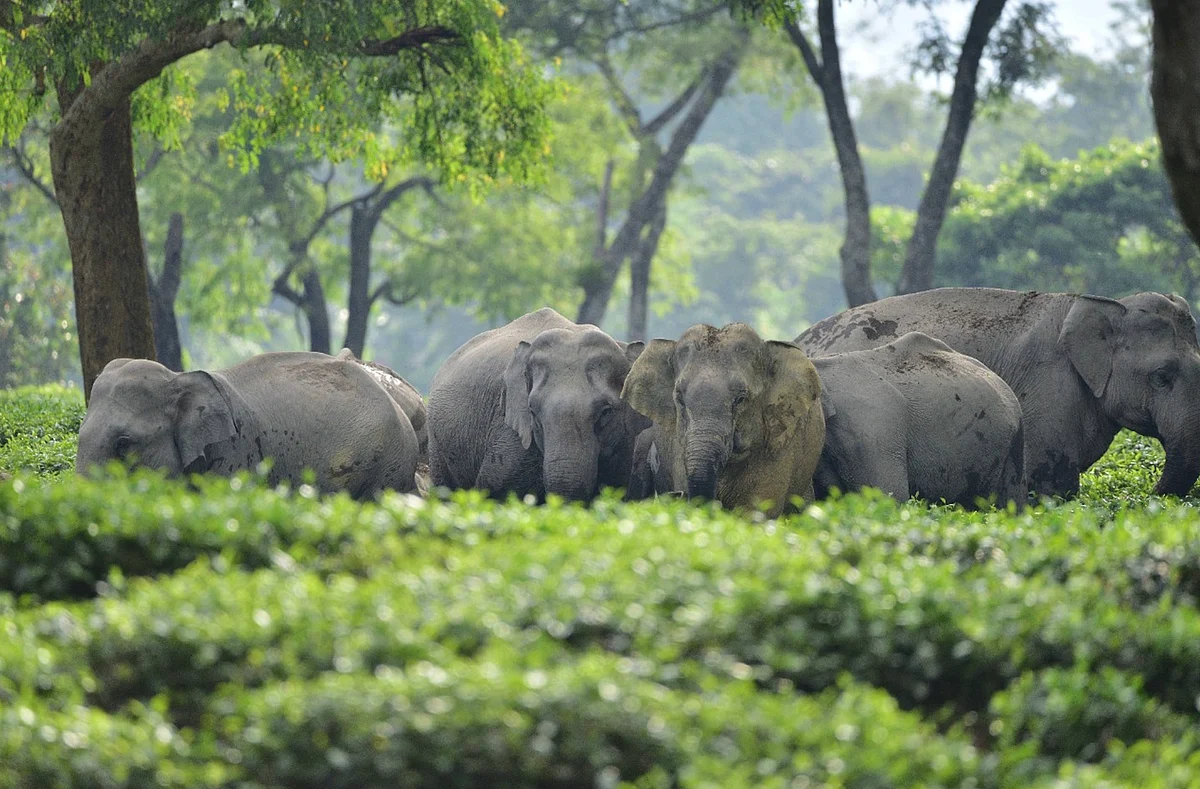
In the early hours of Saturday, the Sairang–New Delhi Rajdhani Express met with a tragic encounter in Assam’s Hojai district when it collided with a herd of wild elephants crossing the tracks. The collision derailed the locomotive and five coaches, resulting in the deaths of at least seven elephants and injuring a young calf. All passengers and crew emerged unscathed, but the accident has once again thrown a spotlight on the growing danger posed by expanding railway networks intersecting wildlife terrain.
Collision In The Night: What Happened In Hojai
Shortly after 2:17 am, the Sairang–New Delhi Rajdhani Express, a flagship long-distance train carrying passengers from Mizoram to the national capital, struck a herd of wild elephants near the Changjurai area along the Jamunamukh–Kampur section in Hojai district under the Lumding division of the Northeast Frontier Railway.
According to officials, the train’s loco pilot noticed the herd on the tracks and applied emergency braking, but heavy fog and the momentum of the 650-passenger service made it impossible to stop in time. Five coaches and the locomotive were derailed on impact, but remarkably, no injuries to passengers or railway staff were reported.
Forest officials confirmed that at least seven adult elephants were killed in the collision, and one calf was injured; veterinarians are attending to the injured animal. Autopsies on the deceased elephants were underway with plans for legal and customary rites to follow.
Emergency response teams from the railway and forest departments rushed to the scene. Passengers from the affected coaches were accommodated in other compartments, and the train later resumed its journey to Guwahati, where additional coaches were to be added before continuing to Delhi. Rail traffic on the Jamunamukh–Kampur section was temporarily disrupted and diverted to alternate routes as restoration work progressed.
A Broader Conflict: Trains And Elephants
While the Hojai accident is one of the most dramatic recent examples, collisions between trains and elephants are far from isolated in India, particularly in Assam and other elephant range states. According to government data shared in the Lok Sabha earlier this year, at least 79 elephants have died in train collisions across the country over the past five years, underscoring a persistent threat to wildlife from expanding rail infrastructure.
A longer-term historical assessment shows that at least 186 elephants were killed on railway tracks between 2009–10 and 2024, prompting authorities to map high-risk stretches for targeted mitigation such as underpasses, overpasses, fences, and early warning systems.


Assam alone is home to one of India’s largest concentrations of wild Asian elephants, with numbers estimated in the thousands, and its mixed terrain of forests, agricultural lands, and rail lines makes such encounters more likely. The recent accident occurred at a location not officially designated as an elephant corridor, highlighting gaps in how wildlife movement patterns intersect with human infrastructure.
The Hojai tragedy is emblematic of a deeper challenge: balancing connectivity and development with ecological sensitivity. Assam has been experimenting with technology and community responses to reduce human-elephant conflicts, including AI-enabled detection systems, rapid response “Gaja Mitra” teams, and landscape planning initiatives, but collisions like Saturday’s reveal there is more to be done.
Railway officials have reiterated their commitment to rescue and restoration and expressed condolences for the elephant lives lost, while emphasising that no human casualties occurred. The incident renews calls from wildlife groups for stricter speed restrictions near forested stretches, improved signage, and investment in wildlife crossings on vulnerable rail segments.
FAQs
1. What caused the Rajdhani Express derailment in Assam?
The train derailed after colliding with a herd of wild elephants that had strayed onto the tracks in Assam’s Hojai district.
2. How many elephants were killed in the Assam train accident?
At least seven elephants died in the collision, while one calf was reported injured.
3. Were any passengers injured in the derailment?
No human casualties or passenger injuries were reported following the incident.
4. Where did the Assam train accident take place?
The accident occurred in Hojai district, a region that falls along known elephant movement corridors in Assam.
5. Are train-elephant collisions common in Assam?
Yes. Assam and other parts of northeast India frequently report train-elephant collisions due to railway lines cutting through wildlife corridors.