Did you know that a defining feature of a Syrian Christian home is its layout, whereby the entrance opens straight into the granary?” a teacher was explaining to a group of students gathered in the mellow warmth of a March afternoon. They stood by the single-storey Travancore-style structure, while I lingered nearby, in the Kerala section of DakshinaChitra Museum in Muttukadu, Tamil Nadu.
A living heritage museum, DakshinaChitra, brings together the cultural essence of South India through reconstructed homes, crafts, and performances. Walk in, and you’ll see four states through distinct zones: Tamil Nadu, with homes of merchants, Brahmins, weavers, and farmers; Kerala, with Syrian Christian, Calicut, and traditional Trivandrum Hindu houses; Karnataka, with rural homes from regions like Chikmagalur and Ilkal; and Andhra Pradesh, with coastal and ikat-weaving communities. Each section reflects architecture, occupation, and daily life, making the museum an immersive space that preserves Southern Indian traditions through lived experiences rather than static displays.
East Cost Road, Muttukadu, Tamil Nadu
Museum-going in India remains relatively niche compared to many Western countries. Recently, Zerodha founder Nithin Kamath wrote in his X post, “We don’t really have a strong museum-going culture in India. Maybe the long stretch of British rule has something to do with it.”
However, the numbers are steadily growing. According to the Archaeological Survey of India (ASI), the Indian Museum alone recorded over 6.7 lakh visitors in 2023–24. Private museums today are key custodians of heritage, going far beyond simply displaying artefacts. Through immersive, interactive spaces, they keep traditions alive, support artisans, document fading practices, and make culture accessible to newer generations.

Chhatrapati Shivaji Maharaj Vastu Sangrahalaya
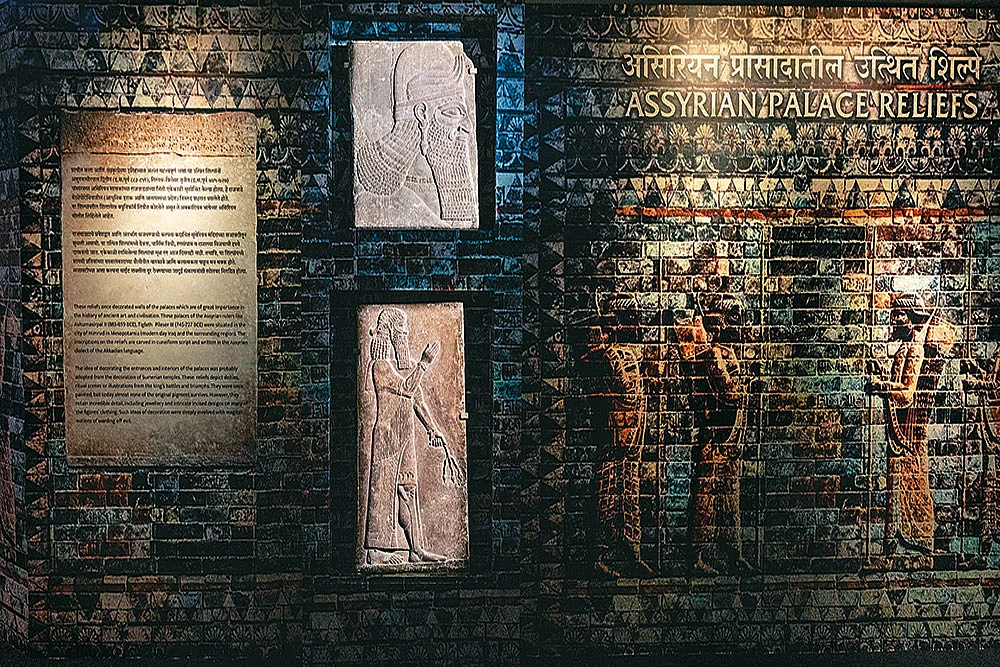
Move westwards, and Chhatrapati Shivaji Maharaj Vastu Sangrahalaya is ready to send you spiralling through a few thousand years of history. Its new galleries—Ancient World, Stone Tools, and Assyria—sit alongside the museum’s vast permanent collections, making the experience feel a little like time travel, only with better lighting and fewer consequences.
The museum houses nearly 70,000 artefacts, with over 400 archaeological objects anchoring the new galleries. There’s a terracotta bull from Mohenjo-daro, a Roman pepper pot that proves India’s spice trade once had the ancient world hooked, a Poseidon sculpture discovered in Kolhapur, jewellery tracing routes across regions, a Roman mosaic of Bacchus lounging on a tiger, and even a Roman Egyptian mummy mask staring calmly across two millennia.
“Why has the Indus Valley Civilisation, also known as the Harappan Civilisation, not been highlighted more prominently in global history? How did people and societies connect across vast geographies? How did the Harappans, Mesopotamians, and Egyptians develop unique scripts to record their social and cultural histories?” said Sabyasachi Mukherjee, Director General, CSMVS.
The narrative thus begins with the Harappan civilisation in the Indian subcontinent some 5,000 years ago. Then it moves on to Mesopotamia, Egypt, China, Persia, Greece, Rome, and India, charting humanity’s evolution from agrarian settlements to sprawling empires, writing systems, and bustling trade routes. It eventually lands at Nalanda and Alexandria, two great centres of knowledge that once drew scholars.
Threaded through it all is the reminder that ancient India was deeply woven into a much larger global exchange of ideas, goods, and culture. And if you’re a student, the Study Gallery offers you something textbooks rarely do: the slightly surreal experience of standing face-to-face with objects that have survived entire civilisations.
159-161, Mahatma Gandhi Road, Kala Ghoda, Fort, Mumbai
Weavers Studio
Textiles, much like history, carry stories within their folds. Take, for example, the Weavers Studio by Darshan Shah. A Kolkata-based textile studio, archive, and research centre, it is dedicated to preserving and reinterpreting India’s handloom traditions. Shah works closely with artisans and weavers, combining traditional techniques with contemporary design.
Speaking to Outlook Traveller, Shah, Founder and Creative Director, Weavers Studio & Weavers Studio Resource Centre, said, “Systematic documentation and close material analysis enable the identification of underlying structural principles such as weave architecture, resist methodologies, dye compositions, and regionally inflected design grammars.”

A striking example is a 19th-century jamdani sari preserved in the archive, featuring a rare boat (nauka) motif, including the mayurpankhi or peacock-prowed boat. Woven entirely by hand using the intricate supplementary-weft technique, it reflects Bengal’s river-based culture. “Historically, this motif functioned as a complex semiotic form embedded within the riverine culture of Bengal,” said Shah.
But the studio is less interested in preservation under glass and more in keeping craft alive through dialogue. You’ll find their shibori experiments reimagining Rajasthan’s leheriya through Japanese techniques, Bauhaus-inspired geometry appearing on sari and kantha on Matka silk, and the 15 Shades of Indigo kurta transforming natural dye into gradients of colour. The Pojagi jamdani similarly brings Korean patchwork traditions into conversation with jamdani weaving.
In a world obsessed with fast fashion and even faster everything else, the studio’s archives steadily preserve patterns, motifs, and techniques that refuse to be rushed into extinction.
5/1, Anil Maitra Rd, Ballygunge Place, Ballygunge, Kolkata
Museum of Art & Photography
At Museum of Art & Photography (MAP), culture stretches well beyond gallery walls. Opened in 2023, the multi-storey museum holds over 60,000 works spanning paintings, textiles, photography, and design, alongside research and learning spaces. After a day with art history, visitors can end with a drink upstairs—proof that museums can be as social as they are scholarly.
Early exhibitions included LN Tallur’s “Chirag-e-AI,” Stephen Cox’s sculptural works inspired by Indian forms, and Jyoti Bhatt’s photographs documenting rural life and traditions. The museum has also explored kantha textiles, food through art, and the life and work of Bhil artist Bhuri Bai, while more recent shows such as “What The Camera Didn’t See” and “The Book of Gold” blurred the boundaries between miniature painting, photography, and storytelling.
Yet, here’s the quirk. The experience doesn’t quite end when the galleries close.
Stay a little longer, and the mood shifts. The rooftop, once a quiet cafeteria and members’ lounge, now unfolds into a lively social setting with Bistro Cameo and the after-hours Bar Cameo. Your reflective day among artworks will now gradually give way to an evening of cocktails and city views, as the space transforms into a relaxed, reservation-based bar after dark.
XHFW+RP8, 22, Kasturba Rd, Shanthala Nagar, Ashok Nagar, Bengaluru
Looking for more such exciting and meaningful stories? Grab our latest issue on Amazon.