A portrait that once hung in Satish Gujral’s family home in Delhi is now set to travel far beyond it. One of only four self-portraits the celebrated artist made during his seven-decade career has been chosen for an INR 5 commemorative postage stamp, released by India Post to mark his birth centenary.
The stamp, unveiled on August 3 at Bikaner House in New Delhi, brings a deeply personal work by one of modern India’s most versatile artists into public circulation. The 2010 self-portrait shows Gujral seated on a sofa with a paintbrush in hand. His face and arms are rendered in black and white, set against a richly coloured composition, giving the work a distinctive photorealistic quality.
The original painting belongs to the private collection of his daughter, interior designer Raseel Gujral Ansal, who received it from her father in 2013. It remains part of her home collection, making its appearance on a postage stamp a rare transition from a family possession to an artwork that can now reach collectors and members of the public across India.
A Life In Art


Born on December 25, 1925, in Jhelum, Punjab, now in Pakistan, Satish Gujral grew up to become one of the defining figures of post-Independence Indian art. His practice moved easily between painting, sculpture, murals, architecture and writing, while his work often drew from the upheaval and displacement of Partition.
Gujral lost his hearing at the age of eight, and art became an important means of expression during his childhood. He studied at the Mayo School of Arts in Lahore and later at the Sir J.J. School of Art in Bombay. In 1952, a scholarship took him to Mexico City, where he studied at the Palacio de Bellas Artes under leading Mexican muralists. The experience had a lasting influence on his approach to monumental art and murals.
Over the course of more than seven decades, his work was exhibited in cities including New Delhi, Mumbai, London, Paris, New York, and Tokyo. His architectural practice was equally significant. The Embassy of Belgium in New Delhi, in particular, is regarded as an important example of modern Indian architecture. He was awarded the Padma Vibhushan in 1999 and later chronicled his artistic journey in his autobiography, "A Brush with Life."
From Canvas To Stamp

Gujral’s connection with India Post predates the centenary tribute. In 1996, he designed a stamp for Videsh Sanchar Nigam Limited’s 125th anniversary, using a spiral motif to represent the flow of communication. In 2019, he also designed a commemorative postage stamp on financial inclusion, incorporating the Indian rupee symbol and a horse as symbols of strength and progress.
The latest stamp draws attention to a less familiar side of the artist: Gujral as the subject of his own work. Portraiture was never the dominant thread in his practice, and he produced only four known self-portraits. The chosen painting therefore offers a particularly intimate glimpse of the artist, away from the large-scale murals, sculptures and architectural projects for which he is better known.
The centenary initiative is being presented by Raseel Gujral Art Legacy (RGAL) in association with the Department of Posts, Government of India. Alongside the official stamp, RGAL has introduced limited-edition Satish Gujral Centenary Stamp Collectibles. The Centenary Edition contains 25 commemorative stamps, referencing Gujral’s December 25 birth date, while the Centenary Master Edition features 100 stamps to mark his hundredth birth year.
See It In Delhi
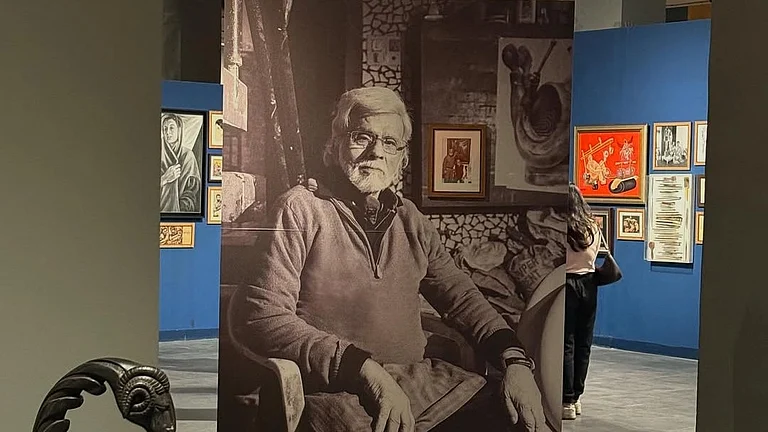
The centenary celebrations continue with a public exhibition at Bikaner House in New Delhi from August 4 to 9. Open daily from 11 AM to 7 PM, the exhibition brings together the stamp collectibles and original artworks that inspired the commemorative stamp and its first-day cover.
For philately enthusiasts, the commemorative postage stamp will also be available through 72 Philately Bureaux across India. It offers a way to encounter Gujral’s legacy through an object that is modest in scale but national in reach.
For an artist whose career crossed disciplines and whose work was shaped by some of the most turbulent chapters of 20th-century India, the choice of a postage stamp feels especially fitting. A self-portrait once confined to a private wall can now become part of countless collections, envelopes and albums, carrying Satish Gujral’s image and legacy well beyond the galleries and buildings that first made his name.
FAQs
1. Why has India Post released a Satish Gujral commemorative stamp?
The stamp marks the birth centenary of Padma Vibhushan Satish Gujral.
2. Which artwork appears on the commemorative stamp?
It features one of Satish Gujral's rare self-portraits painted around 2010.
3. Where was the commemorative stamp unveiled?
It was unveiled at Bikaner House in New Delhi on August 3, 2026.
4. Where can visitors see the centenary exhibition?
The exhibition is open at Bikaner House, New Delhi, from August 4 to 9, 2026.
5. Where can collectors purchase the commemorative stamp?
It is available through 72 Philately Bureaux across India.