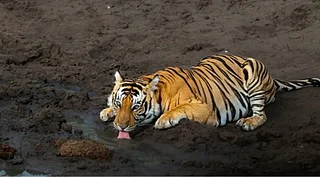
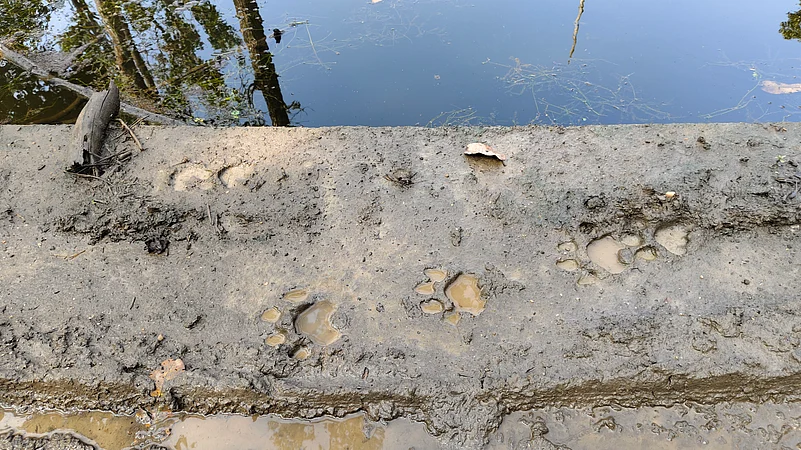
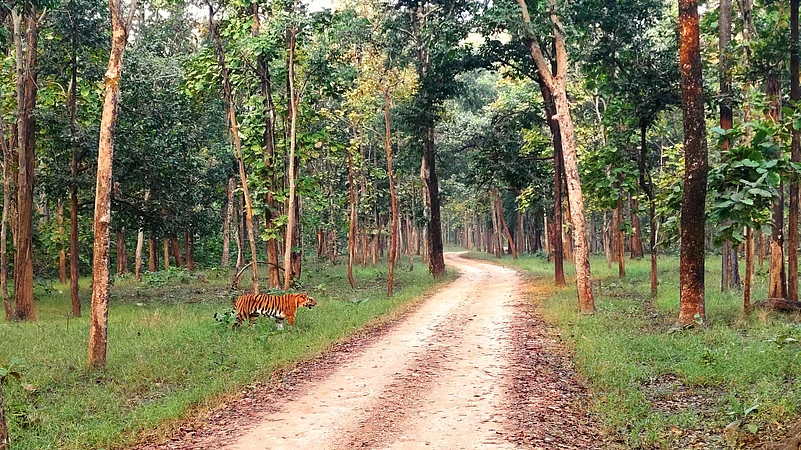
My first wildlife safari was in Jharkhali in the Sundarbans. We spent hours navigating its tidal creeks along the Matla and the Herobhanga rivers, hoping the mangroves would surrender a tiger. They never did. An estuarine crocodile basking on a mudflat was the closest we came to a top predator. Months later, Pench offered the opposite experience. Bijamatta walked past with her sub-adult cub. The following morning, Kalapahad emerged, paused to mark her territory, and vanished. The tigers were unforgettable, but they weren’t what stayed with me. With every safari, I have begun paying less attention to the promise of a sighting and more to the forest itself: the alarm call of a langur, the nervous glance of a chital, fresh pugmarks pressed into the dust, claw marks on a teak trunk. The spectacle gradually gave way to curiosity.
That shift also changed the way I looked at safaris. A forest is not a stage, and wildlife does not exist to indulge our appetite for encounters. We are visitors passing through an inhabited landscape, one where every intrusion, however brief, leaves a trace.

That raises the harder, less romantic question the industry doesn’t like to sit with: how much human intrusion is actually being tolerated, not welcomed, on every drive? Idling engines, camera shutters, vehicles bunching at a sighting—all of it registers as disturbance to the animal, sightings or no sightings. That question is now central to the night-safari debate, gaining traction in India. Proponents cite tourism revenue and livelihoods, and the appeal of observing nocturnal behaviour in species that are most active after dark. Critics counter that nighttime is the one window free of human presence, and opening it up erodes that buffer entirely. The real fault line isn’t pro- or anti-tourism—it’s where wildlife tourism stops documenting the wild and starts reshaping it.
To understand where that line sits, Outlook Traveller spoke to people who’ve spent their careers on either side of it: the man who drafted India’s wildlife law, a forest officer who ran Maharashtra’s tiger landscape, a Kerala photographer who refuses to enter a forest after sunset, and a photographer who has shot night safaris across two continents.
We Go To A Park Merely To Ogle At A Tiger
MK Ranjitsinh Jhala isn’t a bystander in this conversation; he wrote the rulebook it’s being argued over. He drafted India’s Wildlife (Protection) Act of 1972, served as the country’s first Director of Wildlife Preservation, and has spent six decades watching protected areas fill up with vehicles. His verdict on night safaris is unambiguous: “I am not in favour of night safaris. Let me make that absolutely clear.”
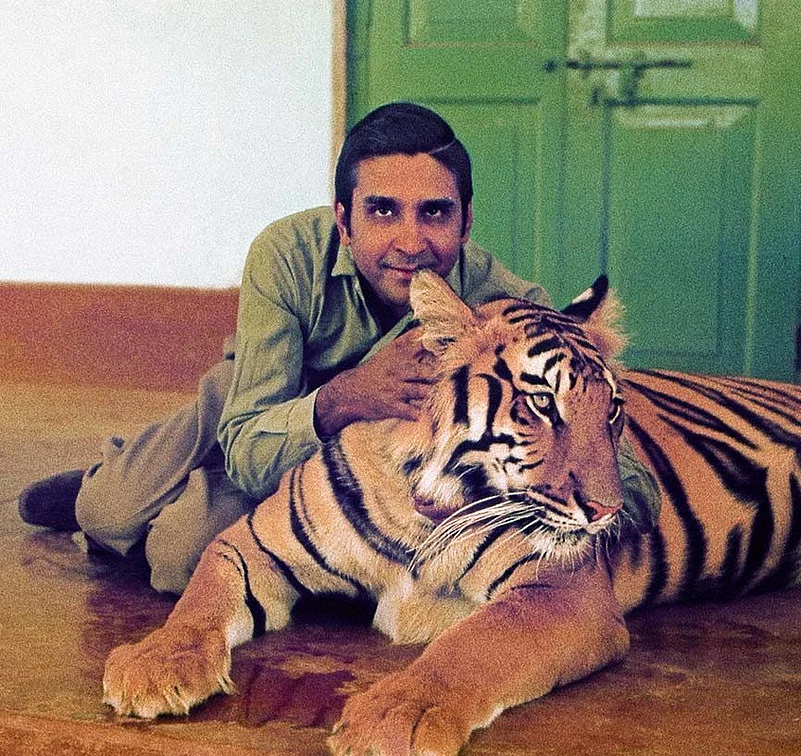
For Jhala, the argument starts with a principle most tourists never think about. “You don’t have to kill an animal to harm it,” he said. “Disturbance itself can be harmful.” Three decades ago, India’s parks operated on strict zonation—a core area off-limits to tourism, and a buffer where visits were tightly regulated. That distinction has all but collapsed. Tourism now spans almost every protected area, and night safaris threaten the one window that’s left. “Night is often the only period when they get relief from human disturbance,” he said. “If we take that away as well, when do these animals get any respite?”
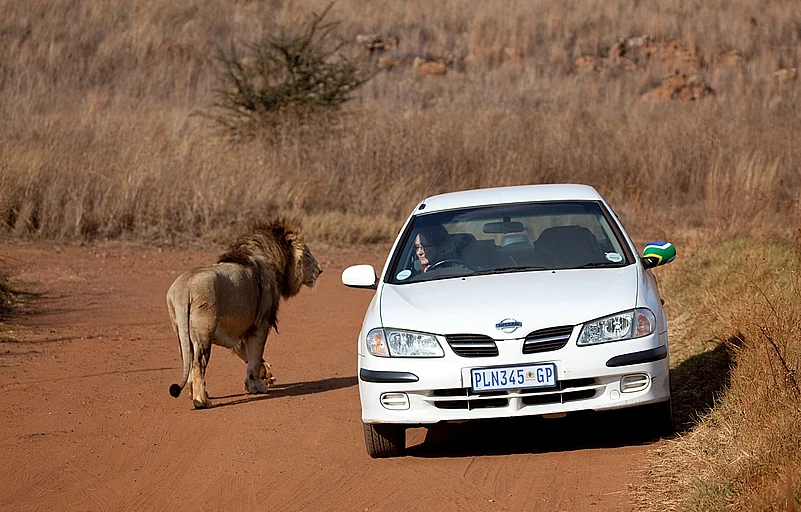
He’s lived the consequences of over-familiarity firsthand. During the 2016 Asiatic Lion Census in Gir, a lion walked past his vehicle without so much as glancing at it, close enough, he said, that he could “almost touch a lion's mane.” He doesn’t read that as a triumph of coexistence. He reads it as a warning. Tigers now squeeze between rows of parked gypsies because there’s simply no other path through the crowd, and drivers cut animals off mid-walk so tourists get a cleaner shot. “That isn't wildlife viewing,” he said. “It’s harassment.”
He recounted an incident in Bandhavgarh that illustrates exactly how that harassment can turn. A tigress was walking a road lined with roughly forty vehicles. A man was filming her from directly above, leaning over the back of his jeep. She looked up mid-stride, leapt onto the vehicle, grabbed his shoulder, bit down hard enough to pierce the shoulder blade, then dropped back onto the road and kept walking—as if, in Jhala’s telling, she were simply saying, “I don’t like what you’re doing.”
Jhala also flags a more immediate hazard: headlights and spotlights can genuinely blind an animal. “An animal may become disoriented, run onto the road, collide with a vehicle, or even crash into it,” he said. The longer-term risk troubles him more—repeated exposure to light and voices at night, he argues, could erode the wariness that keeps carnivores away from people, the same habituation already visible in leopards drifting into settlements by day. “They will soon realise that lights, vehicle sounds, and human voices are not necessarily a threat,” he said. “Once that happens, why should they hesitate to enter villages or towns after dark?” The consequence, he said, is usually fatal for the animal: “Someone gets killed, or an animal attacks a person. The response is often to shoot or capture the animal.”
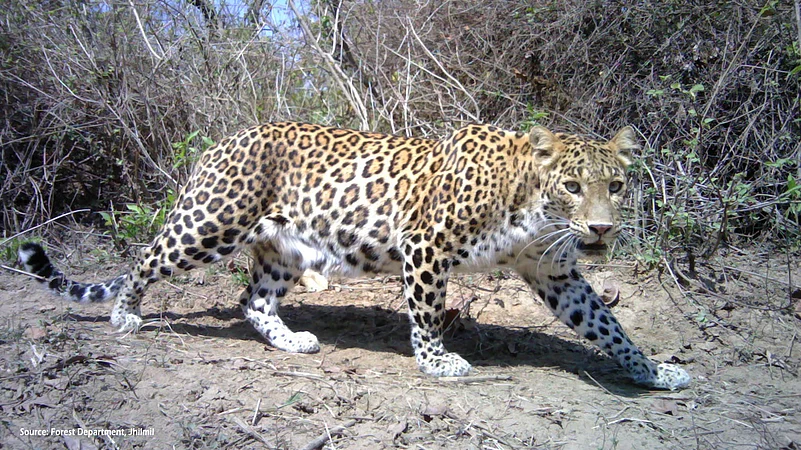
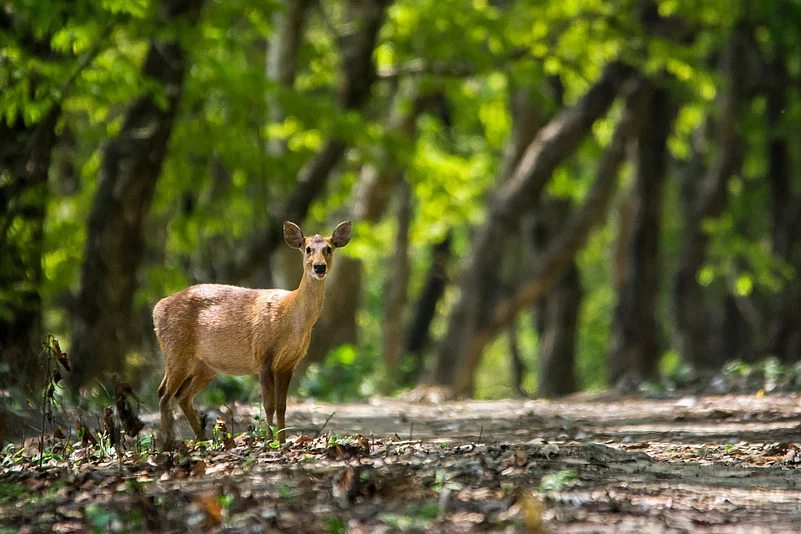
Jhala has a name for the deeper problem driving all of this: Mega Mammal Myopia, or “MMM”—India’s conservation obsession with big cats at the expense of everything else. “If people see a tiger, they feel they have seen everything,” he said. “If they don’t see a tiger, they think they have seen nothing.” He points to hog deer in Corbett—once more numerous than spotted deer when he first visited in 1962, now down to barely two dozen—as proof that species nobody photographs can vanish without anyone noticing. Fireflies that used to light up entire sal trees in central India, he says, have all but disappeared, and no one is talking about it.
His fear about night safaris isn’t about the buffer-zone pilots being tested now—it’s about precedent. “My greatest concern is that the recent permission for night safaris in certain areas will become an excuse to introduce them inside protected areas,” he said. He’s watched this pattern before: permission granted outside a park, followed by demands for access inside it because “there is nothing interesting to see” on the periphery.
Darkness Is an Ecological Resource, Not An Empty Interval
Sunil Limaye retired in 2022 as Maharashtra’s Principal Chief Conservator of Forests and Chief Wildlife Warden—a career that included running Sanjay Gandhi National Park through Mumbai’s leopard-conflict years. Two species, a jumping spider and a gecko, are named after him. His framing of the night-safari question is less about individual incidents than ecology itself.
“Darkness is not merely the absence of light,” he said. “In ecological terms, darkness is a vital natural resource.” By his estimate, nearly 70 per cent of vertebrate species and the overwhelming majority of invertebrates depend on the night for feeding, hunting, breeding, and navigation—rhythms that took millions of years to synchronise with the day-night cycle. Introduce headlights, engine noise and human voices into that window, he argues, and you’re not adding a new tourism product; you’re interrupting a process that every other hour of the day is built around protecting.
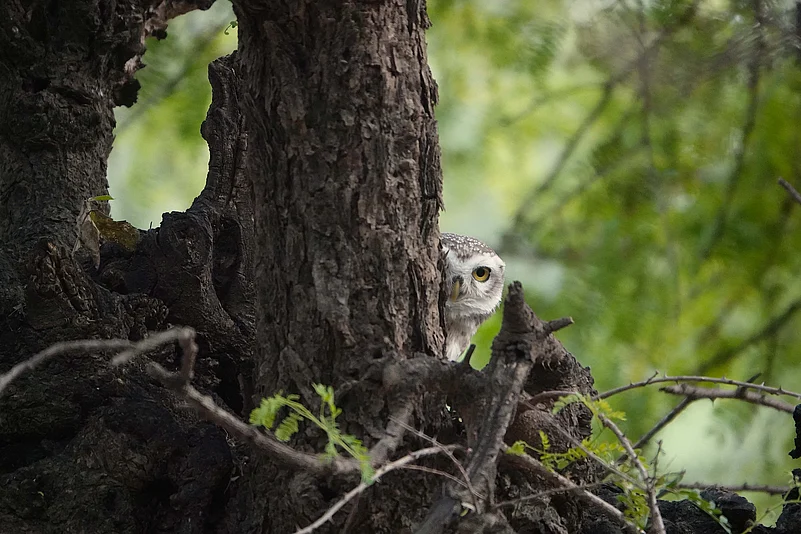
Limaye is careful not to reduce this to tigers and leopards. He worries more, he said, about owls, nightjars, civets, bats, moths, and frogs—species that “receive far less scientific attention than large mammals,” even though bats pollinate and disperse seeds, and nearly all forest frogs breed exclusively after dark.
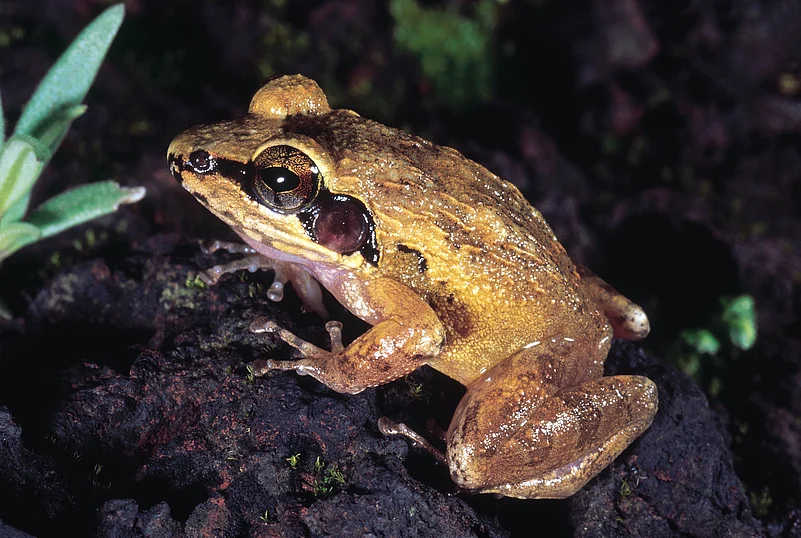
What sets Limaye apart from an outright ban is his insistence on evidence over instinct. Any night-tourism proposal, he argues, needs rigorous ecological screening first—breeding sites and corridors kept completely undisturbed, carrying-capacity limits that account for vehicle frequency and noise, and long-term behavioural monitoring with the power to suspend the programme if harm shows up. “In conservation, precaution must always precede commercial experimentation,” he said, “but as a forester I would never like to promote night safaris in forest areas.” He points to a small, closely supervised experiment now underway in Pench’s buffer zone, where trained biologists escort small groups on foot-paced, closed-vehicle drives for an hour or two after sunset—the narrowest possible version of the idea, he stressed, not a template for scaling up.
Imagine Someone Peeping Through Your Bedroom Window
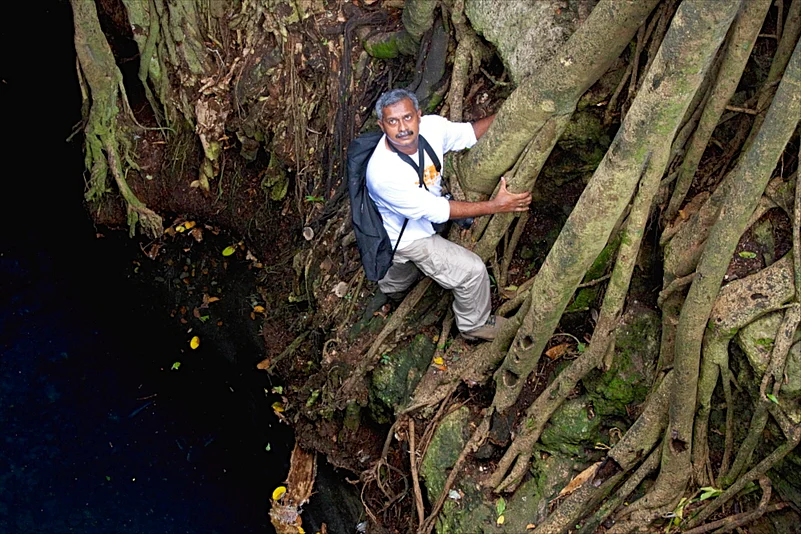
Balan Madhavan has spent decades photographing Kerala’s forests, most notably Periyar Tiger Reserve, and holds a UNEP photography award. His position on night safaris is stark: he doesn’t go into forests after dark, on principle, and doesn’t think anyone else should either.
He raises a physical concern too: powerful flashlights and headlights can damage eyes built for the dark. “When headlights or powerful flashlights are directed at them, there is a possibility of retinal damage,” he said. “Even if the effect is temporary, the animals can be blinded or disoriented for some time.” He also worries about what habituation does to an animal’s ability to judge threat, echoing Jhala’s concern from the other end—a tiger or leopard used to headlights eventually “stops reacting appropriately to people,” no longer telling a safari jeep apart from a poacher. “The next time someone enters the forest carrying a rifle, the animal may not recognise that person as a threat,” he said. “It simply assumes that it is another safari vehicle or another harmless visitor.”
“In my opinion, observing nocturnal wildlife inside a forest is, by definition, a disturbance,” he said. “There is really no distinction between observation and disturbance in such situations. Every wild animal deserves privacy.” His analogy for what a night safari amounts to is blunt: “Imagine someone peeping through your bedroom window while you’re asleep. Wildlife deserves the same respect.”
For Madhavan, the only justification for entering a forest at night is genuine scientific research that adds real value to conservation—never tourism, never entertainment, and certainly never revenue. He’s particularly scathing about a trend he’s watched grow in parts of Africa, where lodges build artificial waterholes rigged with motion-sensor floodlights so photographers in hides can capture dramatic, brightly lit images of hyenas and other nocturnal animals. “That is not true nature photography,” he said. “You are creating an artificial situation purely to obtain a dramatic image.”
He also flags something safari operators rarely mention: species tolerance isn’t the same as species comfort. Even animals that appear used to daytime vehicles, he said, have simply been conditioned to accept them— “that is not how they are meant to live.” His golden rule for anyone who does need to be in a forest, day or night: “Our presence should never alter an animal’s natural behaviour. That should always be the guiding principle.”
The View From The Other Side Of The Camera
Shiladitya Chaudhury, a Kolkata-based communication consultant and restaurateur whose real passion runs to wildlife photography across India and Africa, said that his experience of night drives in African reserves points to something most people pushing for night safaris in India don’t account for: the timing rarely works.

Peak predator activity, he points out, runs from roughly midnight to 4 AM, hours after safaris are permitted to end anywhere in the world, Africa included. “I guess there is no park in the world where safari is allowed” during that window, he said. What tourists actually get is a narrow evening slot with a high chance of seeing little beyond what a regular daytime drive already offers.
Where That Leaves The Debate
None of this is happening in a vacuum. India already carries a heavy human-wildlife conflict burden without adding a nocturnal tourism layer to it—Wildlife Institute of India figures put elephant-related human deaths at nearly 7,900 between 2009 and 2024, with roughly 70 per cent concentrated in Odisha, Jharkhand, West Bengal, and Assam. The National Tiger Conservation Authority’s own data shows most tiger conflict happens at reserve edges and corridors—precisely the buffer terrain now being eyed for night-safari pilots. There’s no India-specific study yet proving commercial night tourism worsens this picture, but the mechanism is well established: nocturnal disturbance measurably alters movement, feeding, and stress levels in wildlife, and animals pushed off their patterns don’t go quiet—they go somewhere else, sometimes towards a village.
That’s a tension none of these three men resolves, because no policy memo resolves it. Jhala wants the door shut before it’s opened further. Limaye wants it opened only under conditions few operators will find commercially attractive. Madhavan wants it left alone entirely, on principle.
What all three agree on is the thing this piece started with: a forest was never a stage, and every light we point into it changes what happens on the other side. The real question isn’t whether night safaris could be regulated well enough to pass an audit. It’s whether an industry built on the promise of a sighting can be trusted to leave a door closed once it’s glimpsed the room on the other side

FAQs
1. Why are wildlife experts against night safaris in India?
Many conservationists argue that headlights, vehicle noise and human activity disturb nocturnal wildlife, alter natural behaviour, increase stress, and may worsen human-wildlife conflict.
2. What is the main concern about night safaris?
The biggest concern is that nighttime is the only period when most wildlife is free from tourism. Opening forests after dark could disrupt feeding, breeding, hunting and movement patterns.
3. Are night safaris allowed in India?
Night safaris are being proposed or developed in select locations, largely outside core protected areas. Some pilot projects are underway, while larger proposals such as the Kukrail Night Safari have received regulatory approval.
4. Can night safaris be conducted responsibly?
Some experts believe limited, scientifically monitored programmes may be possible under strict ecological safeguards. Others argue commercial night tourism should not be allowed in forests at all.
5. What animals are most vulnerable to night safaris?
Experts say nocturnal species such as civets, bats, owls, nightjars, frogs, moths and other small mammals are particularly vulnerable because they rely on darkness for survival.