

I had long wanted to follow the Buddha’s journey not as an idea, but as a traveller, on real roads, under the open sky, through villages that are still lived in. Bihar is where Siddhartha, already years into his search, pushed himself to extremes, turned away from them, and found his balance again. Here, he chose stillness and remained in meditation until he attained enlightenment.
I chose to follow the trail in a simple, chronological way: Dungeshwari Caves and Sujatagarh for the early years of his search, Bodh Gaya for the moment of transformation, and Kolhua in Vaishali for the later phase, where the Buddha delivered his final sermon and announced his impending mahaparinirvana.
The Years Of Austerity
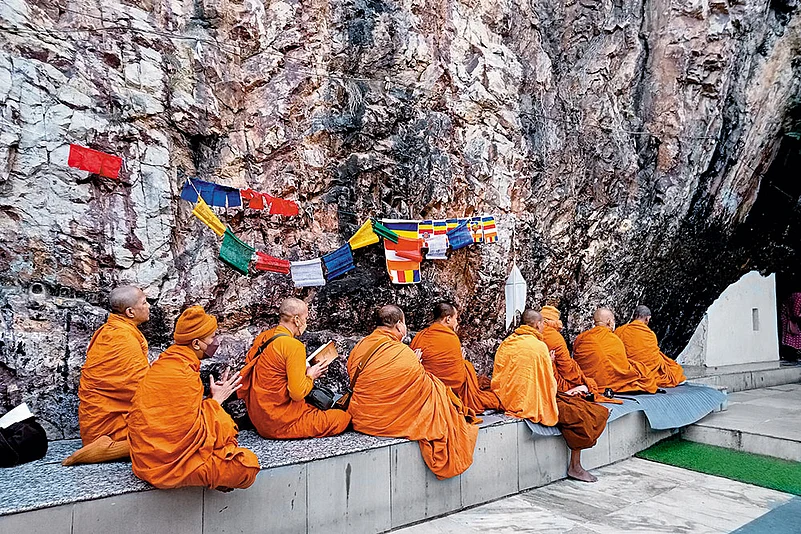
The drive out to Dungeshwari from Bodh Gaya across the Phalgu river does not take long, but the mood shifts quickly. The land turns stonier, the bustle quietens, and the heat feels more direct. Dungeshwari, also called Pragbodhi ("before enlightenment"), is where the Buddha is believed to have practised severe austerities. There is nothing outwardly remarkable about the place.
I climb up the hill and have already broken into a sweat by the time I reach the cave, tired and a little irritated. The flies swirling around do not help. Inside, there is a golden statue of the Buddha, deep in meditation and near-skeletal. The intensity of the self-deprivation he undertook is immediately apparent. The cave is cool, with a discernible drop in temperature. I step outside and return to the thriving ecosystem of stalls, snacks, souvenirs, and donation requests. I look out across the terrain and think: the Buddha’s search was not abstract. It unfolded in a landscape like this, with a body that weakened and a mind that kept asking.
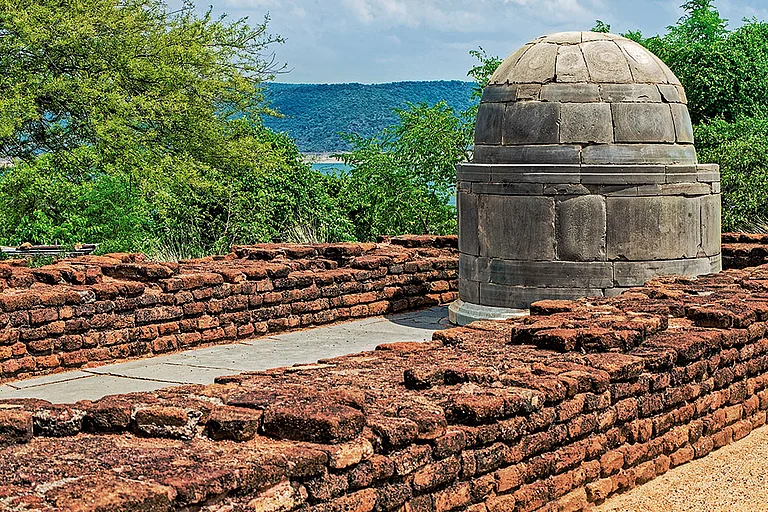
From Dungeshwari, the journey returns to open fields and nearby villages, and the shift is striking. In the village of Bakraur, Sujata, a milkmaid, is believed to have encountered the emaciated Siddhartha and offered him a bowl of kheer. The act marks a turning point in his quest, a move away from extreme austerity towards what would later be understood as the Middle Path.
Centuries later, a Buddhist king built Sujata Garh at Bakraur to mark this moment. The stupa is simple and does not call out to you, but it makes you pause. It marks a moment when a simple act changed the direction of a life.
Under The Bodhi Tree
The Mahabodhi Temple is buzzing with activity, which is not surprising because it is the foremost Buddhist pilgrimage site that draws hundreds of visitors every day. Here the sacred and the everyday overlap constantly.
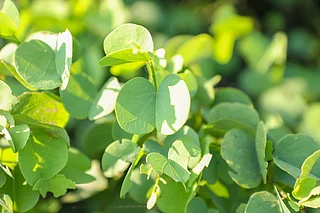
I sit on a bench in the Mahabodhi complex to catch my breath. It is hot, and I gulp some water. A few leaves drift down from the tree above, settling close to me. For a moment, they look ordinary. Then it dawns on me that these are no ordinary leaves; the tree they fell from is the most revered in the world, the Bodhi Tree.
The temple’s shikhara dominates the view from many angles, but what stays with me is the rhythm: devotees moving in loops, monks chanting and pausing, the devout with their prayer beads and notebooks, families entering with reverence and leaving with the usual chaos of Indian travel.
Near the Bodhi Tree stands the stone platform known as the vajrasana, marking the spot where the Buddha meditated. I close my eyes and imagine the moment of enlightenment. It is said that the Buddha had lowered his right hand from the dhyan mudra and touched the earth, calling it to bear witness to his awakening.
I watch the people gathered here; some are praying, some are watching others pray, some are simply sitting, as if they have run out of thoughts. Around the temple are markers linked to the weeks after the Buddha’s enlightenment, including paths and points of devotion that pilgrims retrace. Even without knowing the sequence, you understand the rhythm: repeating, circling, remembering with your feet.
Bodh Gaya also reflects a familiar Indian reality. It comes with interruptions that are less spiritual and more transactional. A monk approaches me. “You are a lucky man,” he says. “The holy leaves have presented themselves to you.” He suggests I hold the leaves between my palms. He chants a few mantras, then explains that he is raising funds for an orphanage. I hand him a few rupees; he blesses me and moves on. It is a small price to return to silence near the Bodhi Tree.

The Last Sermon
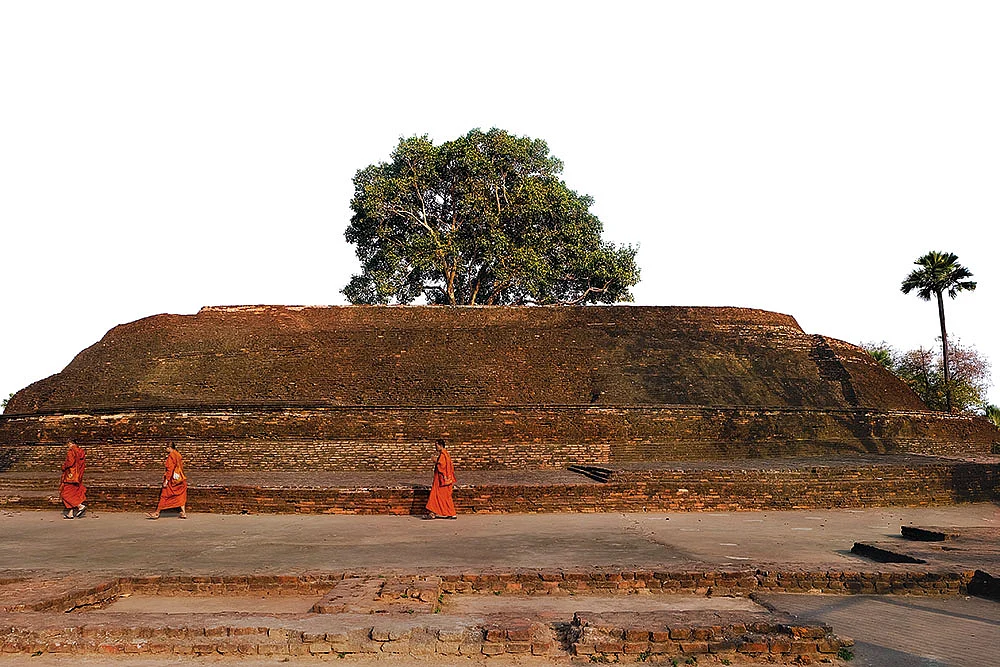
If Bodh Gaya is intense and crowded, Kolhua in Vaishali is the opposite. Vaishali holds an important place in the Buddha’s later life, where the narrative feels less like a single turning point and more like a life reaching completion. It is here that the Buddha is believed to have allowed the formation of the female monastic order, admitting women into the sangha.
The place is also linked to the story of Amrapali, a famed courtesan of the ancient Vaishali republic who held the title of nagarvadhu and was celebrated for her beauty and accomplishments. According to Buddhist tradition, after meeting the Buddha she renounced her former life, embraced his teachings, and became a bhikkhuni. Her mango grove, Ambapali Vana, where the Buddha is believed to have stayed and preached, was later donated by her to the Buddhist order.
Bihar offers proximity to places where a vast story unfolded in ordinary settings, in ordinary weather, within the full range of human behaviour
Walking through the village, I wonder whether the landscape around Vaishali has changed much since the Buddha’s time. Closer to the site, stall owners call out, “Take a look, sahab.” I walk past them.
The Ashoka pillar stands upright, simple and steady. It reminds us that the Buddha’s story did not remain confined to this region, as Emperor Ashoka later marked these sites across his empire.
I do not want to rush Kolhua. I stand among the open grounds and the remains of monastic structures, letting the place settle around me. I imagine the Buddha delivering his final sermon and announcing his impending mahaparinirvana. I pause, aware of the weight of the moment.
I end the trail here because it corrects a common temptation: to reduce the Buddha to a single image under a tree. Kolhua returns him to movement, to teaching, to a life that continued beyond enlightenment.
At the end of this circuit, Bihar does not try to shape the experience. It offers proximity. To places where a vast story unfolded in ordinary settings, in ordinary weather, within the full range of human behaviour.
And that, perhaps, is what makes this journey worth following.
The Information
Best time: October to March offers the most comfortable weather for travel, as the summer months can be extremely hot.
Nearest airports: Gaya Airport lies about 5 km from Bodh Gaya, while Patna Airport serves as the main alternative with better connectivity.
Best bases: Bodh Gaya is the most convenient base for visiting the Mahabodhi Temple, Dungeshwari Caves, and Bakraur, and it also has the widest range of hotel options. Patna works well as a base for visiting Kolhua in Vaishali, which is usually covered as a day trip.
Distances: Dungeshwari Caves are about a 30-minute drive from Bodh Gaya, while Bakraur or Sujata Garh is roughly 10 minutes away. Kolhua in Vaishali is about 1.5 hours north of Patna. The drive from Patna Airport to Bodh Gaya takes about two hours.
Looking for more such exciting and meaningful stories? Grab our latest issue on Amazon.