


More than 2,600 years ago, beneath the silent sal trees of Kushinagar, Gautama Buddha delivered His final teaching: Atta Deepo Bhava (be a light unto yourself) before attaining mahaparinirvana. As I walked upon that same venerated ground in eastern Uttar Pradesh, near the India–Nepal border, I did not feel like a traveller. I felt like a disciple returning, humbly and reverently, to the very source of the Dhamma.
The road to Kushinagar is itself a preparation for the pilgrimage. About 55 km east of Gorakhpur, the city’s bustle slowly gives way to the gentler rhythm of the Indo-Gangetic plains. Fields stretch wide on either side of the road, broken only by village homes and the occasional grove of trees. The air feels gentler here, as though time itself has softened.
Before the town appears, the road crosses the Hiranyavati River, where the Buddha is believed to have taken his final bath. The river flows gently today, almost unnoticed by those who pass it, yet for pilgrims it carries immense meaning. Soon after, subtle signs begin to appear. Prayer flags flutter in the breeze. Monastery gates rise behind clusters of trees. Pilgrims dressed in white walk along the roadside, their steps unhurried.
Gradually, it becomes clear that this modest town is not ordinary. Kushinagar is one of Buddhism’s most blessed destinations.
As a Buddhist monk from Arunachal Pradesh, often called the Land of the Rising Sun, I grew up hearing stories about these holy places. Elders and teachers spoke of the lands where the Buddha walked, taught, and ultimately departed from the world. Those stories planted a seed of longing within me. One day, I hoped, I would walk upon that same spiritual ground and experience the living presence of the Dhamma for myself.
When that moment finally arrived, I travelled from the distant Himalayan foothills to the plains of Uttar Pradesh. The journey was long, both in distance and in spirit. Yet as Kushinagar came into view, a calm anticipation settled within me.
The Dhamma has travelled across mountains and oceans. Yet it always returns here, to this quaint town in Uttar Pradesh
Leaving behind the noise of the outside world, I entered the Mahaparinirvana Temple complex. The moment I stepped onto the grounds, a deep sense of stillness surrounded me. Inside the temple rests the great reclining statue of the Buddha, serene and elongated, lying on His right side in the moment of final liberation. The statue radiates calm.
I walked slowly around the hall, absorbing the peaceful atmosphere. Pilgrims sat in silent prayer. Monks murmured chants softly under their breath. Incense drifted through the air. Standing before the reclining Buddha, I felt a deep sense of belonging, as though the centuries between that final moment and the present had somehow dissolved.
Drawn inward by that serenity, I sat down and recited passages from the "Mahaparinibbana Sutta" (a discourse detailing the final days, death, and funeral of the Buddha). To sit at the very place where the Tathagata laid down His mortal body is a humbling experience. In that moment, I was reminded of impermanence. Life, which we cling to so tightly, appeared fragile and fleeting.
Yet the atmosphere was not heavy with sorrow. Instead, it carried a sense of acceptance. The stillness of the temple seemed to echo a simple truth: liberation lies beyond attachment.
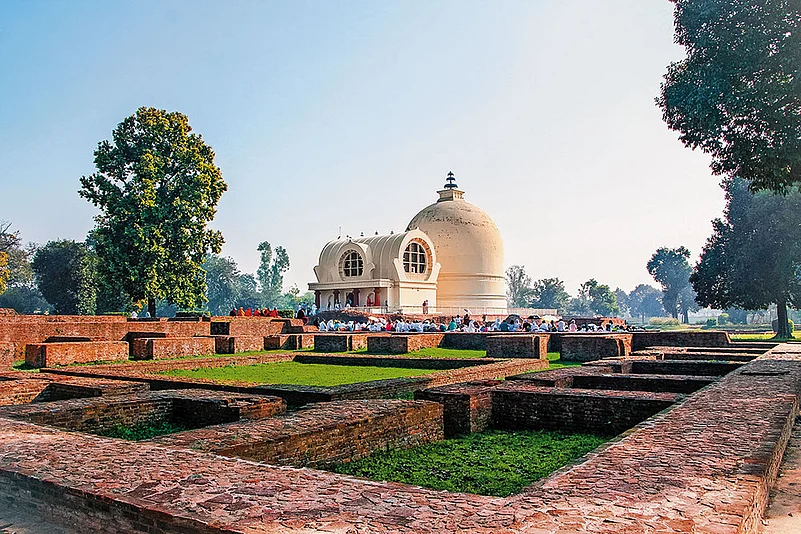

A Meeting Of Traditions
Stepping outside the temple complex, I began to walk through Kushinagar’s monastery district. One of the most remarkable aspects of the town is its international character. Kushinagar feels almost like a meeting place for the Buddhist world.
Monasteries built by Thailand, Sri Lanka, Myanmar, Japan, Korea and Vietnam stand side by side, each reflecting the architectural traditions of its homeland. Sloping Thai roofs edged with gold gleam beneath the sunlight. Burmese stupas rise in smooth white symmetry. Japanese temples express serenity through simplicity and uncluttered courtyards.
Each monastery carries its own architectural language, yet all share the same devotion. Walking through Kushinagar feels like travelling across Asia without ever leaving its contemplative landscape.
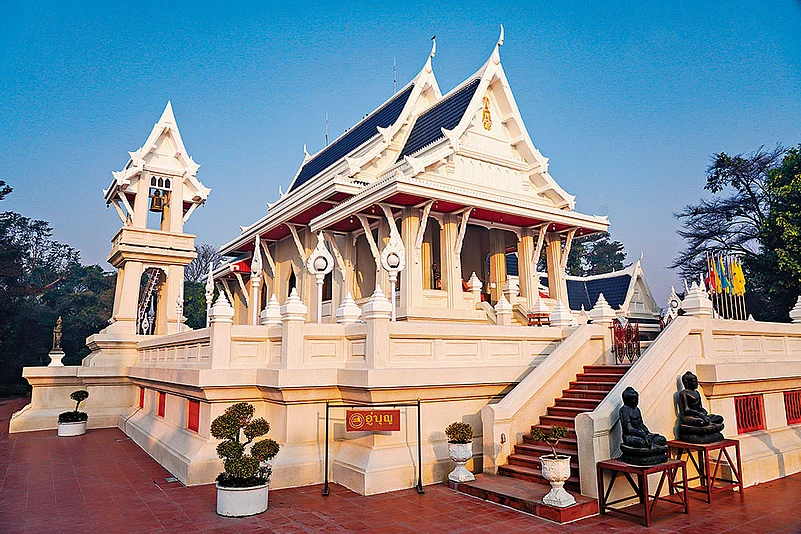
At the Wat Thai Kushinara Chalermaraj Temple, built by the Government of Thailand and the Thai Sangha, white marble walls surround a golden stupa that glows warmly under the open sky. Inside the temple hall, monks and pilgrims gather for meditation.
I joined them in silence. In that shared stillness, surrounded by monks from distant lands, I felt the unity of the Buddhist path. Different robes, different languages, yet the same aspiration. In those moments of meditation, the spirit of bodhicitta, the awakening mind, felt vividly alive.
As my breathing settled into meditation, I reflected upon the teaching of sunyata, or emptiness. It is not a void, but an understanding that nothing exists independently. Everything arises through connection. Sitting there among practitioners from many countries, the idea felt deeply real. The sense of separation between “self” and “other” softened, leaving only a quiet feeling of shared compassion.
Not far from there stands the Sri Lankan Buddhist Monastery, established through collaboration between the AIK World Buddhist Culture Association of Japan and the Sri Lanka Buddhist Centre. The monastery stands amid open fields and gently swaying trees. Its simplicity reminded me of the nearby Ramabhar Stupa, the cremation site of the Buddha.
The atmosphere there is deeply contemplative. There is no grand ornamentation, only the enduring presence of history. Standing there, surrounded by open sky and calm, one feels the immense significance of the place where the Buddha’s earthly journey came to an end.
My final visit was to the Burmese Temple. Its golden stupa glows in the afternoon light. As I crossed the courtyard, humility and gratitude arose within me naturally. I felt as though I were walking not merely upon earth, but upon a landscape shaped by centuries of devotion and awakening.
In that moment, I bowed deeply in gratitude.
The Light Within
Across these diverse traditions, Tibetan, Chinese, Korean, Theravada and Mahayana, I felt the same spiritual refuge being invoked: Buddham Sharanam Gacchami. Different accents, different chants, yet the same devotion.
In that moment, I understood something deeply. The Buddha does not belong to one nation. The Dhamma has travelled across mountains and oceans. Yet it always returns here, to this quaint town in Uttar Pradesh, where the Buddha’s earthly journey reached its final liberation.
Kushinagar is not merely a pilgrimage site. It is a living mandala of global Buddhism. During my stay, I observed pilgrims arriving from around the world. Some carried prayer beads in their hands. Others arrived with cameras and guidebooks. Yet beyond historical curiosity, many seemed to be searching for something deeper.
As they sat before the reclining Buddha, eyes closed and hands folded, calm expressions often appeared on their faces. As I prepared to leave, the late afternoon sun filtered through the sal trees. The words Atta Deepo Bhava echoed within me once more.
Perhaps pilgrimage is not simply about reaching a destination. Perhaps it is about rediscovering the light we carry within ourselves.
May all sentient beings be happy.
The Information
Best time: October to March offers pleasant weather and clear skies, ideal for exploring the temple complex and nearby sites. Summers (April to June) can be extremely hot, with temperatures often exceeding 40°C.
Getting there: Kushinagar International Airport operates select domestic and international flights. Gorakhpur Airport, about 50 km away, offers wider connectivity. The nearest major railhead is Gorakhpur Junction. Kushinagar is also accessible by road from Varanasi (around 220 km) and other cities across eastern Uttar Pradesh.
Stay: Accommodation ranges from modest guesthouses and state-run tourist bungalows to mid-range hotels. Some international monasteries may offer limited stays with prior permission.
Time required: One to two days are sufficient to explore Kushinagar and its surrounding sites at a relaxed pace.
Also visit: Sarnath near Varanasi, Shravasti near Balrampur, and Kaushambi near Prayagraj are key stops on Uttar Pradesh’s Buddhist Circuit. While in Kushinagar, do not miss the Ramabhar Stupa, the Buddha’s cremation site, located a short distance from the Mahaparinirvana Temple.
Looking for more such exciting and meaningful stories? Grab our latest issue on Amazon.


