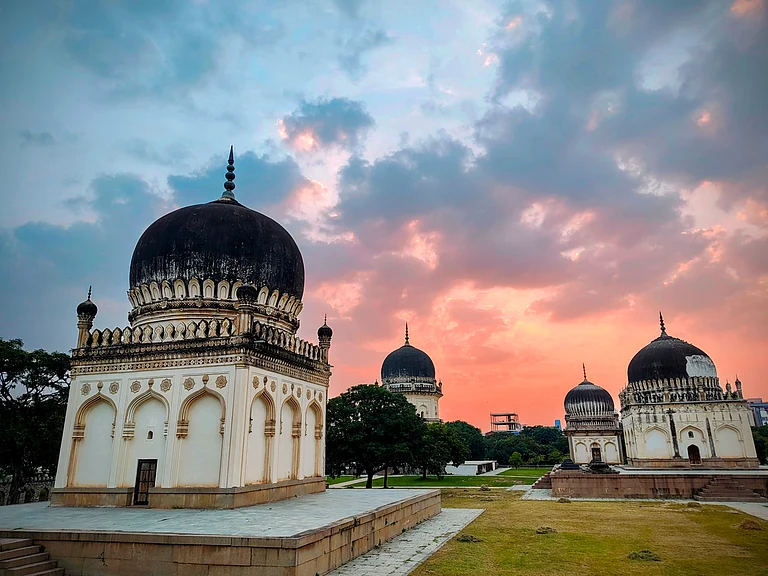


“Adhi mana toranam.” That is our arch.
The cucumber seller says it without looking up, knife still moving through the pile in his lap, while the stone arch of Warangal Fort rises behind him, through traffic, electrical wires, and paan stains. I nod as though I understand him. And at that point, I think I do.
We had left Hyderabad that morning. My mother explained the trip to my grandmother over the phone: “Heritage mandir dekhne jaa rahe hain.” We are going to see heritage temples.
The phrase is meant to make the journey understandable. Temples. History. Sightseeing.
Something that can be narrated neatly from one generation to another without requiring further explanation. But the first thing Warangal shows me is not a temple but the stone itself.
Granite boulders push out of the earth at odd angles, shaping where roads bend and where houses settle. Shrines emerge from rock rather than being placed upon it. Even before the city appears, it is already clear: here, history is not separate from the landscape– it is built into it.
Then the arch begins appearing.
A City Where History Refuses To Stay In The Past
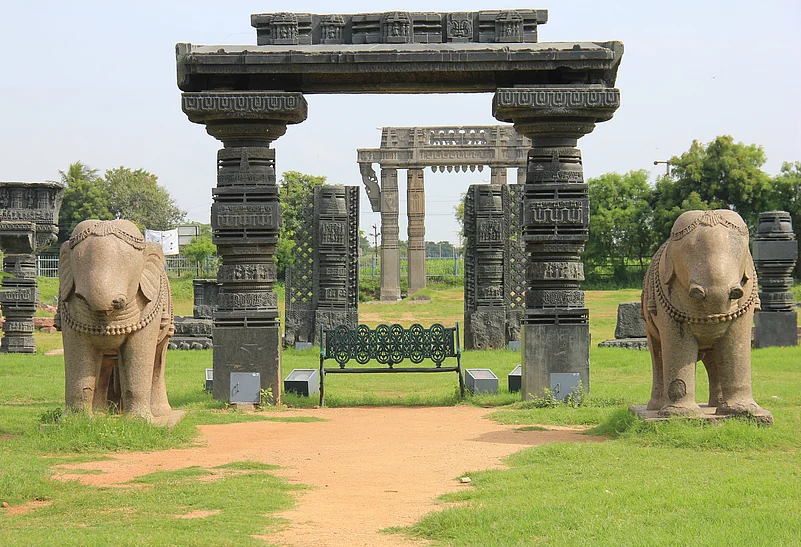
Above a college gate. Above a government office. Outside a restaurant. On buses, signboards, shopfronts. Five minutes into Warangal, I stop counting. The original Keerti Toranam stands inside the fort ruins, built before the Delhi Sultanate siege of 1323. But it no longer exists only as an object in a protected site. It survives through repetition– in logos, emblems, and everyday architecture. A dynasty that collapsed seven centuries ago is still woven into everyday life.
Around it, the city refuses to arrange itself neatly. At a traffic signal, red CPI flags flap beside saffron Hanuman flags and pink BRS banners. Labour Day meetings spill onto the roadside under temporary shamianas. Men sit cross-legged beneath portraits of Marx, while a billboard above them features Lord Ram alongside local politicians smiling into the election season. Nobody pauses to explain the arrangement. Everything occupies the same road with the matter-of-factness of things that have already spent a long time together.

Over the next three days, I begin to realise that people are read the same way here– through overlapping claims, partial recognitions, and small negotiations of belonging.
At the guest house, the man serving lunch watches me carefully as he places rice, dal and gongura chutney on the steel plate. I mix a portion of rice with my fingers, adding pappu to one side and sambar to the other.
His face changes. “Meeru Telugu maatladthara?”
When I answer in Telugu, something shifts immediately. His shoulders loosen. He pulls up a chair without asking.
“Earlier, nobody used to come here,” he says. “Only local people. Now, every year, more tourists. Foreigners also. Last month France people came.” He pronounces France slowly, with visible satisfaction. I realised later that he had been placing me before speaking to me. Tourist. North Indian. Telugu speaker. By the end of lunch, I have moved slightly closer to one category than the others– though not fully into any of them.
At Bhadrakali Temple the next morning, two women ahead of me in the queue are discussing the Kohinoor.
“Amma ki aankh,” one says, adjusting the steel plate in her hands. The goddess’s eye.
The diamond, according to her, was once set into Bhadrakali’s idol before being taken during the invasions and eventually entering the British Crown Jewels. The other woman nods without surprise. Whether or not this is historically exact, it is locally true.
Around it, newer centuries keep entering the temple without replacing the older ones. An e-hundi accepts UPI payments beside brass lamps blackened by oil smoke. The priest presses a crescent tilak onto my forehead; the same crescent curves above Bhadrakali’s brows. The temple does not preserve the past by sealing it away. It carries it forward by continuing to use it.
Temples That Continue To Change With Time
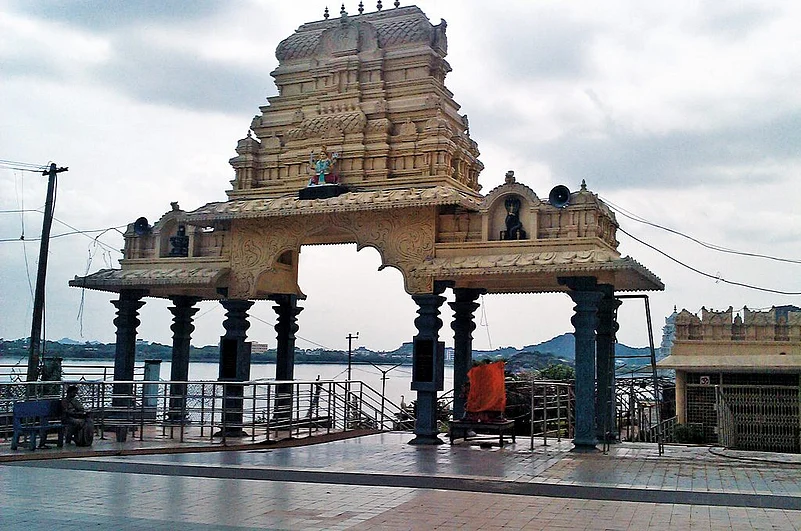
Outside, a lake stretches beside the temple, its edges under restoration for drinking water. The Kakatiyas built their empire around water— tanks beside temple complexes, irrigation folded into devotion. Telangana now restores them under Mission Kakatiya, borrowing the dynasty’s name for a modern policy scheme. Even the water infrastructure carries the past forward.
The older world stays visible because newer lives keep settling around it. At Padmakshi Temple, the same pattern continues in another form.
The space folds into the hillside rather than sitting on top of it. Shrines emerge from cracks in granite. The cave feels occupied rather than constructed. On the rock face, someone points out mata ji ke charan, and just beside them, smaller imprints– “kutte ke bhi hain.” The goddess’ footprints. A dog’s too. No one resolves the contradiction. It stays, layered but unbothered.
Even the rituals seem to negotiate between centuries instead of choosing one. The priest reads Telugu chants from printouts stapled together under fluorescent lights while an air-conditioning unit hums faintly against the stone, cooling a deity carved into a surface that has withstood centuries without it. During aarti, the lights and AC are switched off, and drums take over the room. For a few moments, the cave becomes only sound and flame.
The temple’s oldest accommodation remains standing quietly in one corner. Black Jain Tirthankaras, worn smooth with time, sit slightly apart from the stream of devotees moving toward Padmakshi Devi. I ask the priest about them.
“Chaala paatavi.” Very old.
“People still pray there?”
“Koncham mandi.” Some people.
Then, almost while turning away: “Teeseyadam tappu.”
Removing them would be wrong.
The shrine was once Jain before Kakatiya rulers turned toward Shaivism. The temple changed around the figures. The figures stayed. Not because of any preservation order. Because removing them would simply be wrong.
Outside, women stack small rocks into uneven towers beside the path. “Illu kosam,” she says. For a house. If the stones stay balanced, the wish will too. The gesture feels strangely familiar by then– another way of carrying belief forward through repetition.
By the time we reach Ramappa Temple, I am no longer sure what I am meant to be looking for.
At Ramappa, Every Stone Still Speaks
A UNESCO board stands outside beside a shop broadcasting recorded advertisements for coconuts to offer the deity. The language of recognition and the language of commerce run parallel, neither interrupting the other.
Our guide Vijay touches a pillar before saying anything.
“Mana kattadam.” Our construction.

He says this before mentioning kings, centuries or World Heritage designations. “Only temple named after architect,” he adds, pausing slightly. He speaks of engineering and carving as if they are still active knowledge, not historical fact.
But his attention shifts when he points to a detail. Thirteen holes in a bangle carved into stone. A hunter woman wearing a toe ring. Another wearing high heels centuries before colonial modernity supposedly introduced such aesthetics. Persian and Egyptian figures appear carved into the walls beside Hindu deities. Trade routes survive in stone long after empires collapse.
“See properly,” he says. “Every sculpture is doing something.” He then leads us to a blank pillar with no carvings. “One pillar plain on purpose. Otherwise, evil eye.” Even absence, here, is given a role to play.
Near the sanctum, a mouse runs across the base of the Shivalingam and disappears.
“Mooshakraj,” my mother says immediately. Ganesh’s vehicle. Inside a space like this, even a mouse is folded into meaning. I see a mere rat. My mother sees a presence. We have inherited the same stories and learned to read them differently.
As we walk back toward the parking lot, Vijay points further down the road. “I’ll show you another temple,” he says. “Kota Gullu– even bigger than Ramappa.” But if Ramappa survives through recognition, Kota Gullu survives through neglect.
What Survives, What Is Forgotten
The gate is locked. Someone phones the caretaker. He arrives on a motorcycle, keys jangling from one finger, and looks around at the empty complex while turning the lock. "Foreign lo unte ticket 1000 dollars," he says. "Ikkada evaru raadhu." Abroad, they would charge a thousand dollars. Here nobody comes.
Inside, there are twenty-three temples from the same Kakatiya period. The structures remain, but not as they are framed elsewhere. The floors are thick with dry leaves. Cows move between pillars. The ASI signboard has rusted to the point of illegibility. A newer plaque, perfectly legible, records politicians who inaugurated restoration work that never arrived.
Near a broken Ganesh carving, someone has left fresh yellow flowers. No priest. No guide. No record of the visit. Someone still comes. The temples remain because they have not been removed. But survival is not fixed in the temple itself– it shifts with how the present chooses to hold it.

At the Thousand Pillar Temple, restoration has imposed a cleaner order. Reconstructed pillars. Symmetry. Yet even here, the broken sculptures remain stacked in one corner– too damaged to worship, too significant to discard. Inside, the shrines do not match. Shiva remains, solid and central; Vishnu and Surya are marked by absence, their idols not replaced because, as a priest explains to a small group, “broken gods are not remade.” The Sultanate destroyed figurative idols, he says. The Shivalinga, formless, was harder to read as one.
By evening, we are no longer moving between separate temples. The Warangal fort holds all of them together in the same space—what is recognised, what is neglected, what is restored, and what simply remains.
“Qila,” the locals call it. A fort layered over a temple complex– the four Kakatiya gateways standing intact, repeated so often across the city that seeing the original feels almost like déjà vu.
Broken pillars lie in clusters, rearranged but not restored. Sculptures lean against one another, detached from the structures they once belonged to. A man rests his elbow casually against a Nandi while speaking into his phone. Nearby, a dargah sits draped in green cloth. The ASI signboard stands in Telugu, English, Hindi and Urdu– one of those languages arriving through the very invasions that shattered much of what the board now describes. No one treats this contradiction as unusual.
Across Warangal, the past is rarely encountered as something complete. Yet it is not treated as lost either. There is no language of blame directed at the Sultanate, no effort to mark it as a rupture sealed off from the present. Its traces remain folded into the landscape, alongside everything that came before and after. What survives here survives through continued familiarity. The ruins are not separate from everyday life. They are part of how the place recognises itself.
Outside the fort that night, the cucumber seller is still there.
“Mana toranam,” he had told me. Our arch.
He glances up briefly. Then he returns to cutting. The knife keeps moving.
FAQs
1. Why is Warangal important in Telangana’s history?
Warangal was the capital of the Kakatiya dynasty and remains one of Telangana’s most important heritage cities, known for its temples, forts, gateways and irrigation systems.
2. What is special about Ramappa Temple?
Ramappa Temple is a UNESCO World Heritage Site celebrated for its intricate Kakatiya-era carvings, engineering techniques and detailed sculptures depicting dancers, traders and everyday life.
3. What are the Keerti Toranams in Warangal?
The Keerti Toranams are iconic stone gateways built during the Kakatiya period. They have become enduring symbols of Warangal and Telangana’s cultural identity.
4. Which temples should travellers visit in Warangal?
Key sites include Ramappa Temple, Thousand Pillar Temple, Bhadrakali Temple, Padmakshi Temple and the temple ruins within Warangal Fort.
5. How far is Warangal from Hyderabad?
Warangal is around 150 km from Hyderabad and can be reached in approximately 3 to 4 hours by road or train.