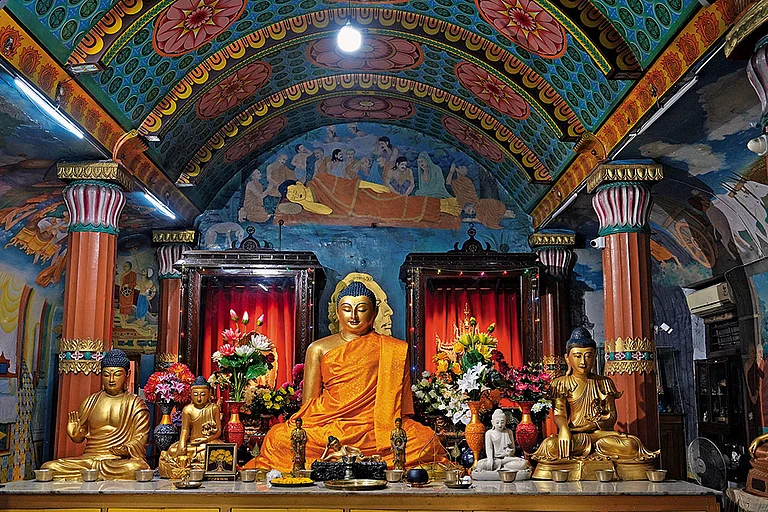
Buddhism is one of the major religions of the world. Its adherents number in the hundreds of millions, approximately six to seven per cent of the global population. Beginning in the sixth century BCE as a largely non-theistic and pragmatic guide to liberation, it evolved over millennia into diverse traditions with distinct rites and rituals. What remains constant, however, is a deep commitment to non-violence, reflected not only in ethical conduct but also in daily habits of sustenance. In Buddhism, food is not merely nourishment; it becomes discipline.
The founder of this faith was born into a royal lineage in the Terai region of present-day India and Nepal. Siddhartha, the young Shakya prince, grew weary of palace life. Indulgence in sensual pleasures left him dissatisfied. Confronted with sickness, old age and death, he recognised the inescapable fragility of human existence. One night he renounced family and kingdom and entered the forest to practise severe austerities in pursuit of liberating insight.
Years of extreme self-denial reduced his once radiant body to near collapse. Enlightenment dawned only after he accepted nourishment. Tradition recalls that he broke his prolonged fast with a bowl of kheer offered by a village woman. The experience shaped what became central to his teaching: the Middle Path, or Madhya Marg.
The Buddha often compared the body to the string of a veena. Tightened excessively, it snaps; left slack, it produces no music. Freedom from suffering required balance rather than extremes. In food, as in all things, he counselled moderation. Eating was to sustain the body, not indulge desire or punish the flesh.


Non-violence remained foundational. No creature, great or small, should be harmed unnecessarily. Yet the Buddha acknowledged that absolute non-violence in daily life was difficult to practise. Separate guidelines evolved for monks and householders. Monks were instructed to accept whatever was placed in their begging bowls, provided the “threefold purity” rule was observed: the animal had not been seen, heard, or suspected to have been killed specifically for them.
At dawn, monks walked silently through villages, bowls in hand. Whatever was offered was received without preference. Meals were taken in quiet reflection. The emphasis was not on taste but sufficiency. Food became part of spiritual training.
Adaptation And Restraint
Across Asia, Buddhist communities adapted dietary practices to geography and climate. Japan, Korea, China, Mongolia, Vietnam, Laos, Cambodia, Thailand, Burma and Sri Lanka did not uniformly embrace vegetarianism. In Ladakh, Sikkim and Arunachal Pradesh, environmental realities shaped similar adaptations. The underlying principle was restraint rather than rigidity.
Meals in monastic settings were largely simple. Rice, milk, ghee and vegetables were prepared in community kitchens. Pungent vegetables such as onions, garlic and leeks were often avoided, as they were believed to disturb meditation. The aim was to provide adequate nourishment to sustain the body and keep distracting hunger at bay.
On rare occasions, meat-based tonic broths were permitted, provided the animal had not been killed specifically for the monk. This reflected pragmatic adherence to the threefold purity principle.
Such dietary moderation contrasted with stricter Mahayana interpretations that later evolved in other regions, yet it remained well-suited to local conditions and early monastic traditions in the subcontinent. Chinese Buddhist scholar and traveller Xuanzang, who journeyed to India in the seventh century, provides insights in his travelogue into the daily meals of monks at Nalanda Mahavihara in Bihar during his years of study there.
He records simple fare: porridge accompanied by a slice of ginger and a wedge of lemon to lend flavour to otherwise insipid sustenance. The emphasis was on basic nutrition. Food was frugal, sufficient only to quiet the distracting pangs of hunger, prepared with time-tested ingredients believed to sustain the body and preserve health.
The Buddha taught that the root of suffering, dukkha, lay in insatiable desire, trishna. The more one succumbs to craving, the deeper the unrest. Mindful eating, samyak ahar, therefore becomes part of the ethical life. It is food taken with awareness, sufficient for the individual and sustainable for the world.
Historical accounts in the early Buddhist texts record that the Buddha’s final illness followed a meal described as pork, offered respectfully as alms. Interpretations differ regarding the exact preparation, yet the essential lesson endures: attachment, not food itself, lies at the heart of suffering.
The Contemporary Table
Over centuries, Buddhist reflections on diet entered into dialogue with broader Indian culinary thought. Distinctions between lighter and heavier foods found resonance within Ayurvedic classifications of sattvic, rajasic and tamasic dispositions. Buddhist scholar-practitioners such as Nagarjuna emphasised that diet, for monks and laypersons alike, should be appropriate to region and season. Ingredients possess qualities, and what we consume can either aggravate or alleviate physical and emotional imbalance.
The youth of today, who constitute the majority of the planet’s population, are increasingly conscious of the hazards posed by highly processed foods and industrial food systems. Many are turning towards what they perceive as natural and organic, seeking nourishment uncontaminated by excessive chemicals, fertilisers and pesticides. Veganism is no longer merely a passing trend. The principle of non-violence now resonates beyond the appeals of pacifists; it strikes a chord among all who are concerned about sustainability and the future of the earth.
To eat mindfully, to avoid extremes, and to follow the Middle Path in the footsteps of the Enlightened One is no longer simply a matter of personal discipline. It is an ethical imperative.
Looking for more such exciting and meaningful stories? Grab our latest issue on Amazon.