

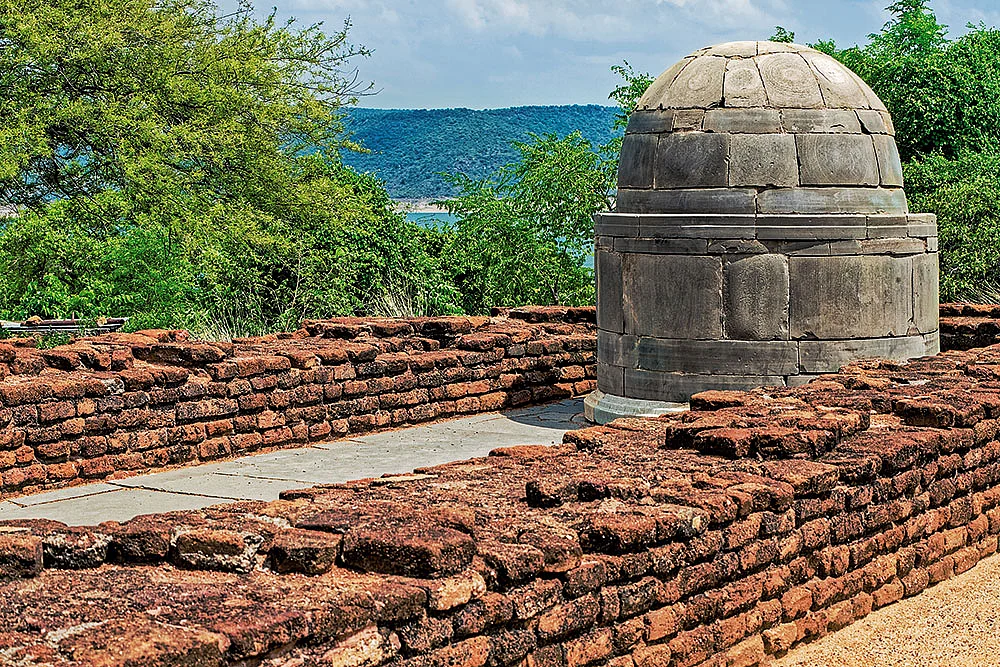
I stood on the terraced heights of Chandavaram as the wind moved steadily across the Gundlakamma River valley. Below me, fields shimmered in the afternoon heat. The stupa’s double-tiered platform rose like a fortress of brick and silence. Grass pushed through ancient masonry. Somewhere in the distance, a farmer called out across his land.
When we speak of the Land of the Buddha, the imagination travels north to Bodh Gaya, Sarnath and Kushinagar. Yet as I stood on that Andhra hillock, it became impossible to ignore another truth. For nearly a millennium, the Deccan plateau and the southern peninsula nurtured a Buddhist world as dynamic and expansive as the Gangetic heartland.
Here, Buddhism did not merely survive. It adapted, experimented and sailed outward.
Terraces Of Faith
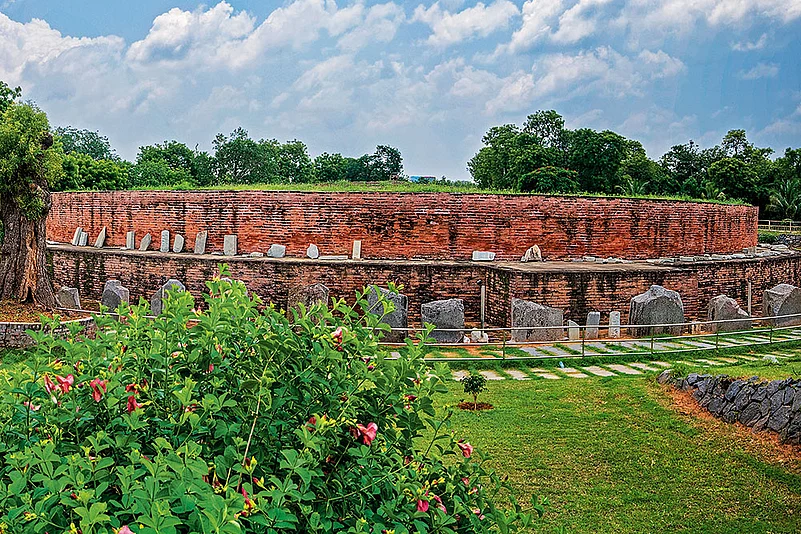
Chandavaram is unlike the domed stupas of the North. Built between the 2nd century BCE and the 2nd century CE, its Maha Stupa rises in massive terraces, each level meant for circumambulation. The structure feels deliberate, almost defensive, as though protecting both relic and doctrine.
Along the high pathways stand the remains of Ayaka pillars, distinctive to Andhra Buddhism, representing the five pivotal events of the Buddha’s life. The design reflects regional imagination at work. This was not imitation. It was innovation.
The site’s rediscovery in 1964 was accidental. Ancient bricks were found being reused in local construction. What had long been dismissed as a hill of old stones emerged as a major monastic complex. Its scale suggests it once served pilgrims and merchants travelling between inland Deccan settlements and the eastern coast.
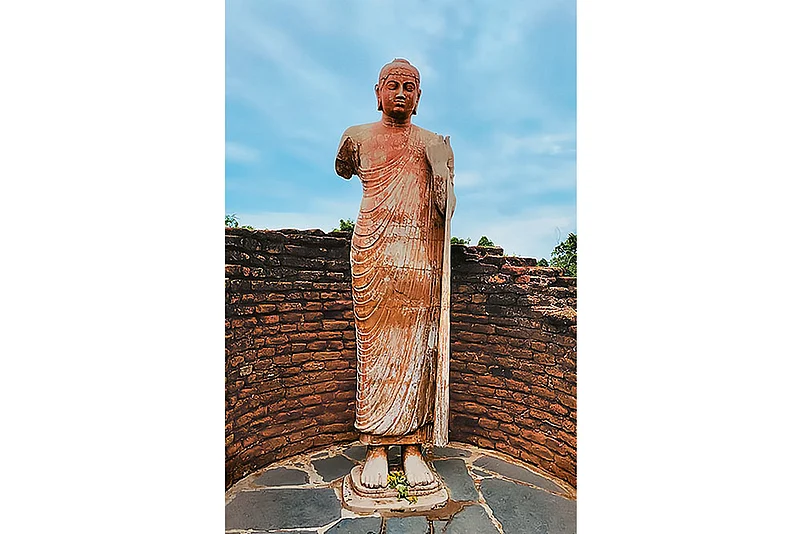

From this height, I could imagine caravans moving along the river, monks observing both faith and commerce unfolding below. The Sangha here was never isolated from the world. It was embedded within it.
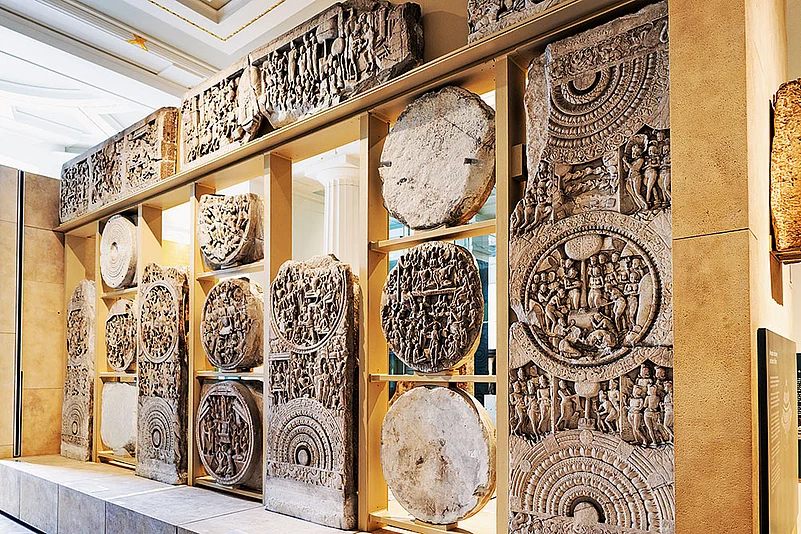
Further south along the Krishna River valley lie the great centres of Amaravati and Nagarjunakonda. Amaravati, once the nucleus of what scholars call the Andhra School of art, produced marble reliefs that travelled across Sri Lanka and Southeast Asia. At Nagarjunakonda, the Ikshvaku rulers supported a thriving monastic university complex. The river bends gently around the island where ruins still surface, hushed but eloquent.
This region also carries the philosophical shadow of Acharya Nagarjuna, the second-century thinker whose Madhyamaka doctrine of the Middle Way reshaped Buddhist metaphysics. The Southern Trail, as later texts described it, was a corridor of debate and doctrinal refinement.
Standing at Chandavaram, then tracing the riverine geography southward in my mind, the movement felt organic. Thought travelled the same routes as trade.
Rivers To Plateau
From the coastal plains of Andhra, the journey turns inland toward Karnataka’s Gulbarga district. The landscape hardens into rocky stretches and open sky. Here lies Kanganahalli, one of the most significant Buddhist discoveries of the modern era.
Until the late 1980s, the site was an unassuming mound near the Chandralamba Temple. Structural concerns led archaeologists to investigate. What they uncovered altered our understanding of southern Buddhism.
For nearly a millennium, the Deccan plateau and the southern peninsula nurtured a Buddhist world as expansive as the Gangetic heartland
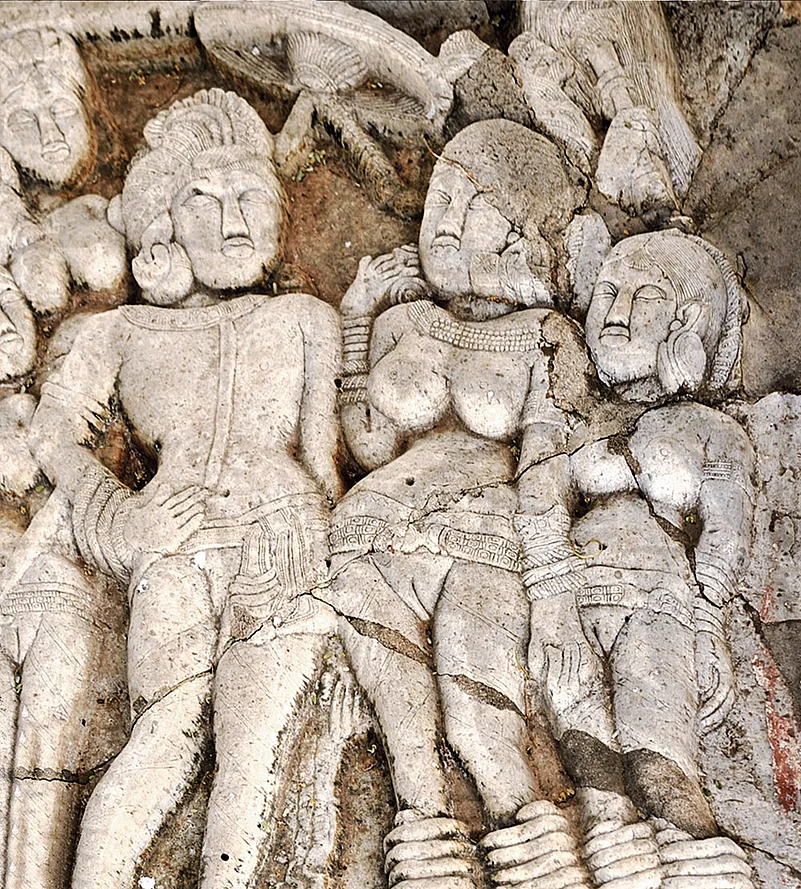
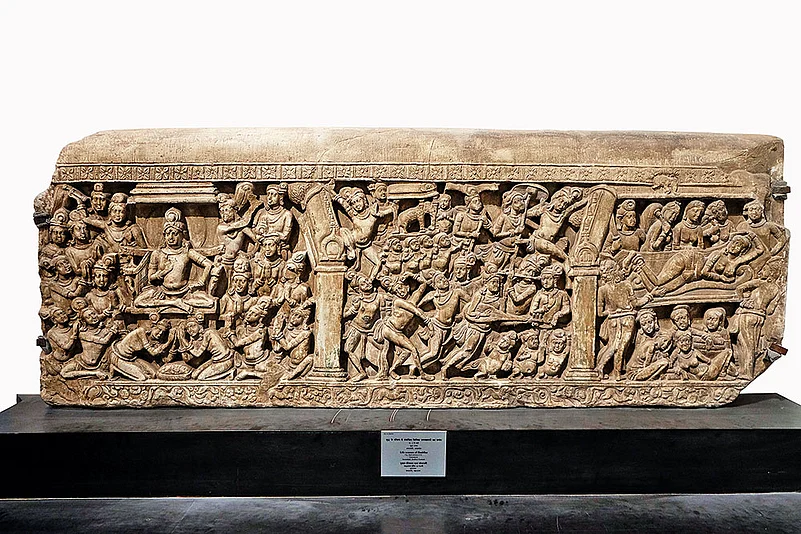
The Mahastupa at Kanganahalli was adorned with greenish-white limestone panels narrating Jataka tales with remarkable fluidity. Among them appeared something unprecedented: a relief identified by inscription as “Raya Asoko.”
It is the only known contemporary sculptural depiction of Emperor Ashoka.
Standing before that panel, I felt the distance between edict and image collapse. Ashoka’s dhamma was not confined to pillars scattered across the North. It had entered the artistic and devotional life of the southern Deccan. Xuanzang, the seventh-century Chinese monk, recorded that stupas attributed to Ashoka still stood in the South during his travels. The archaeological record affirms that memory.
The Deccan plateau was not peripheral to Buddhist history. It was integral.
Shorelines Of Exchange
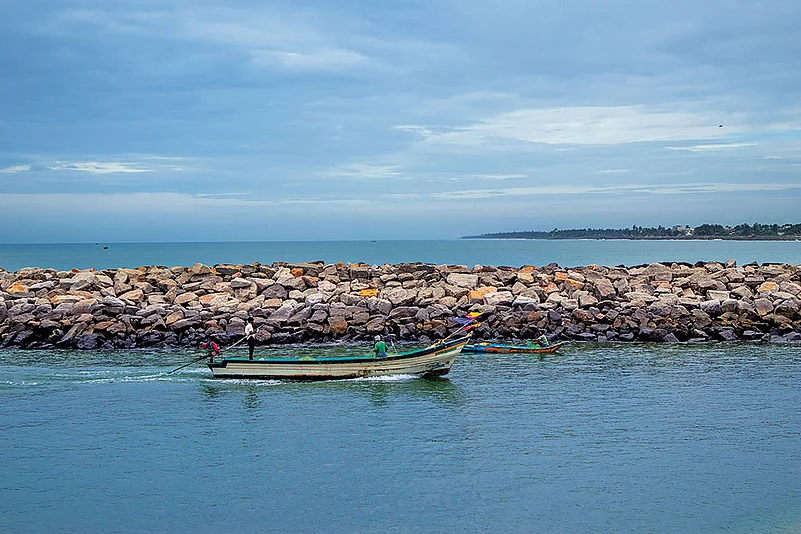
From the plateau, the trail bends once more toward the coast of Tamil Nadu. The air grows heavier with salt. Fishing nets dry along the shoreline. At Nagapattinam, the narrative shifts from hills to horizon.
In the 11th century, the Choodamani Vihara was built here by the Srivijaya king Mara Vijayottungavarman with the patronage of the Chola emperor Rajaraja I. This was not an isolated monastery but part of a maritime network linking South India to Southeast Asia.
Excavations at Nagapattinam revealed over 300 Buddhist bronzes. These icons embody a distinctive Chola-Buddhist aesthetic, graceful yet grounded. The sea here was not a boundary. It was a bridge.
Tamil literature bears testimony to this cultural synthesis. The epic "Manimekalai" follows a young woman who renounces worldly life to become a Buddhist nun.
The text describes bustling port cities, monasteries and philosophical debates with vivid immediacy. It is impossible to read it and still imagine Buddhism as an imported northern faith. It was woven into Tamil ethical and literary life.
Even in Kerala, where visible Buddhist monuments are rare, echoes remain.
In the village of Karumadi stands a weathered black granite Buddha known as Karumadikkuttan. Dating to the ninth or 10th century, the statue was rediscovered in a stream in the 20th century. Its missing half seems symbolic of a lost chapter, yet its presence hints at deeper absorption rather than disappearance.
Kerala’s circular temple forms and strands of Ayurvedic thought carry subtle resonances of Buddhist influence. The faith did not vanish here. It dissolved into the region’s cultural bloodstream.
Across The Sea
The Southern Sangha did not end at the shoreline. Tradition holds that Bodhidharma, who would shape Chan and later Zen Buddhism, hailed from the Pallava realm of Kanchipuram. The monk Bodhisena journeyed from South India to Japan in the eighth century and presided over the eye-opening ceremony of the Great Buddha at Todai-ji in Nara.
From these coasts, monks and merchants sailed eastward. The granite hills of the Deccan and the ports of Tamil Nadu were connected to China, Sri Lanka and Southeast Asia through living maritime routes.
Standing at Nagapattinam at dusk, watching waves roll toward shore, I felt the continuity of that outward gaze.
The Echo In Stone
South India’s Buddhist trail is not merely a story of ruins. It is a story of synthesis.
From the terraced stupa of Chandavaram to the limestone reliefs of Kanganahalli and the salt-sprayed bronzes of Nagapattinam, the Southern Sangha reveals a Buddhism comfortable with wealth, engaged with politics and unafraid of the sea.
These monasteries rose beside trade routes. Philosophers debated within earshot of merchant caravans. Emperors were carved into stone. Kings patronised vihara alongside temples.
As I left the coast and turned back inland, the map of Indian Buddhism felt recalibrated. The Buddha’s footprint was not confined to the alluvial plains of the North. It pressed deeply into the granite ridges and tidal winds of the South.
And if one stands quietly among these ruins long enough, one begins to hear it. Not as proclamation. But as echo.
Mapping The Southern Sangha
Amaravati, Andhra Pradesh
Major Buddhist centre from 2nd century BCE to 3rd century CE. Known for the “Andhra School” of white limestone sculpture that influenced Sri Lanka and Southeast Asia. Key reliefs now in Chennai and London museums.
Nagarjunakonda, Andhra Pradesh
Ikshvaku-era monastic university complex in the Krishna River valley. Associated with Acharya Nagarjuna and the Madhyamaka school. Excavations revealed viharas, chaityas and inscriptions reflecting global patronage.
Salihundam, Andhra Pradesh
Hilltop site near Srikakulam overlooking the Vamsadhara River. Shows successive Hinayana, Mahayana and Vajrayana phases. Noted for its rare wheel-shaped stupas.
Kanganahalli, Karnataka
Mahastupa with limestone Jataka panels and the only known sculptural portrait of Emperor Ashoka, inscribed “Raya Asoko.” A landmark Deccan discovery.
Nagapattinam, Tamil Nadu
Chola-era maritime Buddhist hub. Site of the 11th-century Choodamani Vihara. Over 300 bronze icons found here reveal strong Southeast Asian connections.
Karumadi, Kerala
Home to the 9th–10th century “Karumadikkuttan,” a rare surviving black granite Buddha, marking Kerala’s largely absorbed Buddhist past.
Looking for more such exciting and meaningful stories? Grab our latest issue on Amazon.