The road out of Cuttack grows quieter with every kilometre. The flyovers disappear first. Then the petrol pumps. Then the rhythm of traffic.
Soon, there are only paddy fields, coconut palms and an occasional banyan casting a wide shadow. Women walk with firewood balanced on their heads. A tea stall radio hums an old Odia song. It is difficult to imagine that this unhurried countryside once sustained one of eastern India’s most significant centres of Buddhist learning.
And yet, atop three hillocks in Jajpur district, Ratnagiri, Udayagiri, and Lalitgiri flourished for nearly a millennium. Together they form what is now called Odisha’s Buddhist Diamond Triangle.
On the ground, however, nothing announces a triangle. There is only sky, field and brick. Ratnagiri is the most extensively excavated and the most dramatic of the three. Excavations carried out between 1975 and 1983 under Debala Mitra of the Archaeological Survey of India revealed sealings—objects stamped with a seal—identifying the establishment as Sri Ratnagiri Mahavihara. “This was not Pushpagiri, as some once believed,” my guide, whom I had hired from Bhubaneswar, said, pointing to a photograph of one such sealing in his folder. “The name Ratnagiri is clear in the inscription.”

With origins in the fifth century CE and activity continuing until the 13th century, the monastery grew into a major centre of Mahayana and later Vajrayana Buddhism. Art historian Thomas Donaldson has written that Tibetan texts even associate Ratnagiri with the development of Tantric traditions.
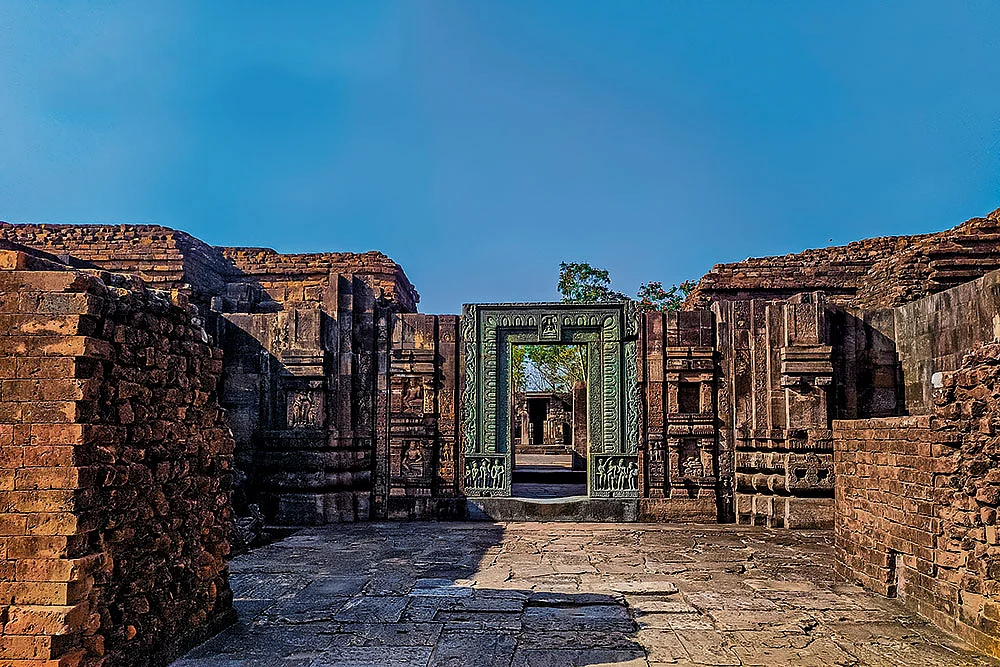
The carved entrance gateway appears suddenly against the sky. Executed in dark chlorite stone, it is one of the most photographed Buddhist facades in India. Inside, monks’ cells frame a broad quadrangle. Votive and commemorative stupas cluster across the hillside. The Mahastupa anchors the complex. Ratnagiri is also the only monastery in India known to have had a curvilinear roof, a detail that suggests architectural confidence and experimentation.
A short drive away, Udayagiri shifts the mood. Set within the foothills of the Eastern Ghats, it is the largest and perhaps the most picturesque of the three. Excavations began in 1985, and large portions remain untouched, giving the site a feeling of being only partially revealed.
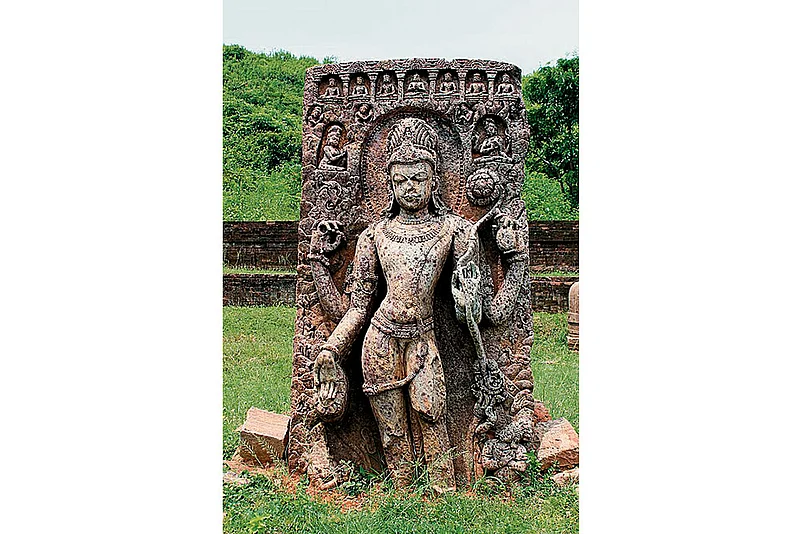
The complex is divided into the Madhavapura Mahavihara and the Simhaprastha Mahavihara. The former contains a substantial Mahastupa and chaityagrihas, along with votive and commemorative stupas. The latter preserves meditation chambers and sculptural fragments, including an evocative image of Avalokitesvara (a bodhisattva who embodies infinite compassion) and a lion sculpture set dramatically against the hillside.
“Notice what is missing here,” the guide said. Unlike Ratnagiri and Lalitgiri, Udayagiri has yielded no strong evidence of Vajrayana practice so far. Its sculptures feel older and simpler, perhaps representing a more orthodox phase of monastic life. Birdsong carries easily across the slopes, and the ruins appear absorbed into the landscape rather than imposed upon it.
By the time one reaches Lalitgiri, the terrain opens towards the Birupa and Chitrotpala river valleys. Locally known as Naltigiri, it is regarded as the oldest of the three, with foundations dating to the first century BCE. Though first identified in 1905, systematic excavations took place only between 1985 and 1991, drawing in part on references from the Chinese pilgrim Xuanzang.
Lalitgiri’s Mahastupa crowns the hilltop. Nearby stand chaityagrihas and rows of votive stupas scattered across green slopes. The monastery reflects multiple phases of Buddhist development, from early Hinayana traditions to Mahayana and later Vajrayana influences under the Bhaumakara rulers.
Excavations by the ASI in 1985 at Lalitgiri uncovered three khondalite relic caskets placed around the Mahastupa. Two contained gold caskets within silver ones—one held a charred bone wrapped in gold foil, the other a similar unwrapped fragment—while the third was empty. Such relics, also found at sites such as Sanchi, Vaishali, and Amaravati, link Lalitgiri to a wider Buddhist sacred network. Today, the caskets and sculptures are preserved in the site museum.
What lingers after visiting all three is not spectacle, but continuity. Stone carving continues in villages; fields stretch where debates once unfolded. The Diamond Triangle remains understated, free of crowds. You can still sit alone on a monastery wall and hear nothing but the wind moving through grass. History here does not perform. It simply remains.
The Information
Location: The Diamond Triangle lies in Jajpur district, Odisha, about 100 km from Bhubaneswar and roughly 80 km from Cuttack. Ratnagiri, Udayagiri and Lalitgiri are within 20 to 25 km of one another.
Getting there: The nearest airport is Biju Patnaik International Airport in Bhubaneswar. Major railheads include Bhubaneswar, Cuttack and Jajpur Keonjhar Road. A private car or hired cab is recommended.
Best time: October to March offers pleasant weather and clear skies. Summers can be extremely hot, while monsoon months bring humidity and slippery paths.
Time required: Allow one full day to cover all three sites. A relaxed two-day itinerary works well if combining with Bhitarkanika or Bhubaneswar’s temple circuit.
Pro tips: Carry water and snacks, as facilities are minimal; knowledgeable guides are available only at Bhubaneswar or Cuttack.
Looking for more such exciting and meaningful stories? Grab our latest issue on Amazon.