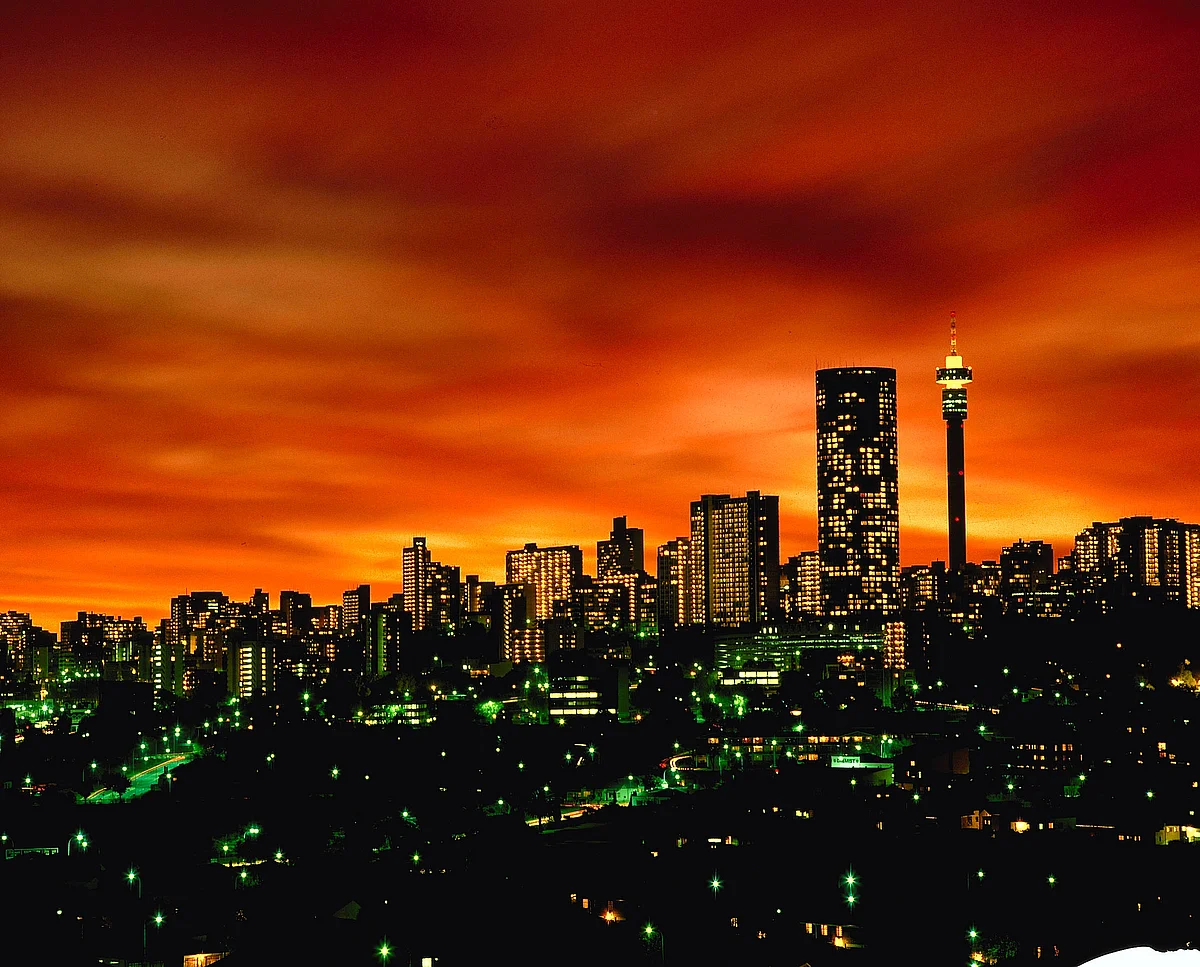
Some cities announce themselves through a skyline. Johannesburg reveals itself through a story. From the window of a descending aircraft, South Africa’s largest city appears unexpectedly green—an expanse of treetops interrupted by clusters of high-rises, mine dumps glowing faintly in the afternoon light, and the unmistakable geometry of a city that was never meant to exist here at all. There is no river curling through its centre, no glittering coastline framing its edges. Instead, Johannesburg rises from the highveld, built on a ridge of earth that changed its destiny in 1886, when gold was discovered beneath the Witwatersrand.
That single discovery transformed a stretch of grassland into one of Africa’s most dynamic urban centres. It also gave Johannesburg its enduring sobriquet: the City of Gold. Today, locals call it many things—Joburg, Jozi, eGoli—but the old nickname still lingers because, even now, the city seems to shimmer with the weight of everything it has been.
Where The Gold Changed Everything
Long before the city’s glass towers and financial districts, this landscape was marked by rocky outcrops, seasonal streams and open bush. Archaeological evidence suggests that people lived in this region for hundreds of thousands of years, from early Stone Age communities to Tswana settlements whose iron furnaces still speak to a much older history. But Johannesburg as the world knows it is a relatively young city, born not from trade or empire, but from extraction.
When Australian prospector George Harrison reportedly stumbled upon gold in Langlaagte in 1886, the quiet plateau erupted. Prospectors arrived first, followed quickly by merchants, speculators and labourers from across Europe, Asia and southern Africa. Tents and wagons gave way to timber structures, then brick buildings. Within a remarkably short period, a mining camp had become a city.
Unlike many great capitals that developed gradually over centuries, Johannesburg grew with astonishing speed. Wealth from the mines pushed buildings higher and suburbs further outward until the city became the economic heartbeat of South Africa. Even now, Gauteng—the country’s smallest province by size—contributes a significant share of the national economy, with Johannesburg at its centre.
A City Built On Contradiction
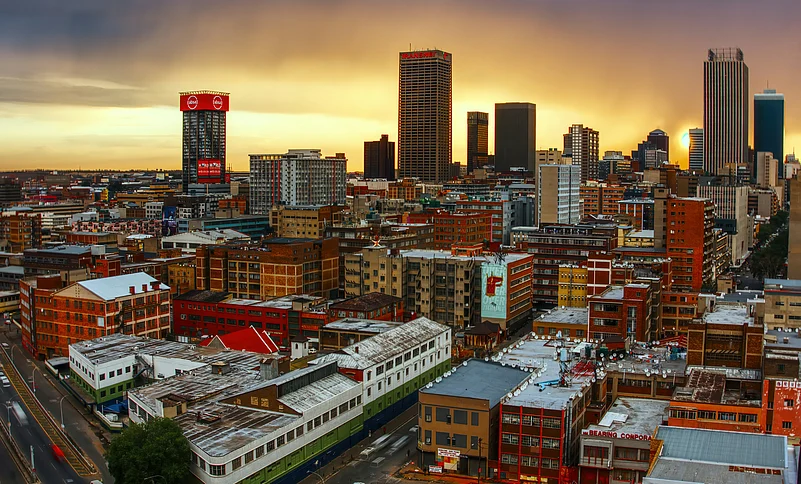

For all its glamour, Johannesburg has always carried another story beneath the surface. The same gold that created extraordinary fortunes also entrenched brutal inequality. Deep-level mining demanded vast amounts of labour, drawing Black South Africans into dangerous work underground while wealth accumulated elsewhere. The city’s expansion was shaped as much by exclusion as by ambition, and long before apartheid was formalised, segregation had already begun to define Johannesburg’s geography.
Entire communities were forcibly removed from neighbourhoods near the city centre. In 1904, residents of Brickfields were relocated south to what would later become Soweto, laying the foundations for one of the most historically significant townships in the country. Decades later, Sophiatown, once a vibrant cultural quarter of writers, musicians and political thought, was dismantled under apartheid planning.
Yet Johannesburg also became the city where resistance found its voice. Mahatma Gandhi spent formative years here, developing the principles of passive resistance while campaigning against discriminatory laws. Nelson Mandela and Walter Sisulu sharpened their political vision here. In Soweto, schoolchildren changed the course of South African history in 1976 when they rose against apartheid in protests that reverberated around the world. To understand Johannesburg is to understand that its history has never been simply gilded. It has always been complicated.
Beyond The Old Reputation
For years, Johannesburg was often treated as a city travellers passed through rather than paused for. Visitors flew in, connected onward to safari lodges or Cape Town, and rarely gave the city more than a night. Its reputation for crime often overshadowed its character. That perception, though, has never captured the full picture. What Johannesburg offers is not postcard beauty in the conventional sense. It is something more layered. It is a city that rewards curiosity.
Neighbourhoods such as Maboneng have reimagined former industrial blocks into creative districts where galleries, design studios and cafés spill onto pavements. Braamfontein hums with students, bookstores and contemporary culture. In Sandton, polished towers and luxury hotels reflect the city’s continuing role as a continental financial capital, while Nelson Mandela Square remains one of its most recognisable urban landmarks.
Elsewhere, the city’s quieter corners reveal themselves in unexpected ways, jacaranda-lined suburbs in spring, old Randlord mansions that recall mining wealth, and rooftop bars where Johannesburg’s famous sunsets turn the skyline copper.
There is also an unmistakable energy here, a sense that the city is always becoming something else.
The Soul Of Modern Johannesburg
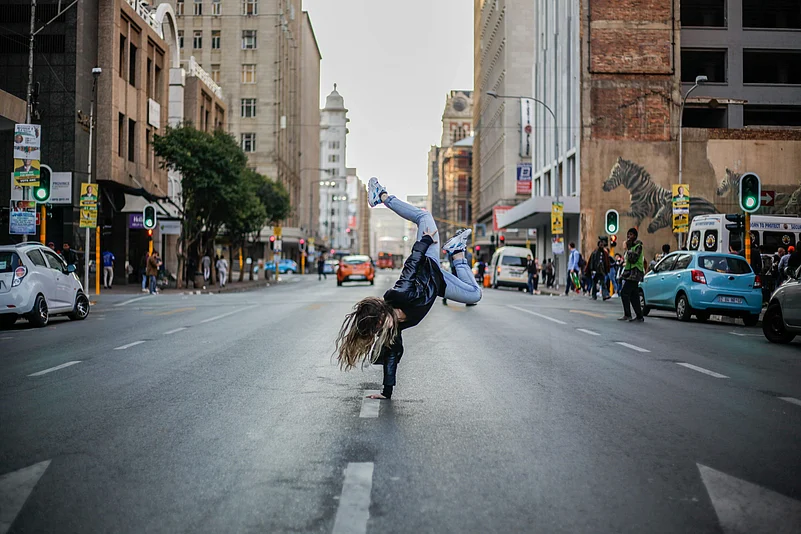
What makes Johannesburg compelling today is not simply its history, but how visibly that history coexists with the present. In Soweto, visitors can walk Vilakazi Street, where both Nelson Mandela and Desmond Tutu once lived, and then sit down for lunch in a neighbourhood that has become a symbol of cultural renewal. At Constitution Hill, once a notorious prison complex, South Africa’s Constitutional Court now stands as one of the country’s most powerful symbols of democracy. At the Apartheid Museum, the city confronts its past with a candour that is both unsettling and essential.
And then there is the greenery, perhaps the city’s greatest surprise. Johannesburg is often considered one of the largest man-made urban forests in the world, with millions of trees softening its hard edges. For a city born from the ground, it has become remarkably defined by what grows above it.
Why The Nickname Still Endures
Johannesburg earned the title City of Gold because of what was discovered beneath its soil nearly 140 years ago. But the name endures because it still feels apt. Not because of bullion or mine shafts, but because Johannesburg remains a place of restless possibility. It is a city of reinvention, resilience and remarkable contrasts, where history and ambition sit side by side, often uneasily, but never quietly.
Many cities ask to be admired. Johannesburg asks to be understood. And perhaps that is why, long after the gold rush faded, the city still shines.
FAQs
1. Which African city is known as the City of Gold?
Johannesburg in South Africa is widely known as the City of Gold.
2. Why is Johannesburg called the City of Gold?
It earned the name after major gold deposits were discovered in the Witwatersrand in 1886.
3. What does eGoli mean?
eGoli is a Zulu name for Johannesburg that translates to “place of gold.”
4. Is Johannesburg South Africa’s capital city?
No, Johannesburg is not the capital, but it is South Africa’s largest city and economic hub.
5. What is Johannesburg known for today?
It is known for finance, history, art, culture, and landmarks linked to South Africa’s anti-apartheid struggle.