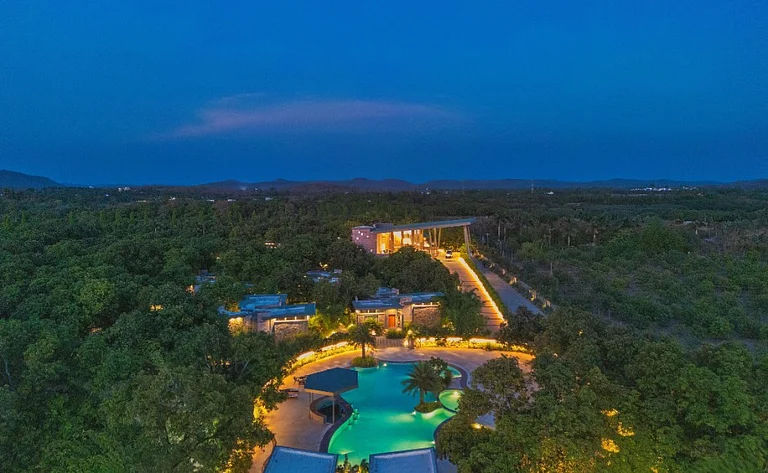


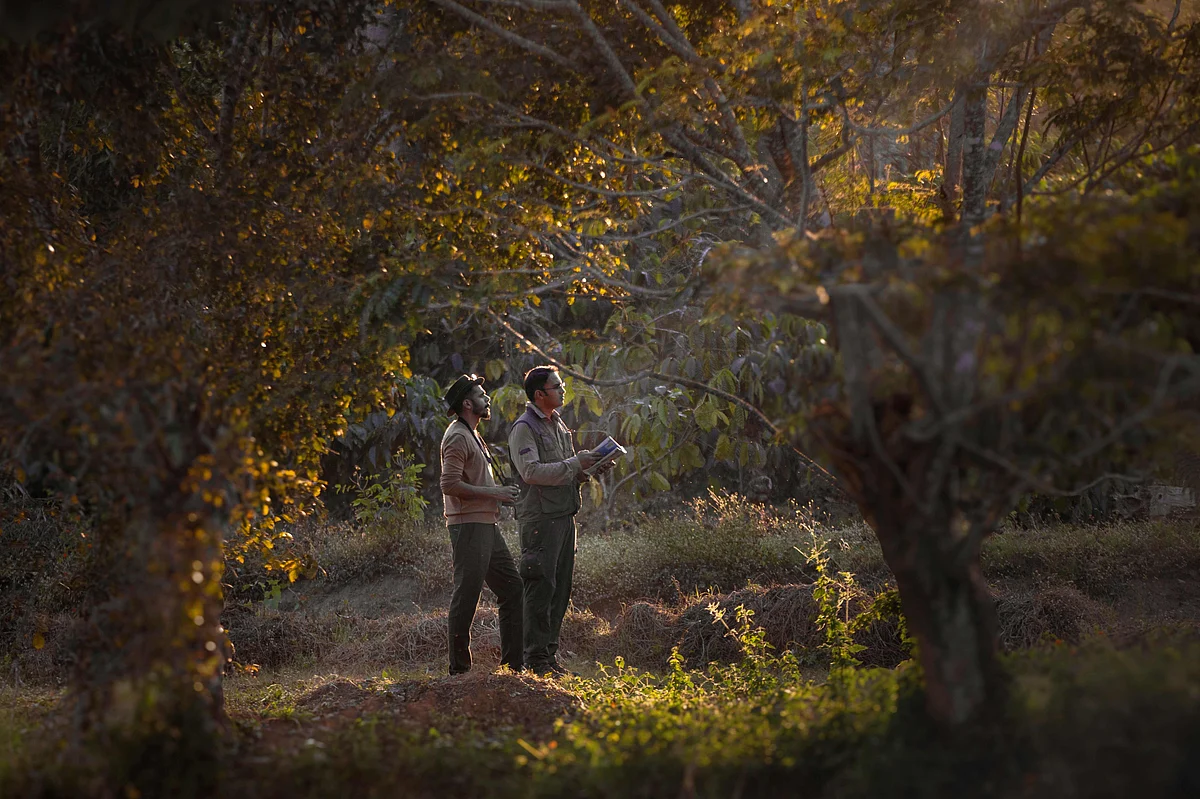
Kamla Didi used to mix and carry cement. She hauled dust and aggregate, passed stone from hand to hand down a line of workers, and helped raise the walls of what would become Sariska Lodge in the foothills of the Aravallis. She had never worked in hospitality. She had never been to school. When the construction was done and the lodge opened its doors, she didn't leave; she became one of its housekeepers. Today, Anand Shekhawat—co-founder of Sariska Lodge, and former regional director for India, Bhutan, and Sri Lanka and global head of sustainability at Aman—describes her the way you'd describe someone you've watched genuinely transform. “She notices which side of the bed the guest sleeps on. She swaps the shoes that way. She ensures hygiene; she knows their coffee,” he pauses, “for someone who has never been to school.”
It would be easy to read this as a feel-good footnote to a property's sustainability report. It isn't. Kamla Didi's story, and others like it unfolding across India's wildlife properties, from the Aravalli foothills to the tea slopes of Darjeeling, from the forests of Corbett to the spice gardens of Kerala, points to something more structural, more interesting, and arguably more important than anything on an amenities list. It points to a fundamental rethinking of who hospitality is actually built around, and what happens when a lodge decides that the community living at the edge of the forest is not a backdrop but a foundation.
The Village Before The Lobby
According to market research firm Future Market Insights, India's wildlife and safari tourism sector is projected to nearly double—from USD 2.8 billion in 2025 to USD 5.3 billion by 2035. Globally, the wildlife tourism market, valued at USD 150.6 billion in 2023, is expected to more than double to USD 316.2 billion by 2033, according to Market.us. But the story within that growth is where things get more interesting. The travellers driving this expansion, increasingly domestic, increasingly intentional, are not simply looking for better amenities. They are looking for experiences that feel genuinely rooted in a place— that carry the texture of where they actually are, rather than the texture of a hospitality formula applied the same way everywhere.
And what makes a place feel real, more than almost anything else, is its people. When the guide who walks you into the forest grew up in the village at its edge, they don't consult a field guide. They read the landscape the way they read a face, with context accumulated over a lifetime. When the staff member who brings your evening tea was born three kilometres from where you're sitting, the ease they carry into the room is not manufactured. It's something older and more durable than any training programme can produce. “When someone travels, they are looking for a purpose,” Shekhawat says. “Whether it's time together, a sense of adventure, or they want their kids to understand about the jungle or wildlife.” What they find, in a lodge staffed by people who have lived inside that purpose their whole lives, is something that a curated itinerary alone cannot deliver.
This is what a growing number of India's wildlife lodges have understood and built their model around. 80 per cent of the staff working at Sariska Lodge today were the people who helped construct it—the masons, the labourers, the women who carried material on their heads through the Rajasthan heat. Many of them now run the property they built. “We are not just building a hotel,” Shekhawat says. “We are building a fabulous team. People who will grow up and become leaders in themselves.”
A Movement Across The Jungle
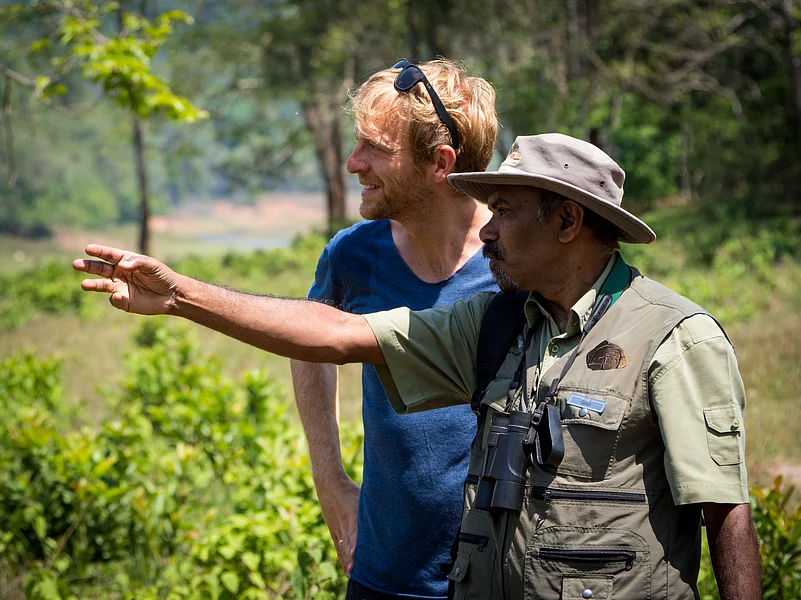

What's happening at Sariska is part of a broader shift in how India's wildlife hospitality sector thinks about its relationship with local communities. Taj Safaris, which operates lodges across Madhya Pradesh's tiger reserves, has built local employment and community training into its responsible tourism model across its properties. TOFTigers, the industry body for responsible wildlife tourism, reports that properties like Forsyth Lodge in Satpura employ upwards of 90 per cent local staff, with some reaching near 100 per cent. Independent research commissioned by TOFTigers found that revenue for small businesses in communities with tourism infrastructure is four to eight times greater than in those without, because that money circulates locally rather than flowing out to a distant corporate centre.
Shekhawat believes this has a direct bearing on the kind of experience a guest walks into. “Hotels should definitely have local employment—at least 50 per cent. That will open up doors to communities where guests could go and interact with people. They would welcome them and offer them tea. That would really open up a lot of doors and change the meaning of experiences for any hotel.” It's a simple idea, but its implications run deep as local employment doesn't just serve the community; it changes what a stay actually feels like.
At Taj Corbett Resort & Spa, nearly 70 per cent of the team comes from the surrounding Kumaon region, says Nivedan Kukreti, the general manager of the resort. He described the effect as something that goes well beyond staffing numbers. Local communities, he observes, have lived alongside these forests for generations; they carry an intuitive understanding of seasonal patterns, animal movement, and terrain that no external hire can replicate. “This local knowledge becomes extremely valuable, especially during difficult situations such as heavy rains, road disruptions, or instances of animal-human conflict." The outcome is a property where the line between the resort and the landscape it sits within is genuinely thin—and where, as Kukreti puts it plainly, “conservation becomes meaningful when people feel economically and emotionally connected to it.”
CGH Earth, whose collection of intimate escapes operates under the banner of Saha, Sanskrit for togetherness, has built the same philosophy into its operating model across properties in Kerala, Tamil Nadu, Darjeeling, and beyond. George Joseph, vice president of operations, CGH Earth, describes local hiring not as a policy but as the starting point for everything else. “The hotel is important, the office is important, but we learn a lot from the community, from the design, the cuisine, the small things that make a big, big impact.” The Darjeeling property, set within a working tea estate, draws roughly 80 per cent of its staff from within the estate itself and its immediate surroundings, meaning the people who tend the slopes and the people who welcome guests are, quite literally, the same community. In Coorg, that figure reaches 90 per cent.
Then there is the question of what happens when an entire region's economy collapses and tourism steps into the gap. Sariska's surrounding villages were sustained for decades by marble and dolomite mining. When those mines shut down, hundreds of people lost their livelihoods at once. Tourism, with its guides, its drivers, its lodge staff, and the fuel stations and tea stalls and puncture shops that grow up around a functioning tourism corridor, has become, imperfectly but meaningfully, a replacement economy.
What Gets Built When You Hire With Intention
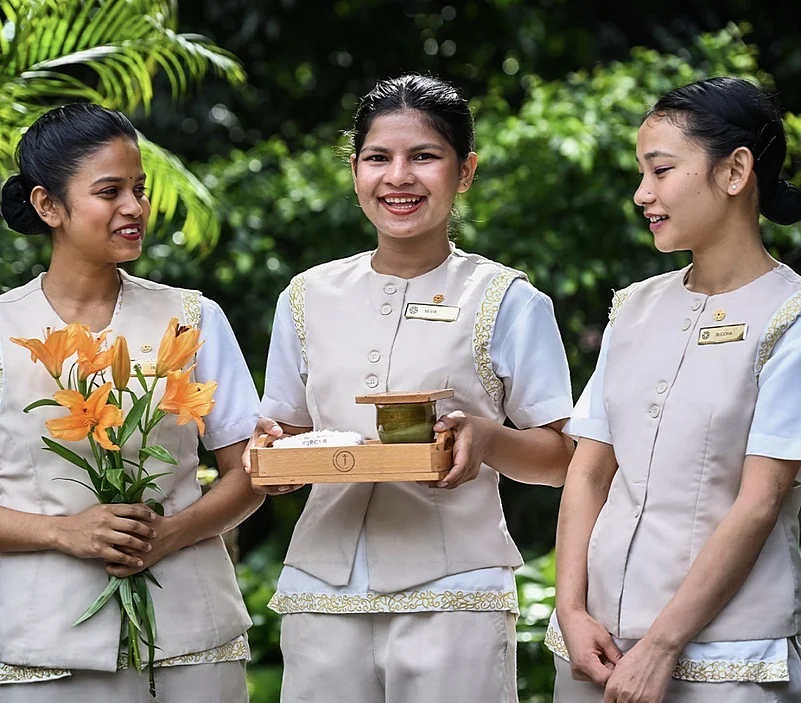
The distinction that matters most in this conversation is not whether a property employs locally, increasingly, they all do, but how deeply that employment goes, and what it's actually trying to do. There is a version of local hiring that is a staffing decision. And there is a version that is, in effect, a development programme.
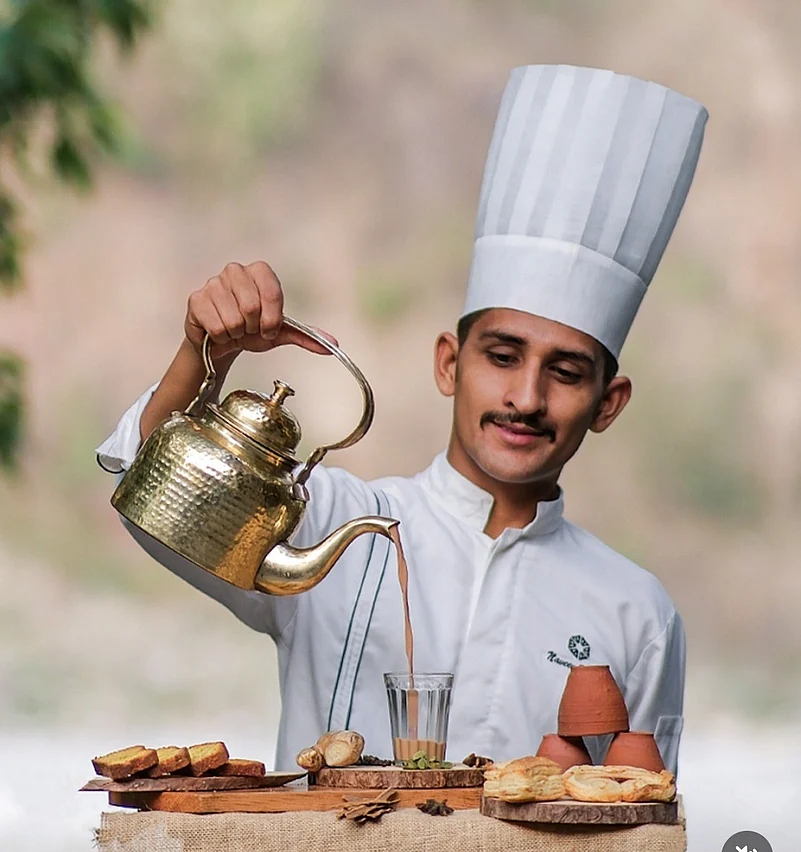
At Taj Corbett, that development has taken shape through people like Champa, a local housewife from the Kumaon region who is now central to the resort's guest experience, not through a formal hospitality role, but through her cooking. Her traditional Kumaoni recipes, prepared using methods passed through her family, give guests a version of the region's food that no commercial kitchen could reconstruct. Then there is Hari Om, from the nearby village of Sundarkhal, who prepares tea for guests using local techniques and flavours, which is a gesture so understated it shouldn't carry the weight it does, and yet it's what guests apparently carry home. IHCL has since formalised this investment through a dedicated skill centre in Nainital, training women and youth from the region in hospitality and creating a pipeline that didn't previously exist. “These journeys represent something much larger than employment,” says Kukreti. “They reflect how wildlife tourism can preserve local traditions, create dignified livelihoods, empower communities, and build pride in regional identity.”
Joseph recalls an encounter that crystallises the same idea from a different geography. During a routine visit to CGH Earth's Visalam property in the Chettinad region of Tamil Nadu, a local woman offered to take him on an evening walk. She was, he says, a very simple lady; she only led walks. By the end of it, when she discovered he was connected to the company, she gave him the full story she would never otherwise have told. She had started as a housekeeping trainee at Spice Village, CGH Earth's property in Kerala, working her way up through the ranks before marrying and relocating to Tamil Nadu. Within a year and a half, she had convinced her mother-in-law that women could work, drawing on the confidence she had built, quietly, in those housekeeping years. When she heard the Visalam property had opened, she reached out. The GM found a way to include her without uprooting her life: he trained her to lead morning and evening walks for guests. “Today, I can earn a living even though I'm at home most of the time,” she told Joseph. “And it has only been possible because of CGH.”
Joseph heard the story and thought about the dozens like it he hadn't happened upon by chance. "The skill that local communities carry is world-class,” he says. “We just need to see the potential in them and work with them.”
The woman whose story Shekhawat tells without naming her sits in the same register. As her income and independence grew, things at home became difficult. Her husband came to the property once. The lodge's position was careful but unwavering. “We said, any help you need, we are all there. But this is your battle; you will have to stand by yourself.” She took some time away. She came back. She is, in Shekhawat's words, invaluable to the team. The lodge didn't solve her problem. It gave her income, structure, colleagues, and the standing to solve it herself.
When Culture Is The Challenge
None of this unfolds without friction. High turnover is a persistent challenge across Indian hospitality, and it erodes training investments in ways that are frustrating and costly. Remote locations add logistics that other properties never have to consider. And the cultural barriers, particularly for women in conservative rural communities, are real and cannot simply be wished away by a hiring policy.
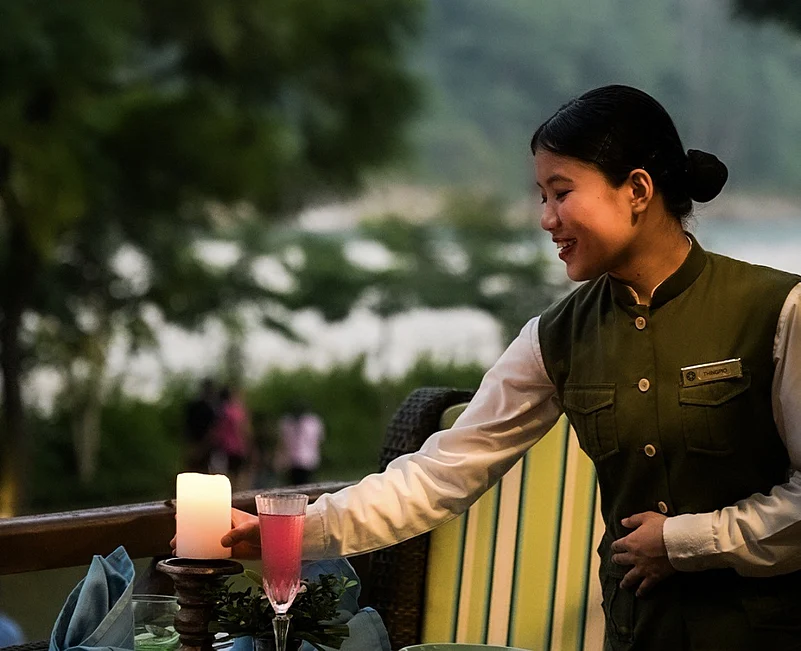
The women on Sariska Lodge's housekeeping team are from villages where tradition means covering your face with a ghoongat in the presence of men. The journey from that to running the housekeeping of an eleven-suite lodge involves a hundred small negotiations with expectation, their own, their families', their communities'. Shekhawat doesn't pretend this is simple. What he describes instead is patience and the creation of an environment where confidence can build in its own time.
The walkie-talkie moment captures this better than any policy statement could. When the lodge's two male staff members were temporarily posted elsewhere, the all-women housekeeping team had to coordinate across the property by radio. At first, there was hesitation; getting on a frequency and speaking with authority was not a small thing for women who had spent their lives being told to speak less, not more. Then one of them simply did it. “She was like—no, we have to talk. We have to tell them.” Shekhawat heard it over the radio and felt, he says, something he hadn't quite anticipated: proud.
CGH Earth faced a version of the same negotiation decades earlier, when it first began hiring women at Spice Village. The resistance came not from the women themselves but from their families. The company's response was practical and unhurried: they invited the families into the property, walked them through how it worked, and showed them how their daughters and sisters would be looked after. One woman who came in through that process rose through the housekeeping ranks, eventually left, and became an entrepreneur. “It was coming out of a shell,” Joseph says, “to really give them the space, show them the confidence.”
At Taj Corbett, “many women who were traditionally confined to household responsibilities,” says Kukreti, “are now becoming active contributors to the tourism economy while also preserving regional traditions.” The skill centre in Nainital is the institutional form of that commitment that is slow-burning by design, because it has to be.
How Local Becomes The Experience
CGH Earth Saha has built its sourcing philosophy around a distinction that most hospitality brands never bother to make. Joseph describes it as the difference between local and hyper-local—local meaning within the district, hyper-local meaning within 25 kilometres of the property itself. A distributor of a regional brand who lives in the city is a different kind of partner than a farmer working land within sight of the property. CGH Earth is currently building a formal impact study to measure both, separating the qualitative and quantitative value of each relationship, so that the community-first model can be strengthened with evidence rather than instinct alone. “How we define local is very important,” Joseph says. “Local means immediate.”
The guest experience, when it is working, becomes something that cannot be assembled from a playbook. “Local experiences are curated based on how we spend time with the community,” says Joseph. “Moving around, talking to people. It is only by immersing ourselves with locals that we develop something, even if it is going to the market, taking a tuk-tuk, walking through the village, or sitting down for a meal in someone's home.”
At Taj Corbett, the local supply chain has become a point of pride: fresh produce from nearby farmers, menus built around regional ingredients, and a retail offering that spotlights homegrown brands including Shunya India, Nirvana Organics, and the state-led House of Himalayas. Kukreti frames the shift in guest expectations in terms that much of the industry is still catching up to. “Luxury today is becoming more minimalistic, culturally rooted, and experience-led rather than only infrastructure-led. Guests no longer remember only the size of a room or the grandeur of a lobby. They remember the local stories they heard, the regional food they tasted, the nature experiences they had, and the emotional connection they felt with the place.”
What The Traveller Walks Into
When a property employs locally with genuine commitment, the guest experience becomes something that cannot be assembled from a playbook. The naturalist who has spent his whole life in this landscape does not acquire knowledge—he has it, in the way you have something you were raised inside. The cook who grew up eating the food of this region does not need to research authenticity. The housekeeper who takes pride in the room she manages, because this place is, in some real sense, hers, brings to it an attention that is closer to care than service.
“We don't tell them to say ‘I hope you enjoyed the food,’” Shekhawat says. What he is building instead is a team trained not in scripts but in standards, people he believes can become some of the finest practitioners in the industry. “When you take guests in and have them interact with the community, they are more respectful,” he adds. “They understand that these are meaningful conversations. And that always stays more.”
The stakes extend well beyond any individual stay. Joseph warns that what gets built when hospitality develops without deep community roots is not just a blander experience; it is a destination slowly emptied of itself. “Wildlife is very important as a reason to visit,” he says, “but if it becomes only about sighting, that is an angle you need to protect against. The cultural aspect of the local community is what you see a big uproar about later, when it is gone.”
The experience is not just richer in the moment; it stays with you, because it was made by people for whom it also meant something. A woman who carries cement becomes a housekeeper, then a team leader. A housewife's Kumaoni recipes become the thing a guest talks about on the flight home. A woman who once had to justify her right to work now leads guests through the landscapes she grew up in, on her own terms.
“When our colleagues go home,” Shekhawat says, “they carry that awareness with them. To their farms, their families, their villages. Someone sees solar panels and the electricity bill drops; they put one kilowatt on their roof. Then two… and the awareness spreads.”
The traveller who walks into a property where this is genuinely happening is not just buying a safari and a comfortable bed. They are, without necessarily knowing it, participating in something that runs considerably deeper than the experience they booked. They are inside a community that has been given something to build, and is building it. And increasingly, it may be the future of wildlife hospitality itself.
FAQs
1. Why are wildlife lodges focusing on local hiring?
Local hiring creates livelihoods, strengthens conservation efforts, and delivers more authentic guest experiences.
2. How does local employment benefit wildlife tourism?
It keeps tourism revenue within communities and builds long-term support for protecting natural habitats.
3. Which wildlife properties are leading this approach in India?
Examples include Sariska Lodge, Taj Safaris, Taj Corbett Resort & Spa, and CGH Earth properties.
4. How does community involvement improve guest experiences?
Guests gain access to local stories, traditions, cuisine, and knowledge that cannot be replicated elsewhere.
5. Is community-led hospitality becoming a luxury travel trend?
Yes. Travellers increasingly value authentic, purpose-driven experiences over traditional notions of luxury.