

Anand Shekhawat drove from Sariska to Delhi in three hours that morning. Door to door—goodbye to Nigel the dog and straight into the city. The detail says a lot about the man: grounded, specific, a little amused by how close the wild actually is to where most of us live.
Shekhawat is the co-founder of Sariska Lodge, a property built in the shadow of the Sariska Tiger Reserve that took nearly a year and a half just to source the wood for. Before that, he spent years as the Regional Director - India, Bhutan & Sri Lanka, and also the Global Head of Sustainability at Aman Resorts.
Before that, he grew up in the forest—his father, Mr RS Shekhawat was in wildlife service as the former Director of Ranthambore National Park, which meant the bush was home, mammals and flora and the specific stillness of undisturbed jungle. 16 years within Aman sharpened that instinct further. Each property taught him something different about how people relate to land. "Sustainability is not a rulebook," he says. "It's how you live. You learn things over time and you adopt them into your life. What shapes you personally is inseparable from what you become professionally in the end."
Building It the Hard Way
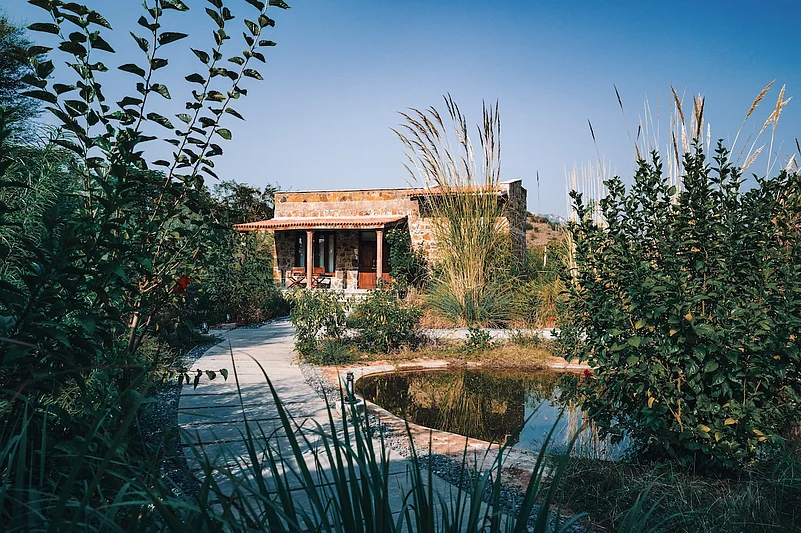

The rules Shekhawat set for construction were almost stubborn in their specificity. Nothing sourced beyond 15 kilometres. No tree to be cut. A part of the team went out through the villages of Shekhawati, talking to people, buying old wood—purana lakdi—lying unused in homes and yards. They engaged local carpenters to work with it on site. Where wood wasn't enough, they used stone and dust. Where possible, they turned to invasive species like eucalyptus and juliflora—plants that had been spreading across Rajasthan for decades and choking out native growth. "We said we had a right to use them in their raw form," he explains. "They were already doing damage, so we just redirected them."
The lodge that came out of this process is, by design, impossible to replicate elsewhere. The material is too specific, the sourcing too local, the decisions too rooted in this particular patch of land. Most hotel companies, Shekhawat points out, go the other way entirely, they build first and then apply green certifications after the fact, or landscape a property in Ranthambore with palm trees and imported Bermuda grass while claiming to honour local context. "You can't say you've integrated the spirit of the place and then plant things that have never grown here," he says, with the patience of someone who has watched this happen too many times. "We planted local grasses, local trees. We removed the invasive species. People come and say it looks like a jungle." He pauses. "Yes. That is exactly what it should look like."
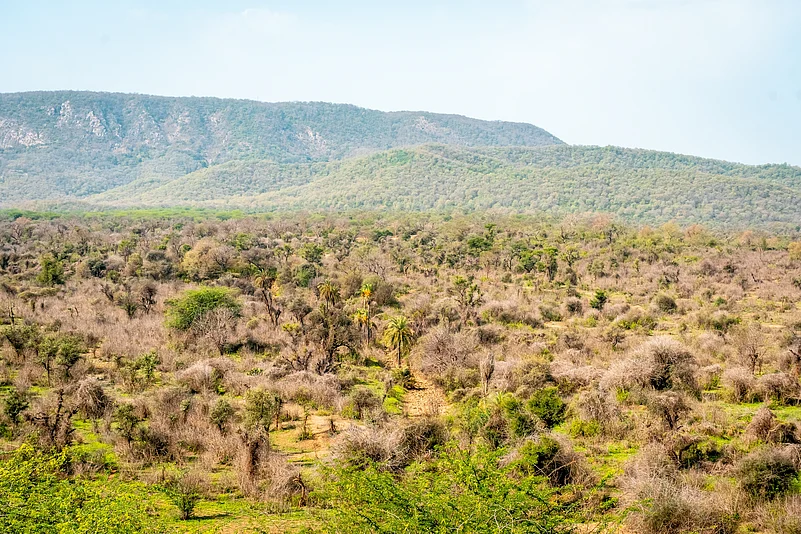
The results show up in the mornings. Leopards visit the property. Deer wander through. Jackals and hyenas have settled in the surrounding scrub. Twenty-seven bird species have been recorded on the grounds. None of this was engineered, it followed naturally from the decision to let the land be what it already was.
The People Are The Point

80 per cent of the staff working at Sariska Lodge today were on site during construction. The shift from building the place to running it was, for Shekhawat, never really a shift at all. It was always the plan.
Kamla Didi used to mix and carry cement during construction. She is now, by Shekhawat's account, one of the finest housekeepers he has come across in his decades in the industry, attentive to which side of the bed a guest prefers, precise about hygiene, warm in a way no training manual produces. There is another colleague whose husband used to trouble her, and once even came to the property looking for her. Things began to shift when she started earning her own income and becoming more independent, something he had not expected. "It was her battle," Shekhawat says. "We just made it clear we were there." She took some time away, eventually returned, and is now an invaluable part of the team.
Then there are the walkie-talkies, a story he tells with visible pride. The housekeeping women, from nearby villages, were too shy to speak on them at first. Some would still put on a ghoonghat while cleaning. When the two male staff members had to be temporarily moved to another property, there was no choice but to step up. "The first time I heard one of them come on, clear and confident, I felt genuinely proud," he says. "They took it on."
This, for Shekhawat, is what sustainability actually looks like up close. Not certifications or carbon offsets, but a woman from a village near Sariska speaking into a walkie-talkie for the first time because the job asked it of her and she decided she was ready. "We are not building SOPs," he says. "We don't tell people to walk up to a table and ask, how was your meal, may I help you, and then the supervisor comes and asks the same thing, and then the manager. We are teaching them to become one of the finest in the hospitality industry."
He is one year into this project, and already thinking about the next stage—horse riding, birding, guiding, English, a genuine sense of ownership over the place. A few of his colleagues, he says, he can already see it in them. They will run lodges of their own one day.
What The Industry Gets Wrong
Shekhawat gets visibly restless when the conversation turns to how the hospitality industry currently uses the word sustainability. "Replacing a plastic straw with a paper straw, not printing your bill, switching to a glass bottle—this is waste management. It is a dot. People put a dot and call it sustainability." The deeper problem, he thinks, is structural. Large hotels assign one person to lead the effort, and that person, however sincere, cannot move anything because sustainability cuts across every department, every procurement decision, every hire. "It is like a religion. If your whole self isn't in it, you will never get there."
The financial case, he argues, makes complacency even harder to justify. Sariska Lodge has seen operating cost reductions of up to 30 per cent. Energy, whether sourced from coal or nuclear, is one of the largest fixed costs in any hotel, and with battery storage technology maturing and lifespans now reaching 12 to 15 years, the economics of generating your own power are changing fast. "The financial case and the environmental case are the same case," he says. "Hotel owners just haven't fully accepted that yet."
On whether luxury and sustainability can genuinely share the same space, he doesn't hesitate. "They are meant to be together. They are exactly one." The purpose of travel has changed, he says. People going to remote destinations are not looking to consume—they want something that feels real. Brands like Soneva and Six Senses have already proved the point commercially. Any property that still treats the two as opposing values is, in his view, working from an outdated map.
If sustainability became non-negotiable tomorrow, he says, city business hotels would struggle the most to survive. They are the furthest from anything genuinely rooted—in land, in community, in the kind of honest sourcing that makes a place worth travelling to. Sariska Lodge, built scooter ride by scooter ride through the villages of Rajasthan, is his argument for what the alternative looks like.
"We haven't just built a hotel," he says. "Everything in it, the wood, stone, and the people, came from within 15 kilometres of where you are sitting. You cannot replicate that anywhere else, and that's the whole idea."
FAQs
1. What is Sariska Lodge known for?
Sariska Lodge is known for its sustainable design, locally sourced materials, and community-led hospitality near Sariska Tiger Reserve.
2. Who is Anand Shekhawat?
Anand Shekhawat is the co-founder of Sariska Lodge and former Regional Director - India, Bhutan & Sri Lanka, and also the Global Head of Sustainability at Aman Resorts.
3. How was Sariska Lodge built sustainably?
The lodge used salvaged wood, local stone, native landscaping, and materials sourced within 15 kilometres of the property.
4. Where is Sariska Lodge located?
Sariska Lodge is located near Sariska Tiger Reserve in Rajasthan, within the Aravalli landscape.
5. What makes Sariska Lodge different from other luxury hotels?
Its focus on local communities, native ecology, and deeply place-based design makes it a unique model for sustainable luxury hospitality.