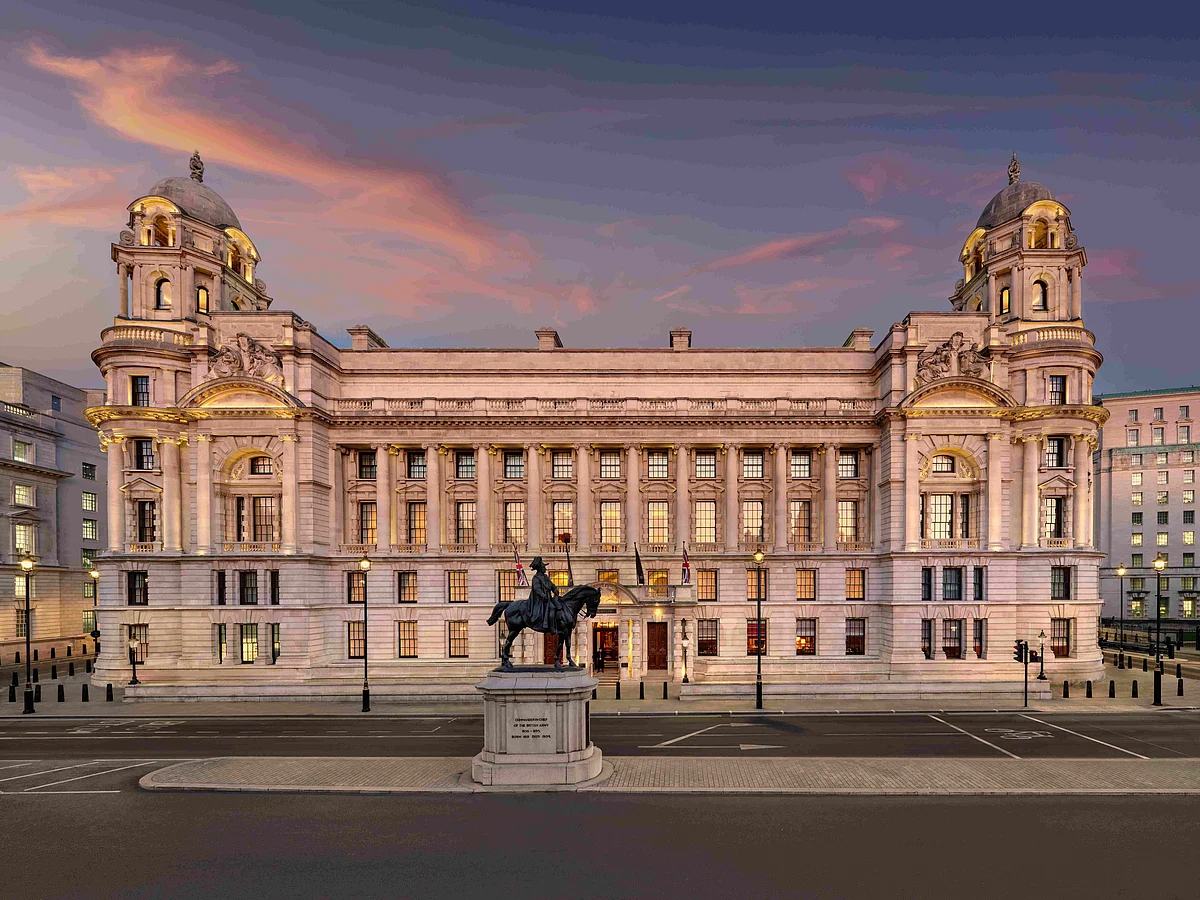
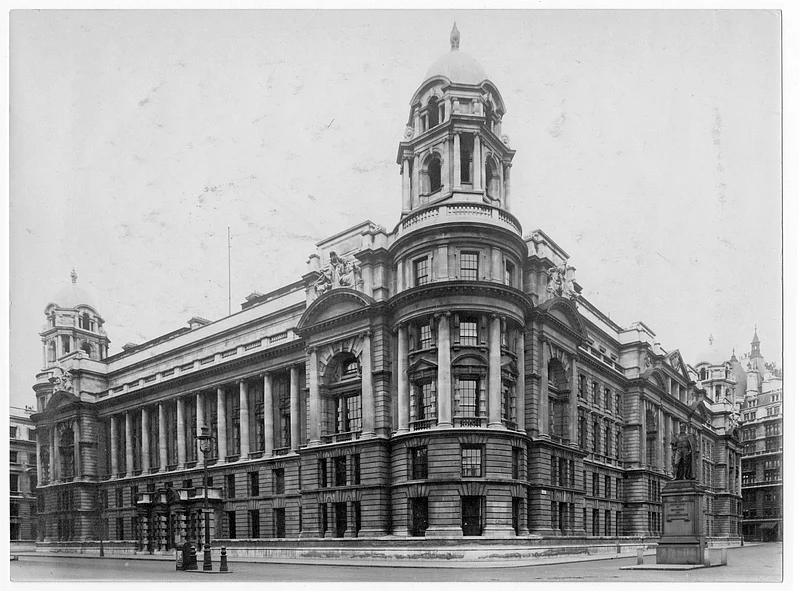
There are grand hotels in London, and then there is The OWO—a building where military strategy, political drama and quiet acts of wartime courage once unfolded behind heavy oak doors. Standing on Whitehall, a short walk from Downing Street, the former Old War Office occupies a singular place in Britain's institutional memory. For decades, it was a place ordinary Londoners and travellers could only admire from the outside, its vast Portland stone façade and four distinctive corner turrets revealing little of the history contained within.
Today, the building has entered a new chapter as Raffles London at The OWO, following one of the most intricate heritage restorations Britain has seen in recent years. Yet beyond its polished new life lies a deeper story—one that stretches from the royal courts of Henry VIII to wartime intelligence, and from Winston Churchill to the women whose work inside its walls was once barely acknowledged.
Where History Passed Through The Corridors
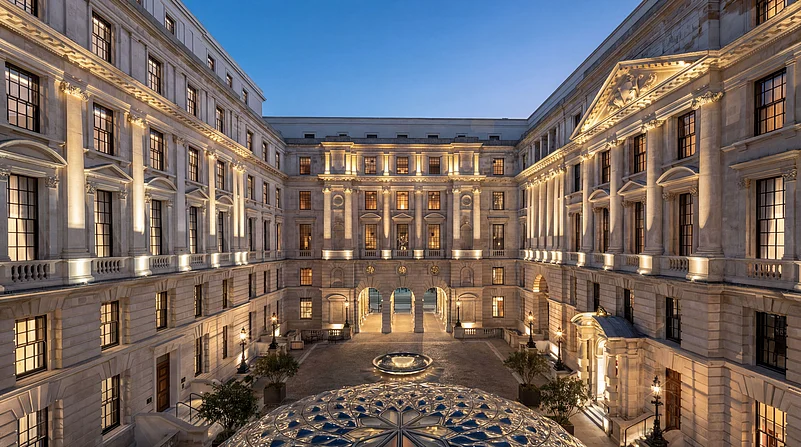

The ground beneath The OWO carries history of its own. The building stands on the former site of Whitehall Palace, once home to monarchs including Henry VIII, meaning that long before generals and spymasters walked these halls, kings did. Completed in 1906, the Old War Office was designed as the administrative nerve centre of the British Army, and was considered one of Europe's most expansive and palatial government buildings of its time, with more than a thousand rooms spread across a vast footprint in the heart of Westminster.
Its corridors became the backdrop for decisions that shaped world events. Winston Churchill held office here. So did Lord Haldane, who transformed the British Army in the years before the First World War. Long before he became a legend of the desert, T. E. Lawrence began his career within these walls. And in 1963, the building found itself at the edges of the Profumo Affair, one of Britain's most seismic political scandals, a reminder that its corridors held secrets well beyond military strategy.
High on its Portland stone façade, allegorical statues by sculptor Alfred Drury stand sentinel, quietly symbolising power and authority. The building's unusual trapezoidal shape, designed to fit an irregular plot, is softened by those four corner turrets, an architectural solution that gives The OWO its distinctive, almost palatial symmetry.
Spies, Bicycles And A Very Famous Fictional Agent
The OWO's connection to secrecy runs deep, and nowhere is that more apparent than in its labyrinthine corridors, which stretch for miles and once formed the arteries of its daily operations. In an era before digital communication, messages were physically carried across the building, sometimes by young messengers navigating the vast hallways on bicycles or trolleys to keep pace with the demands of wartime government.
A discreet side entrance, known simply as the "Spies' Entrance," adds another layer of intrigue. Designed to allow confidential comings and goings, it reinforced the culture of secrecy that once defined the War Office. Today, it serves as a private entrance to the building's residences, a subtle but evocative reminder of a past shaped as much by intelligence as by strategy.
That atmosphere of espionage later seeped into popular culture. Ian Fleming, who worked in naval intelligence, is believed to have drawn inspiration from the world of Whitehall while creating James Bond. The OWO itself has appeared in several Bond films, among them Octopussy, A View to a Kill and Skyfall, blurring the line between its real history and cinematic mythology in a way that few buildings in London can claim.
The Women History Almost Overlooked
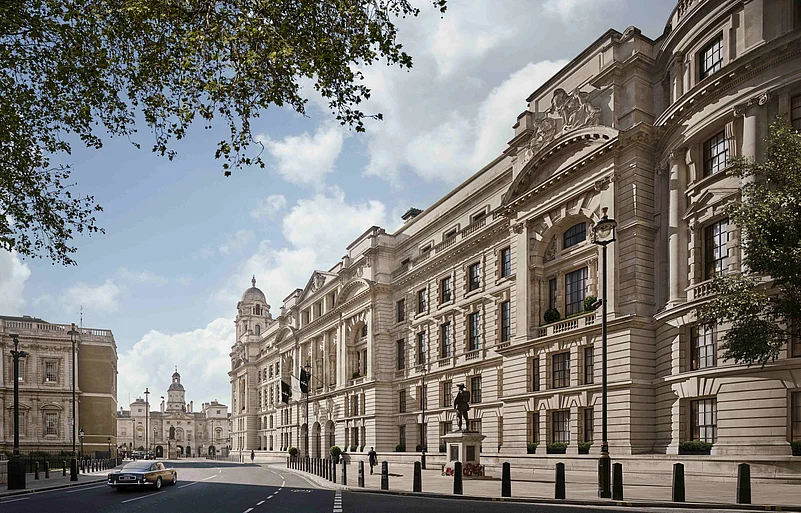
The OWO's transformation into Raffles London began with its acquisition by the Hinduja Group in 2014. Guided by the late Gopichand Parmanand Hinduja, who described the project as his "greatest legacy to London for future generations", the vision was clear: to open a historically inaccessible building to the public for the first time in over a century while preserving every layer of its character. Family members Sanjay and Shalini Hinduja supported the restoration throughout, ensuring the project stayed true to that founding ambition.
What followed was eight years of painstaking work on one of Britain's most complex heritage projects. Restoring a Grade II* listed building of this scale was as much an exercise in restraint as engineering. As restoration teams peeled back decades of institutional modification, the building began to reveal itself: finely detailed oak panelling, marble fireplaces, intricate ironmongery and original stone mosaic floors slowly reappeared beneath layers of wartime adaptation.
One of the most demanding challenges happened below ground. New subterranean spaces, including a spa and leisure facilities, were excavated beneath the existing structure, a precision operation that had to safeguard everything standing above it. Meanwhile, modern comforts such as air-conditioning, digital infrastructure and discreet service systems were woven in almost invisibly, allowing the building to function as a contemporary luxury destination without surrendering its soul.
The grand staircase was restored to become a centrepiece once again. Former offices have been reimagined as hotel suites, allowing guests to inhabit spaces that were once centres of decision-making. Within the residences, original stone mosaic flooring has been retained, and former corridors reinterpreted as striking entrance hallways, subtle reminders of the building's earlier life now woven quietly into its present.
While much of The OWO's story has traditionally centred on political leaders and military figures, some of its most consequential workers were women whose contributions remained largely unacknowledged for decades. During both World Wars, women played a critical role inside the building, handling administration, communications and intelligence, often managing highly sensitive material that kept Britain's wartime operations functioning.
Some would go on to become extraordinary figures in their own right. Christine Granville, one of Britain's most daring wartime operatives, and Vera Atkins, whose work with the Special Operations Executive has since become the subject of lasting historical interest, are among those now more widely recognised. Countless others worked anonymously, their contributions absorbed into a larger machinery that rarely paused to record their names.
The restoration has made space for those stories to be acknowledged. Several heritage suites and interior details now quietly honour the women who once worked within the building, adding another layer of meaning to a place already dense with memory.
That may be what makes The OWO so compelling for the traveller who arrives today. It is not simply a restored landmark or a luxury hotel. It is a building where royal, military, political and social histories converge, where every polished corridor seems to carry a story, and where some of the most fascinating ones were nearly lost altogether.
FAQs
1. What does OWO stand for in London?
OWO stands for Old War Office, the former British government building on Whitehall.
2. Where is The OWO located?
The OWO is located on Whitehall in central London, near Downing Street and Horse Guards Parade.
3. What is The OWO used for now?
The building is now home to Raffles London at The OWO, along with private residences, restaurants and wellness spaces.
4. Why is The OWO historically important?
It served as the administrative headquarters of the British Army and played a key role during both World Wars.
5. What is the connection between The OWO and James Bond?
Ian Fleming is believed to have drawn inspiration from the building's intelligence links, and The OWO appeared in several Bond films.