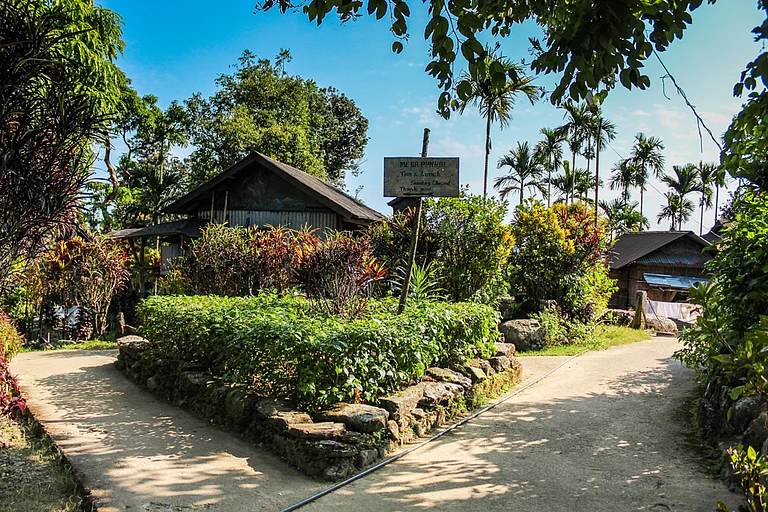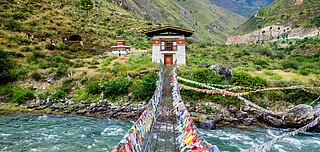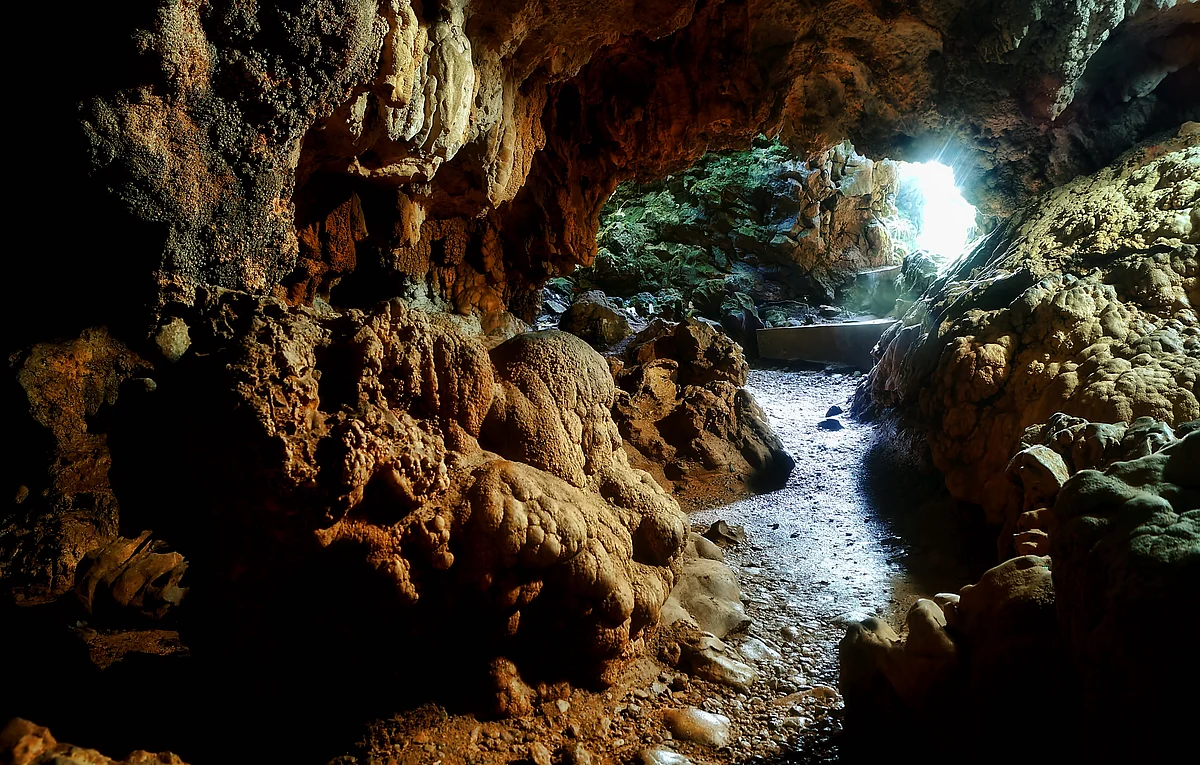
Outside Sohra in Meghalaya’s East Khasi Hills, Mawsmai Cave sits about 6 kilometres from Cherrapunji, cut into limestone that has been shaped slowly over thousands of years by water and time. Inside, narrow passages open into small chambers where stalactites hang like stone icicles and stalagmites rise from the floor in uneven clusters. The walking route is short but constantly shifting in texture and shape, with damp walls, tight bends and sudden openings. A system of carefully placed, eco-friendly lighting runs along the path, and it is this that gives the cave its much-talked-about “glow” — colours bouncing off the wet limestone and crystalline formations, turning the rock into something that seems to shimmer as you move through it.
Inside The Limestone Glow
The “glow” effect: The cave does not produce light of its own. Instead, moisture on the limestone walls and carefully placed coloured spotlights work together, making the rock surfaces shimmer and reflect light in shifting tones.
Rock formations: Along the narrow walkway, the effects of erosion are visible at close range. Stalactites descend from the ceiling in irregular shapes, while stalagmites build up from the ground below, formed drop by drop as mineral-rich water has dripped through the limestone over long stretches of time.
Scale and access: The cave extends to roughly 820 feet (250 metres) in total, though visitors are guided through a clearly marked 150-metre section. The path is lit throughout and relatively easy to follow, making it suitable even for those entering a cave for the first time.

Through The Narrow Passages
The route: The walk through the cave in Meghalaya follows a single direction. Visitors go in through a broad entrance, then the passage narrows in parts, where you have to stoop or edge through tighter gaps before coming out on the other side.
Underfoot conditions: It stays damp inside, with water steadily dripping from the rock overhead. The ground can feel uneven and a bit slippery, so proper shoes with grip are useful for the short walk.
Signs of life: Small patches of moss and algae grow on some surfaces, and you may notice a few insects in the quieter corners. In the tourist section, there are hardly any bats, likely because of the lights and constant movement of visitors.
Why It Stays With Visitors

Inside Mawsmai Cave, the limestone takes on a maze-like quality, shaped by water over long stretches of time into pillars, fissures, and uneven patterns that catch the light as you move. Although the main 150-metre stretch is safe and partly illuminated, it still carries a sense of exploration, with visitors stepping across simple platforms, ducking through low sections and, in the monsoon months, occasionally passing through shallow water on the cave floor. Its appeal also lies in how easily it can be reached, just a short drive of around 6 km from Cherrapunji and within day-trip distance from Shillong. Beyond the main route, the cave remains part of a wider ecosystem, where small cave insects and bats continue to inhabit quieter, less disturbed sections.
Practical Information
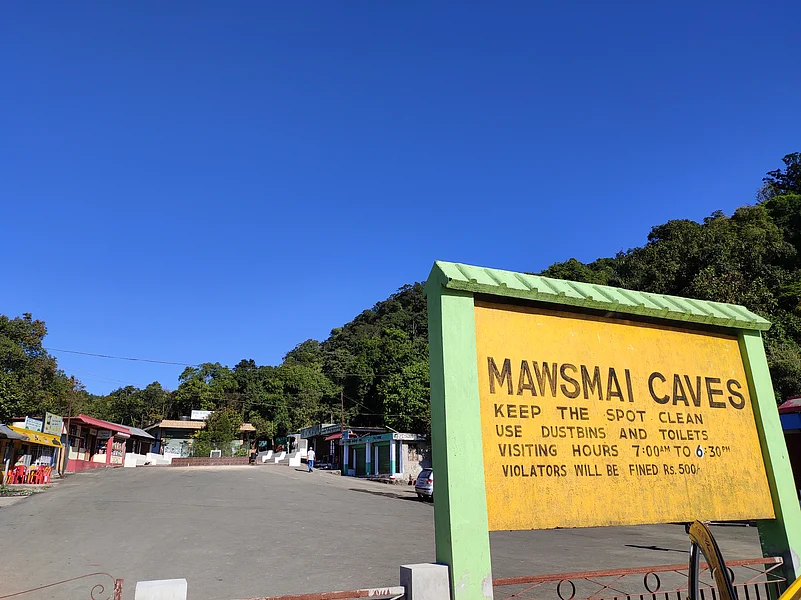
Location: In Meghalaya’s East Khasi Hills, the cave lies around 58 km from Shillong and about 6 km from Sohra (Cherrapunji) market.
Getting there: It is reached by road, with taxis and shared sumos running from Shillong or Cherrapunji. The turn-off comes off the main Sohra hill road.
Entry: A small fee is taken at the gate. Local guides can be hired there if visitors want help through the narrower stretches.
What to wear: The cave floor stays damp and uneven, so shoes with a good grip are useful. Loose, easy-to-move-in clothing helps when bending through tight sections.
Best time to visit: After the monsoon, the surrounding landscape is at its greenest. During the rains, water inside the cave runs more actively, which adds to the experience but also makes it wetter.
Who it suits: It is best avoided by young children, older visitors, and anyone who struggles with confined or narrow spaces.
FAQs
Q1. Is Mawsmai Cave natural or artificial?
The cave is entirely natural, formed from limestone over thousands of years. However, the lighting inside has been added later to help visitors see clearly and highlight the rock formations.
Q2. How long does a visit usually take?
Most visitors spend around 20 to 40 minutes exploring the accessible section of the cave. The walk is short, but people often pause to take in the formations and narrow passageways.
Q3. Is Mawsmai Cave suitable for children?
Children can enter, but they must be closely supervised. Some sections are narrow and the floor can be slippery, so it is better suited to older children rather than very young ones.
Q4. Do you need a guide to explore the cave?
A guide is not mandatory, as the main route is clearly marked and easy to follow. That said, local guides are available at the entrance and can be helpful for first-time visitors.
Q5. Is photography allowed inside the cave?
Yes, photography is permitted. The lighting creates striking effects on the limestone, though some areas are quite dim, so steady hands or phone flash may be useful.