


Journeys worth recounting rarely begin at the point of departure; they begin in the mind’s quiet negotiations with time, memory, and intent. One of mine took shape in Delhi in early March 2026, in the midst of a deeply personal and intellectually resonant gathering—the 70th birthday of Dr Shashi Tharoor. It was during this evening, suffused with conversation and reflection, that a call arrived from Bolpur, my friend Gopika Menon on the other end, gently setting into motion what would become a layered journey across eastern India.
Delhi itself, in those preceding days, revealed its duality with characteristic clarity. It is a city where the political and the personal coexist with ease: days spent catching up with friends, and formal engagements, including a meeting with Congress President Kharge amid the charged backdrop of Kerala’s election. For travellers, Delhi offers more than monuments: an immersion into India’s living political theatre, where history is not archived but actively negotiated.
After a few days that blended companionship with purpose, I travelled eastward to Kolkata, where I joined my friend and former colleague Jayan Jacob at Howrah, even as the city pulsed with political energy on a busy day when Prime Minister Modi was also present at the Maidan to lead the BJP’s state election campaign. Few cities in India reward unhurried attention as richly. Kolkata is not merely historic; it is historically conscious. Its cultural density resides not only in its institutions but in its everyday rhythms.
Kolkata and Bolpur: Cities of Memory and Mindfulness
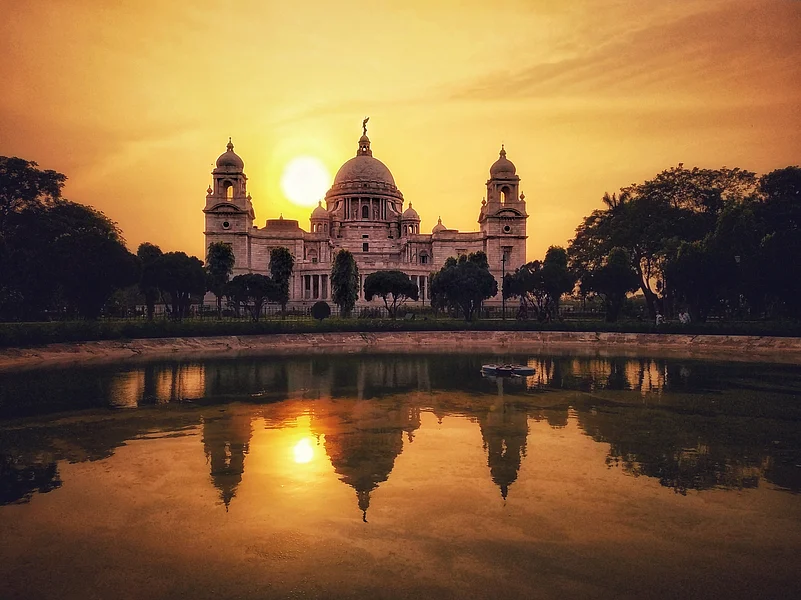
At the Victoria Memorial, imperial grandeur is preserved in curated nostalgia, while Netaji Bhawan offers a compelling counterpoint—an intimate archive of resistance and nationalist fervour. Yet Kolkata’s true vitality resides beyond its landmarks: in the enduring presence of yellow Ambassador taxis, vestiges of a postcolonial urban aesthetic; in the intellectual ferment of College Street, among the world’s largest second-hand book markets; and along the ghats of the Hooghly River, where ritual and routine dissolve into one another at dawn and dusk.
A ride on India’s first metro route, from Esplanade to Netaji Bhavan, joined by my Bihari friend Aditya, who is pursuing a PhD at IISER, added its own kinetic charm: crowded and chaotic, yet quietly emblematic of the city’s layered, stagnant modernity.
Culinarily, the city is both diverse and profound: the kathi roll, arguably one of India’s most ingenious portable creations, finds its origin here, while mishti doi and rosogolla elevate confectionery into cultural identity, complemented by fish-centric Bengali thalis, street-side telebhaja, and the storied coffee houses that once hosted debates shaping modern Indian thought; even as areas like Sonagachi quietly remind one of the city’s layered social realities, where resilience and vulnerability coexist within its dense urban fabric, Kolkata lingers not merely as a destination, but as an enduring sensibility.

An unforeseen episode at Howrah Railway Station, Jayan’s phone being stolen while boarding a chaotic Modi-rally special train, might have unsettled the journey. Instead, he accepted it calmly, registered a complaint, and offered a perspective that it actually stripped away the digital scaffolding that often mediates modern travel. For the next five days, he existed in a state of near-digital abstinence, using my phone only when essential. What emerged was a quieter, more attentive mode of travel: one that privileged presence against distractions.
From Kolkata, we journeyed to Bolpur Shantiniketan, a necessary deceleration both geographic and philosophical. Founded by Rabindranath Tagore, Shantiniketan was envisioned not merely as an educational institution but as a critique of rigid, colonial pedagogy—a space where learning unfolded in dialogue with nature.
Bolpur itself, often overlooked by hurried travellers, rewards patient exploration. The red laterite soil, skies, and the sparse but thoughtful architecture create an environment that feels intentionally uncluttered. The Kopai River, immortalised in Tagore’s writings, meanders gently through the landscape, reinforcing a sense of continuity between literature and geography.
We were received there by our common friend and usual travel companion, Gopika, whose villa exemplified a rare equilibrium: refined yet rooted. Lunch, a millet-based vegetable pulao, was both nourishing and symbolic, echoing a return to indigenous grains and sustainable consumption. Her pet dog added a layer of warmth that no curated hospitality can replicate.
For travellers, Shantiniketan offers more than Tagore’s legacy. The Visva-Bharati campus, seasonal festivals such as Poush Mela and Basanta Utsav, local handicrafts, including batik and kantha work, and the surrounding Santhal villages together create an immersive cultural ecosystem rather than a performative one. It does not overwhelm; it persuades. It recalibrates the traveller’s pace, preparing one for regions where nature, not infrastructure, dictates experience. It was, in that sense, the ideal threshold before entering Meghalaya via Assam. We then travelled from Bolpur to Guwahati overnight by train, a journey that marked both a geographical transition and a quiet anticipation of the landscapes ahead.
Meghalaya: The Geography of Wonder, the Sociology of Grace
From Guwahati, the ascent into Meghalaya is both physical and perceptual. The first encounter with Umiam Lake en route to Shillong, a vast man-made reservoir created in the 1960s, feels almost theatrical, its still waters reflecting the surrounding hills with near-perfect symmetry.
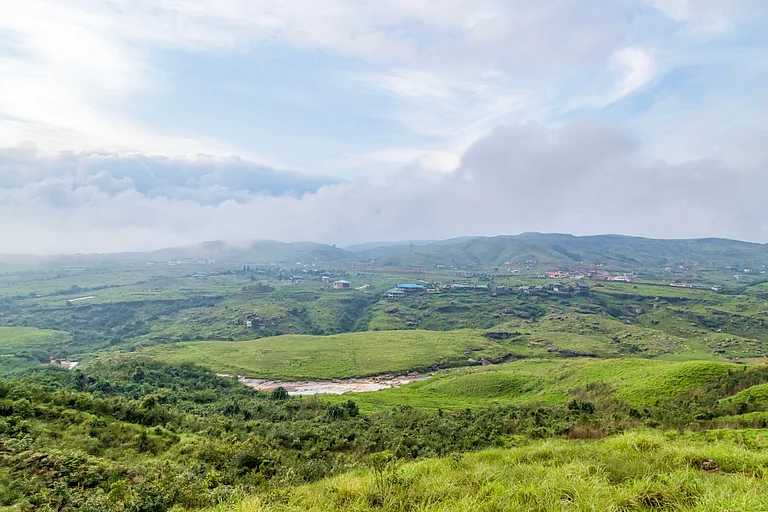
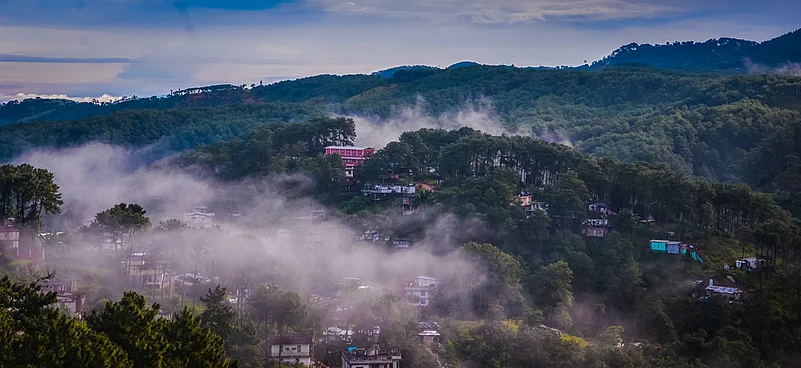
Shillong, the state capital, resists easy categorisation. Often reductively called the “Scotland of the East,” it is, in truth, a distinctly Khasi urban centre: mostly disciplined, musically vibrant, and culturally self-assured. Its café culture, live music scene, and relatively high literacy rates distinguish it from many Indian hill towns. After a night of port-wine leisure, a share-taxi ride, and the next day exploring the police market, we rented two wheelers and extended our journey to Sohra in the East Khasi Hills: once the wettest place on Earth, and still among the highest rainfall regions globally. Yet Sohra is more than a climatic record; it is a geological masterpiece shaped by millennia of rainfall. Valleys plunge dramatically, waterfalls cascade from impossible heights, and mist becomes an ever-present participant in the landscape.
The double-decker living root bridge near Nongriat, by Rainbow Falls, stands as one of the most remarkable examples of indigenous ecological engineering. Crafted over decades by guiding the aerial roots of rubber trees across streams, these bridges embody sustainability in its purest form: functional, regenerative, and deeply integrated with the ecosystem.
The trek to reach them, over 3,000 steps descending into dense forest, tests endurance, but rewards it abundantly. Upon arrival, we found ourselves without cash, fuel, a mobile network, or a charged device. Yet help arrived instinctively: local guides coordinated via walkie-talkies, villagers extended assistance without hesitation. In that moment, Meghalaya revealed not just its landscapes, but its social philosophy: one rooted in trust and reciprocity.
The compelling bamboo trek at Mawryngkhang Trek, where narrow bamboo pathways cling to cliffs, also offers exhilaration and insight into indigenous engineering practices.
The region’s natural repertoire extends far beyond what most itineraries capture. The limestone formations of Mawsmai Cave, the vast subterranean network of Krem Puri, and the dramatic drops of Nohkalikai and Seven Sisters Falls illustrate a terrain shaped by water and time.
Equally significant are lesser-discussed but equally compelling landscapes: the groves of Mawphlang, the expansive Mawkdok Dympep Valley, the David Scott Trek’s colonial-era trail, the Krang Suri and Phe Phe waterfalls with their striking blue pools, and the cave systems of Arwah and Siju. Together, they form a network of experiences that reward visitors.
Villages such as Mawlynnong demonstrate that cleanliness and civic discipline can be culturally embedded rather than administratively enforced. Homes routinely open their doors to travellers for restrooms, meals, or conversation, reflecting a social fabric built on trust.
Food, throughout the journey, remained understated yet memorable. From jadoh to simple rice meals, from red tea to locally brewed rice wines, the cuisine prioritises nourishment over spectacle. Even the smallest roadside establishments offer meals that are economical, fresh, and deeply satisfying—an important note for travellers seeking authenticity.
Notably, Meghalaya also lends itself to a new travel paradigm that integrates work and exploration. With early mornings and disciplined scheduling, my friends managed their remote work commitments without compromising the journey, illustrating the viability of slow, extended travel in the region.
A Journey Within: Tracing Memory Across Generations
Amid the scenic abundance, our journey carried a quieter, deeply personal purpose. Jayan’s grandfather, a soldier in the 509 ASC Battalion of the Indian Army, had been stationed in Shillong in the 1960s. He passed away in 1965, in his early twenties, at a military hospital, and was buried there. The family received the news only weeks later; his daughter—Jayan’s mother—was just a year old. For decades, the site remained unvisited, the story incomplete.
This journey thus became an act of retrieval.
With the guidance of Prabhula Kumar, a personnel from Thiruvananthapuram serving with the Assam Rifles, we navigated military channels to trace records. My revered friend, Major (Retd.) Aimol from Guwahati, whom I met first during a Sevagram visit, played a pivotal role, connecting us with officers and helping reconstruct fragments of the past. Through him, we were introduced to Major Adithya, currently serving with the 509 ASC Battalion, now stationed in Meerut, who provided crucial leads regarding archival records.
We located the hospital, once designated as 2 Section 151 General Hospital, now upgraded to a Base Hospital in Guwahati, where Jayan’s grandfather had been treated. The search for records continues, but the journey itself offered something profound: a sense of reconnection.
In Meghalaya, amid its living root bridges, structures grown patiently over generations, we found an enduring metaphor. Memory, like those roots, may take time to surface, but with care and persistence, it can bridge even the widest gaps of time.
Return: Assam, the Brahmaputra, and the Meaning of Completion
After completing our journey through Meghalaya, we returned to Assam: a transition that felt less like a departure and more like continuity.
In Guwahati, we visited the revered Maa Kamakhya Temple (on the day of Kumari Puja during the Navratri fest), where spirituality is expressed through a deeply symbolic engagement with the divine feminine. Its rituals, often misunderstood, are rooted in ancient philosophical traditions that integrate nature, fertility, and cosmic balance.
We were hosted by my gracious friend Bagmita Borthakur, whose warmth and hospitality offered a fitting conclusion to the journey. Evenings unfolded over traditional Assamese meals, sweets, and some of the finest tea the region is famed for—each element reinforcing the region’s cultural richness.
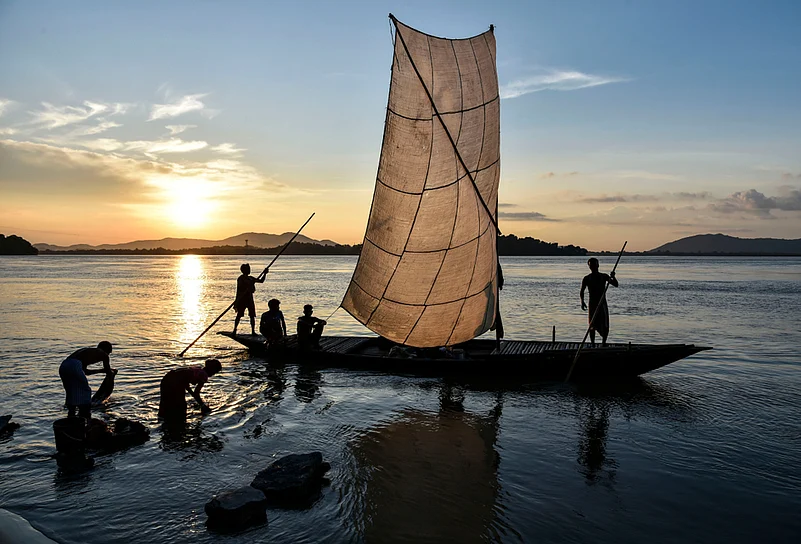
The Brahmaputra River flowed through the city with quiet authority: broad, majestic, and ancient. To sit by its banks is to confront scale—not just geographical, but historical as well.
Beyond Itineraries
Meghalaya is often reduced to a checklist—Shillong, Sohra, Mawlynnong, Dawki. Yet such lists capture only its surface. Its true essence lies in the unnamed waterfalls that emerge after rain, in the unplanned kindness of strangers, and in communities that have mastered coexistence with nature without reducing it to rhetoric. Beyond the familiar routes, it is in offbeat locations and remote villages that Meghalaya’s deeper character unfolds—through its indigenous Khasi, Jaintia, and Garo cultures, oral histories, and living traditions that continue to shape the region’s identity with quiet resilience. It offers both inspiration and instruction; demonstrates that sustainability is a lived practice; that hospitality need not be commodified; and that travel, when undertaken with humility, can become an act of learning rather than consumption.
For us, it was also a journey of friendship—tested, deepened, and quietly affirmed—and a journey of memory, as we sought to reconnect with a past long left unexplored.
One leaves Meghalaya, but not entirely. Its clouds linger—in thought, in memory, and in that subtle recalibration of what it means to travel, not widely, but well.
Amal Chandra is an Indian author, policy analyst and columnist. His debut book, The Essential (2023), was launched by Dr Shashi Tharoor.