


The god's own country is also beauty's own adobe. Brimming with lush greenery,emerald green waters, and beautiful arts, Kerala is a chasm that leads to an unimaginably magical world. The charm of nature may sway you at first glance, but the state's diverse art forms imbue colour and spirit.
Therefore, to truly explore Kerala, you must truly experience the eternal universe of Kerala's classical, ritual and folk arts&ndashespecially Kutiyattam and Mudiyettu, which have been recognised by UNESCO as 'Intangible Cultural Heritage. Both these art forms gloriously celebrate the state's customs and traditions through their unique musical tales, expressions, costumes, and gesture.
Art of Natya Sastra
Based on Sage Bharatha's treatise Natya Sastra, Kuttiyattam is Kerala's oldest theatrical art form&ndashsaid to have originated two millennia ago. This ancient dance form combines the elegance of classical Sanskritic plays with Kerala's vibrant local traditions while continuing to adapt with time. Therefore, even though the performance of Sanskrit plays has become obscure, the theatre tradition continues to thrive&ndashnot just in India but globally, especially after it was declared as one of the 'Masterpieces of the Oral and Intangible Heritage of Humanity' by UNESCO. Even though Kuttiyatam draws extensively from Natya Sastra for its elements and aesthetics, it also brings its distinctive character developed over centuries of practice.
Scenes From Kutiyattam
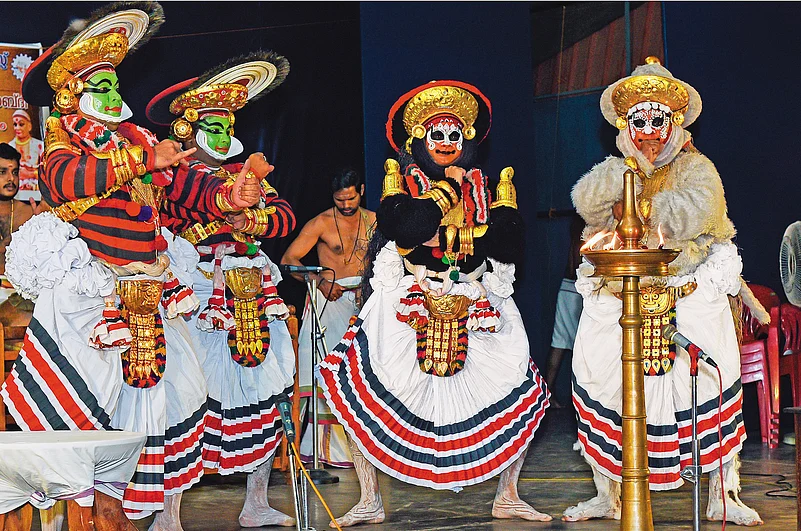

Like every ancient performance art, Kutiyattam too comes with rules and traditions that the performers follow. For instance, only male members of the Chakkiyar community and female members of the Nangiyar community perform this sacred art. These performances are always held in temple premises women play the cymbal while reciting verses in Sanskrit and the Nambiars play the Mizhavu (a large copper drum).
The performances draw from the elaborate themes in India's ancient mythology, where the character of the Vidushaka plays a prominent
part as a compatriot to the hero and a harbinger of change and criticism. In Thrissur's Vadakumnatha temple and Irinjalakudda's Koodalmanikyam temple, Kutiyattam performances are held regularly for tourists from all over the world.
Goddess Kaali's Triumph
Another revered ritual dance form of Kerala recognised by UNESCO as one of the 'Intangible Cultural Heritage of Humanity', Mudiyettu illustrates the battle between goddess Kaali and demon Darika through impactful music and movements. This ancient art form is popularly performed in the Bhadrakali temples of the Kottayam and Ernakulam districts. The heavily- charged dance that depicts goddess Kaali's triumph over the demon by slaying him is ideally performed at night during the months of Meenam (from mid-March to mid-April) as per the Malayalam calendar.
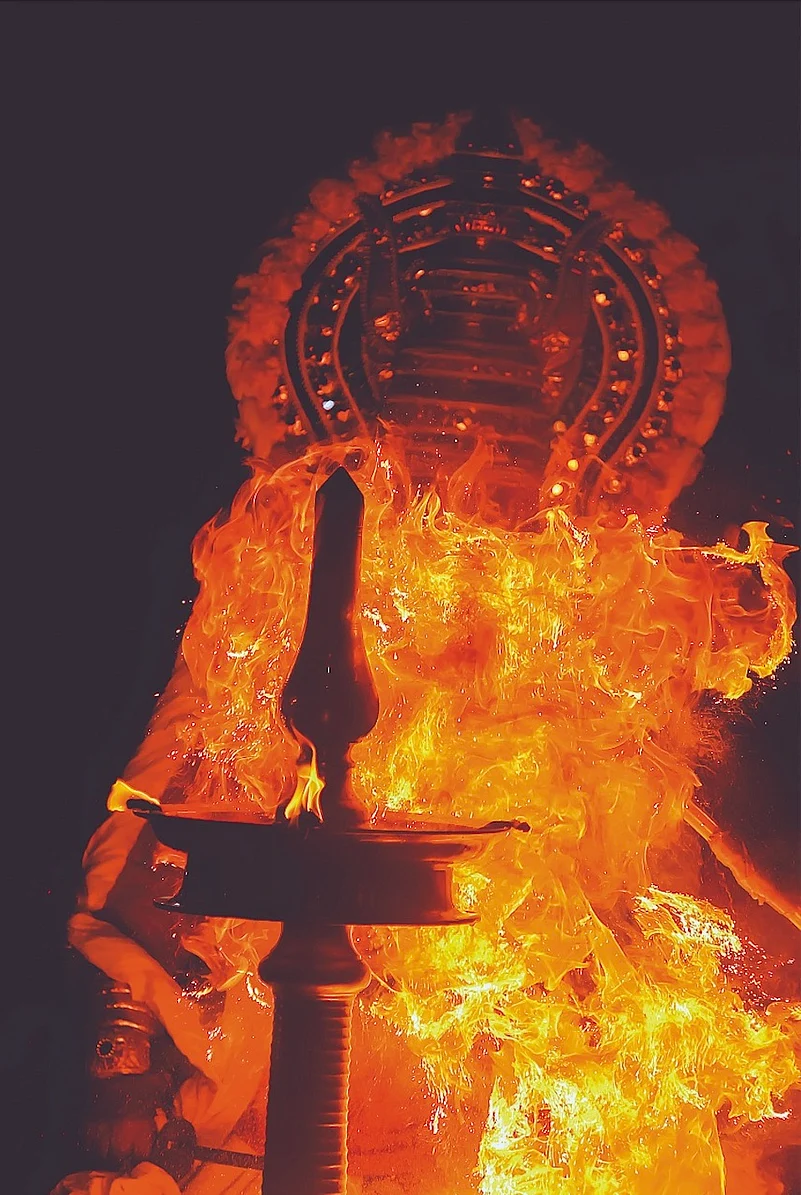
The Mudiyettu Performance
Before the main act begins, the ritual of Kalamezhuthu is performed, where Kaali's colourful portrait is drawn inside the temple to evoke her spirit. This is followed by Kalam pooja, in which the picture is worshipped. These elaborate rituals are concluded by erasing the portrait and singing melodic hymns. This then sets the stage for the performance to begin.
In Mudiyettu, there are seven main characters&ndash goddess Bhadrakali, Darika, lord Shiva, Narada the sage, Dhanavendran, Koyimbadan, and Kooli. The performers, adorning colourful costumes and vibrant make-up, recite the story as a musical while enacting every scene with unmatched intensity. Although most of the scenes are fuelled with rage and fury, they are also marked by subtle moments of humour and moral and social commentary, distinguishing it as a multi-faceted and unique art form.
Even though both Kudiyattam and Mudiyettu date back centuries ago, their prominence continues to reign over Kerala's cultural map and, essentially, India's.


