

In much of our conversations, we speak of winter as the best time to travel anywhere in India. The weather is just right. The rest of the year, the plains of India are mostly hot and humid. Deterrents to tourists, but then ones keen to travel would surely find some place and time to heal, to refresh, to explore. That is what I did for two consecutive years during the monsoon months. There is another thing that links both the places, they are "offbeat."
To someone who has always lived in Kolkata, Odisha conjures up the image of Puri and its beautiful beaches. It was a pleasure, therefore, to find out about a much lesser-known part of the state. Keonjhar, also known as Kendujhar, is a town in the Kendujhar District and its administrative headquarters. With the rains for company, Keonjhar proved to be a delight. Strewn across the area are beautiful waterfalls with names like Sanaghagra and Badaghagra. This land of waterfalls is one that fills the senses.


None of the waterfalls we planned to see is in Keonjhar town, and seeing them involved car journeys. About 50 kilometres from Keonjhar town, Khandadhar is the 9th-highest waterfall in India and is located in Nandapani, in the Sundargarh district of Odisha. Our driver told us that the word khanda means “sword” and that the falls are so named because they plunge straight down from a great height, like a sword. One has to climb a flight of 500 steps, then make a short descent to see its full splendour.
The Waterfalls Of Keonjhar
On our way to the next destination, we stopped at a local tea shop. The vadas looked nice, as did a local semolina sweet. We decided to let our palates do the work. Our next destination was Bhimkund, where the waters of the Baitarani River create a magical effect with the rocks. Located in the Keonjhar district, Bhimkund, locals believe, is where the Bheema, the Pandava, was supposed to have hit the ground with his mace, creating this majestic spectacle of water and rocks. Bhimkund is a natural reservoir that, as it courses through the rocks, creates two waterfalls, Sanakunda and Badakunda. A watchtower has been built for visitors to climb to a panoramic view of the area. The rock forms, the water flowing, dividing into two sections and coursing ahead is a sight to behold.

A drive of over one and a half hours took us to the Gundichaghagi waterfalls, a cascade as the Musada river tumbles over rocks. The waterfalls stretched across the rocky riverbed, requiring visitors to wander around the terrain to experience them from different angles, each revealing a distinct view. As the sun began to set, the sky's changing colours only heightened the landscape’s beauty. A favourite picnic spot among locals, the area carried an easy, unhurried charm.
Day two brought more waterfalls, this time closer to Keonjhar town — Badaghagra, Sanaghaghra, and Handibhanaga. Each possessed a character of its own: a different rhythm in the rush of water, a different interplay of spray and mist. The greens of the surrounding forests, the earthy browns of the rocks and the clear blue sky came together to create a landscape that felt both dramatic and serene.
Then I Visited Muruguma
Cut to a year later, a few photographs that popped up in a WhatsApp group piqued my interest. These photographs had been sent by a friend who was travelling with her colleagues to Muruguma in West Bengal. The usual idea of Purulia district, where Muruguma is located, is that it is arid and dry, with the spring season coloured brilliantly by the “flame of the forest.” These photographs showed a different tale.
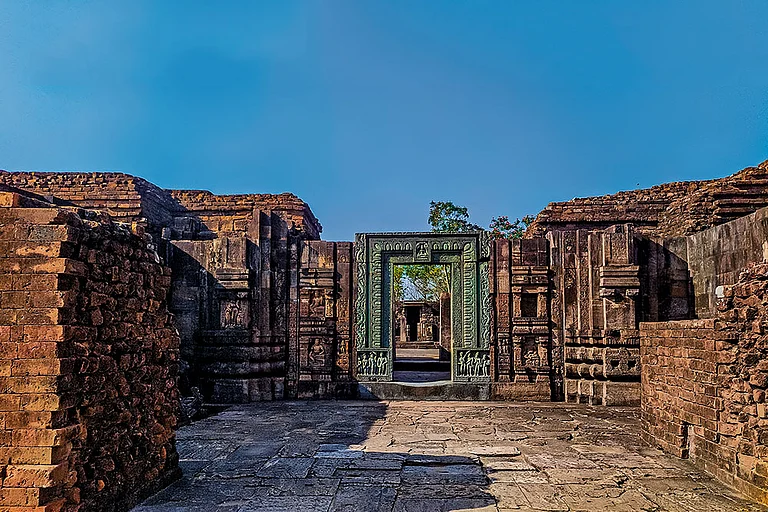
On the way from Adra station to Murugama, the car made its first stop at Deulghata, tucked inside the village of Jaipur Boram, near the Kangsabati River. Here are seen ruins of brick temples dating to the 11th and 12th centuries, possibly Jain temples. What remains of the temples reveals the majesty of what might have been. During the local Tusu festival, several people flocked to the area.
Murugama village is located in the foothills of the Ayodhya Hills in Purulia and extends into the Chotanagpur Plateau. Close by is the Murugama Dam, constructed on the Saharajhore River, a tributary of the Kangsabati River. With the dam and the hills surrounding us, we move ahead, crossing the small village of Murugama before reaching our place of stay at the foot of the hills.

What To See In Muruguma
Our first destination was the Machkanda Falls, which can be viewed from the hills opposite after a short hike down to a rocky ledge offering panoramic views of the hills and distant waterfalls. The walk takes one through dense greenery, and our driver doubles up as a guide. Along the way, the car passes small villages, most of them Santhal settlements, where one sees mud houses adorned with wall patterns and locals busy at work. It was Karam Puja season, and in some villages, we saw people carrying green branches for the rituals.
Our next halt was a government-built watchtower, seemingly in the middle of nowhere. A climb to the top reveals panoramic views of the landscape, with Khairabera Lake visible in the distance. Soon, we reach the Khairabera Dam and the lake — a natural water body surrounded by hills and dense greenery. There is a sense of calm as we walk across the embankment and along the dam.

The car hits the road again, and the next stop is Pakhi Pahar. This is Murraburru Hill, about 800 metres high, whose rocks have become the canvas of artist Chitta Dey and his team, who sculpted images of birds onto the stone, giving the place its name. Women from nearby villages work as guides, leading travellers and hikers through the woods to see the artworks. The guide charges are fixed, and whatever is earned in a day is divided equally among all the women. “There is not much work here,” our guide tells us. “In winter, more tourists come in; otherwise, things remain lean.” Barefoot, she walks into the forest while we follow her through the trails as she points out the sculptures.
Charida village was our next halt for the day. Famously known as the Mask Village, or Mukhosh Gram, it has small shops lining both sides of the road selling masks. One can watch artisans at work, crafting and painting them by hand. Made of papier-mâché, these masks are traditionally used in Chau dance performances, though today smaller versions are also sold as decorative artefacts for homes.
As dusk settles, the jeep resumes its journey back to Murugama. The colours of the setting sun add another layer of beauty to the landscape. By the time we reach the resort, darkness has fallen, and a partly cloudy sky reveals a few stars peeping through. The only sounds are those of crickets and cicadas, along with the gentle murmur of a nearby stream.
The Waters In Muruguma
Dawn brings with it a new set of sounds — the tinkling of bells and the mooing of cattle. Our second day of exploration begins with a journey to Marble Lake. Once an open-pit mine, the stones extracted here were used to construct the region’s Upper Dam and Lower Dam. Both dams are worth a visit. The drive from the Lower Dam to the Upper Dam is particularly fascinating, offering sweeping views of the valley.

Two waterfalls in the area, Bamni and Turga, remind me of those in Keonjhar. A drive to the top of the Ayodhya Hills is equally scenic. On the way back to Murugama lies the Ukumburra View Point. A short hike through rocky, green terrain leads to the vantage point, from which the landscape unfolds like a picture postcard — hills all around, the vast Murugama Lake below, and dense greenery stretching into the distance.
Each of these “offbeat” places is a reminder of the wonders tucked away in remote corners, waiting to be explored. Their charm, especially during the rains, stands in stark contrast to the difficult realities of the local communities who call these landscapes home.
Nishi Pulugurtha is an academic, author, poet, editor, and translator.
FAQs
1. Which are the best offbeat monsoon destinations in eastern India?
Keonjhar in Odisha and Muruguma in West Bengal are among the best offbeat monsoon destinations known for waterfalls, lakes, forests and village landscapes.
2. What can travellers see in Keonjhar during the monsoon?
Keonjhar offers waterfalls such as Khandadhar, Gundichaghagi, Badaghagra and Sanaghagra, along with scenic drives, forests and river landscapes.
3. Why is Muruguma popular during the rains?
Muruguma becomes lush and green during the monsoon, with scenic spots like Ayodhya Hills, Khairabera Lake, Pakhi Pahar and nearby waterfalls drawing travellers.
4. What is Pakhi Pahar in Purulia?
Pakhi Pahar is a hill in Purulia featuring large bird sculptures carved into rock faces by artist Chitta Dey and local artisans.
5. Is monsoon a good time for offbeat travel in India?
Yes, monsoon travel offers greener landscapes, flowing waterfalls and fewer crowds, especially in lesser-known destinations across eastern India.