

Imagine waking up in India, walking across your house for breakfast and finding yourself in Myanmar.
That is the kind of geographical absurdity that makes Longwa, a remote village in Nagaland’s Mon district, one of India’s most intriguing border settlements. Here, the international boundary does not simply run past homes and fields. It cuts through the village itself and famously passes through the traditional residence of the Konyak Angh, the hereditary chief.
The house has become one of Longwa’s most photographed curiosities, with travellers eager to stand on either side of the international border without stepping onto a road or crossing a checkpoint. But the story behind it is considerably older and more complicated than a quirky border fact.
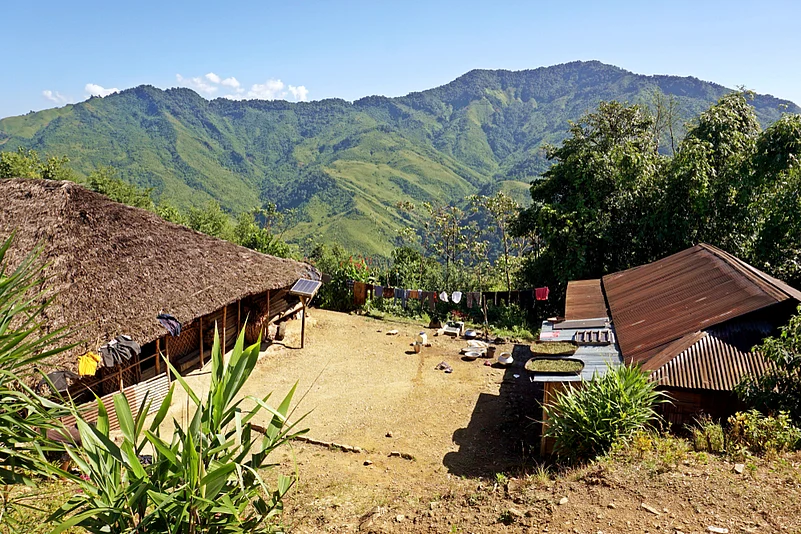

Longwa belongs to the Konyak Nagas, whose traditional homeland stretches across present-day Nagaland and Myanmar. Their villages, kinship networks and systems of customary authority existed long before the modern international boundary was drawn across the hills.
That is why, in Longwa, the map can sometimes seem to have arrived after the people did.
A House That Straddles Two Countries
The Angh’s residence is the village’s most famous example of this peculiar geography. The international boundary passes through the property, leaving parts of the traditional house on either side.
Exactly which rooms fall in which country has been described differently in various accounts over the years. The enduring detail is simpler: the Angh’s home physically straddles India and Myanmar.

And this is not some abandoned structure preserved as a tourist oddity. It is part of a living village and remains associated with the traditional institution of the Konyak Angh.
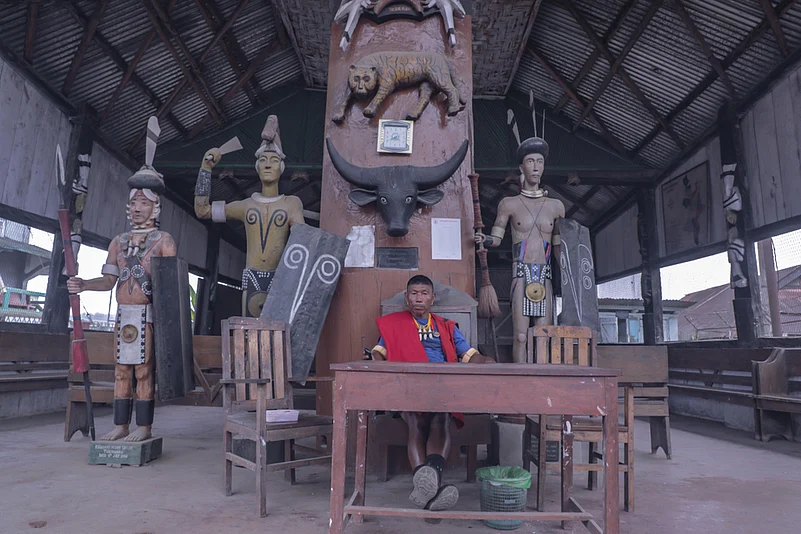
The Angh is a hereditary chief whose customary influence historically extended across several Konyak villages. Longwa’s present-day Angh, Tonyei Phawang, belongs to a line of chiefs who have inherited this traditional authority.

The house itself reflects that history. Its significance comes less from architectural novelty than from what its location says about Longwa: a political boundary has been drawn through a community whose social geography was already established.
Longwa village is divided by the India-Myanmar border, with families and community spaces existing on both sides. The village council has said that the boundary was demarcated during the India-Myanmar survey of 1970-71.
For visitors, this can make the village feel almost surreal. A house, a field or a family connection that seems perfectly ordinary from a local perspective can acquire an entirely different meaning when viewed on a political map.
So, Can You Actually Walk Into Myanmar From The House?
This is where the Instagram version of Longwa needs a reality check.
You may have seen photographs of travellers standing with one foot in India and another in Myanmar, or stories claiming that the Angh can have breakfast in one country and sleep in another. The imagery is irresistible, but it should not be confused with an unrestricted right to cross the international border.
India has tightened its border controls with Myanmar in recent years. In 2024, the Union government announced that the Free Movement Regime along the India-Myanmar border would be scrapped and that movement would be subject to tighter regulation.
For people living in border communities such as Longwa, this is far more consequential than it is for a visitor chasing an unusual photograph. The Konyak community has historically maintained family, social and economic links across the border. Tighter restrictions can therefore affect everyday movement between communities that regard the boundary as a relatively recent division.
Nagaland government information currently states that movement across the border is regulated through designated crossing points and Border Passes issued by the Assam Rifles. The rules allow permitted movement within a specified distance of the international boundary for a limited period.
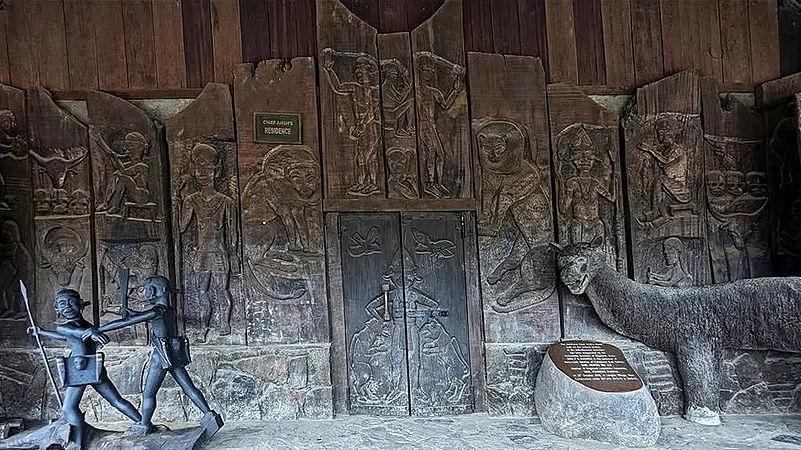
In other words, do not treat the Angh’s house as a shortcut into Myanmar.
The border may pass through the building, but immigration rules still exist.
Getting To Longwa
Getting to Longwa is part of the adventure. The village lies around 40 km from Mon town, deep in Nagaland’s eastern frontier. The journey involves winding mountain roads, and the remoteness is precisely what has helped preserve much of the character that makes the region so compelling.
.jpg?w=801&auto=format%2Ccompress&fit=max&format=webp&dpr=1.0)
For Indian travellers entering Nagaland, an Inner Line Permit is required. The state government currently provides an online application system for tourists, with the tourist ILP valid for 30 days.
Foreign travellers should check the latest entry and Protected Area Permit requirements before planning a trip, particularly because Longwa is directly on an international frontier and regulations can change.
Once in Longwa, arrange your visit locally rather than arriving with the expectation that you can freely explore the border. A local guide or village contact can also help you understand the Konyak traditions and the significance of the Angh's residence, instead of reducing the place to a photo opportunity.
And there is plenty to see beyond the famous house. Longwa is known for Konyak culture, traditional village life, wood carving and remnants of an older headhunting-era history. The wider Mon region has a striking landscape of forested hills and remote settlements, making the journey as interesting as the destination.
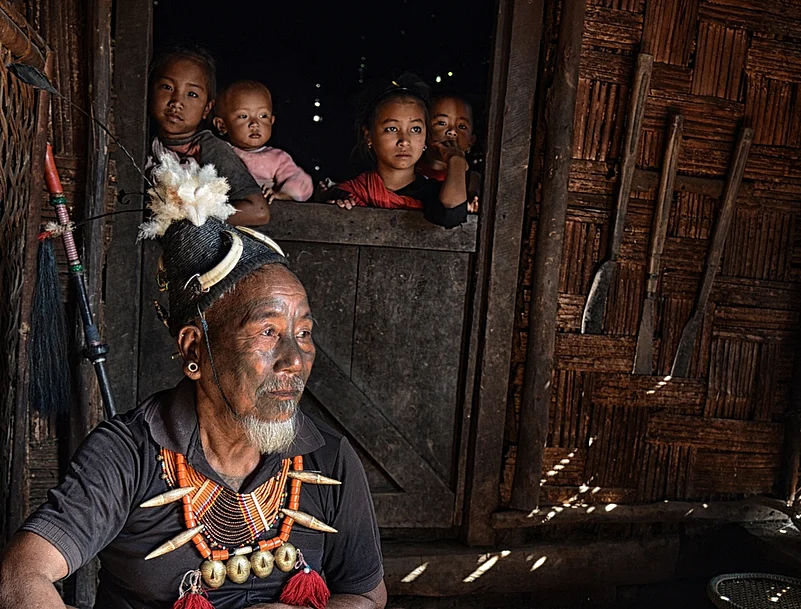
The house in Longwa is unusual because a line on a map runs through it. But that is only the beginning of the story. Stand there, and the border looks almost absurdly simple: India on one side, Myanmar on the other.
The history underneath it is anything but.
FAQs
1. Where is Longwa village located?
Longwa is a remote village in Mon district in eastern Nagaland, close to the India-Myanmar international border and home to the Konyak Naga community.
2. Is there a house in Longwa divided between India and Myanmar?
Yes. The international boundary passes through the traditional residence associated with the Konyak Angh, meaning the property physically straddles India and Myanmar.
3. Can tourists cross into Myanmar from Longwa?
The presence of the border inside the village does not mean tourists can freely cross into Myanmar. Cross-border movement is regulated, and travellers must follow the applicable immigration and border-control requirements.
4. Do Indians need a permit to visit Longwa?
Indian travellers entering Nagaland require an Inner Line Permit. Visitors heading to Longwa should also check the latest local border regulations and movement requirements before travelling.
5. Who is the Angh of Longwa?
The Angh is the hereditary traditional chief of the Konyak community. Longwa's Angh is associated with the village's customary leadership, and his residence is the settlement's most famous border landmark.