

A boy returns from the new village and quietly offers his father a piece of fruit. His father doesn’t take it, and the offering goes unanswered. For Theja Rio, a filmmaker from Nagaland’s Kohima, this is one of the most telling moments in “Angh”, his feature directorial debut. “I find it a very beautiful and painful moment because so little is said, yet so much is communicated,” Rio says. The boy is Amao, and his father, Anghba, is the last chief of an abandoned Konyak village, where he lives with his ailing wife. Their isolation is disrupted by the arrival of an American Baptist missionary, played by Scottish actor Douglas Henshall.
As Christianity spreads, Anghba and his son struggle to hold on to their ancestral faith. Their silences, he explains, reflect the widening emotional distance between father and son as their world changes. “For me, it reflects how relationships can begin to fracture not through open conflict, but through the small, quiet moments when two people can no longer reach each other,” he says.
When “Angh” won the Platform Prize at the 2026 Toronto International Film Festival, a story rooted in Nagaland’s Konyak community suddenly travelled far beyond the hills where it was made. The film became the first Indian film to win TIFF’s Platform competition. Though it was not India’s official Oscar entry, the international recognition could potentially pave a route to consideration through the Academy’s eligibility process for films outside official submissions. Theja Rio grew up in Nagaland with no cinemas before moving to Delhi and training at the National Film and Television School in the UK. His earlier shorts, “Angh” (2021) and “Ade (On a Sunday)” (2024), received festival recognition. Both were produced by Nancy Nisa Beso, his longtime collaborator, who has known him since he was seven.
A World In Between


The title offers the first clue to Rio’s world. Angh is the Konyak word for chief, a figure whose authority carries cultural and historical significance within the community. The Konyaks are one of Nagaland's 17 major tribes, centred in the eastern district of Mon. In the Konyak world of the 1960s, traditional beliefs, customs and social systems were encountering modernity, Christianity and new political realities. “Globally, it was the decade of the Beatles, the space race and enormous social transformation. But in this small corner of the world, a different kind of revolution was taking place,” Rio says.
He describes the decade as a period when “both worlds existed side by side”. The old had not completely disappeared while the new had already arrived. That tension runs through Angh, as the uncomfortable space between tradition and modernity. Historically, Konyak warriors practised headhunting, and facial tattoos signified warrior status and achievement. Today, the tattoos, traditional attire and ornaments worn by some older community members remain fragments of a larger cultural system. Much of the community’s history, preserved through oral storytelling, has been lost over time. “What felt important to me was not simply documenting customs or rituals, but capturing a way of life at a particular moment before it disappeared,” says Rio.
Listening In Mon

Rio belonged to the Angami community, not the Konyak, and he was aware of the responsibility of telling a story rooted in Konyak history. That meant going to the people who still remembered. “I travelled extensively across Mon district starting in 2016, visiting villages like Hongphoi, Wakching, Longwa and Monyakshu, where I met and spoke with many Konyak elders and community members,” says Rio. During his research, he also spent time with members of the last generation of tattooed Konyaks, whose stories gave him a living connection to a fast-disappearing way of life. "Listening to them deepened my understanding not only of Konyak history but also of how quickly cultures can change within a single lifetime," he says.
The film's story is fictional, but its details were checked at every stage, from development to editing. Rio and his team consulted the Konyak Literature Board, community elders and local historians on its language, clothing and rituals. Principal consultants W. Moba Konyak and Pheiwang Konyak, both members of the Konyak Literature Body, also vetted its folk songs and lyrics. “Many of the rituals and culturally specific details in the film came directly from these conversations,” says Rio.
Beyond The Frame

Shooting in Konyak was about more than realism. “Language carries far more than meaning—it carries memory, worldview, humour, emotion and identity,” Rio says. “There are certain rhythms, expressions and ways of relating to one another that simply cannot be fully translated.” The same, he believes, is true of the people telling the story. The film’s casting of Indigenous Naga actors, who understood the silences, gestures and social codes of their communities, further helped capture cultural transformation from within rather than treating it as an exotic backdrop. Shot on 16mm, Angh grounds its world in lived experience.
Rio found Anglong Konyak, who plays Anghba’s role, through a YouTube video of him performing stand-up comedy for a local audience. “Stand-up comedians often have an incredible presence and impeccable timing, and I felt Anglong possessed those qualities,” Rio says. Though younger than Rio had envisioned for Anghba, Anghong’s stage presence won him the role. “His ability to command a crowd, his posture, and the way he delivered dialogue convinced me he was right for the part.” Nagaland student Sobino Rengma makes his acting debut as Amao, Anghba’s son.
Going To Mon

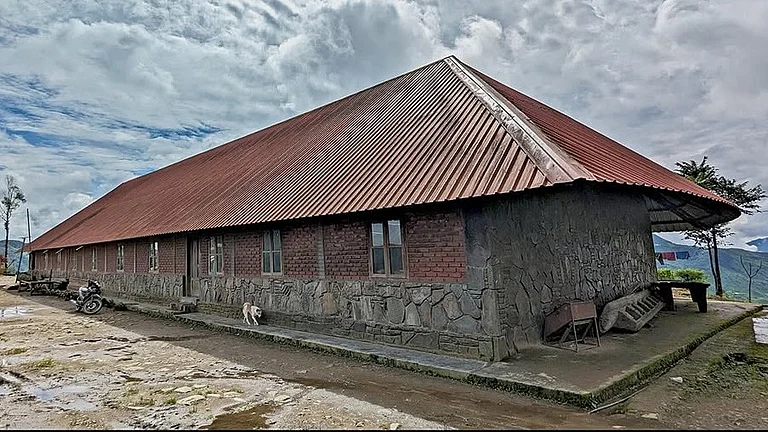
Mon district, home to the Konyak community, draws visitors to its history and cultural landscape. Longwa, Shangnyu and Chui are among its places of interest. In Longwa, the Angh’s house straddles India and Myanmar. The film may bring more eyes to these places. The question is what those eyes see. Tattoos, textiles, houses and ceremonies are fragments of a much larger, living culture, one that continues to change while carrying parts of its history.
For those the film draws to Nagaland, Rio has a simple wish. “I would want them to carry a sense of curiosity and openness.” There is, he says, “so much history, knowledge and tradition here that often remains unseen by the outside world.” A film can offer a glimpse, but not replace the experience of being there. As Rio puts it, “To walk through the hills, hear the languages, share a meal with people and experience the warmth and generosity of the communities firsthand is something entirely different.” Anyone making the journey is, therefore, not stepping into a museum of what once was, but into a living story still being written.
FAQs
1. What is Theja Rio’s film Angh about?
Angh is set in the 1960s and follows Anghba, the last chief of an abandoned Konyak village, as Christianity spreads and traditional beliefs come under pressure.
2. What award did Angh win at the Toronto International Film Festival?
Angh won the Platform Prize at the 2026 Toronto International Film Festival, becoming the first Indian film to win the competition.
3. What does Angh mean in the Konyak language?
Angh is the Konyak word for chief, a figure of cultural and historical significance within the community.
4. How did Theja Rio research Konyak culture for Angh?
Rio travelled across Mon district, spoke with Konyak elders and community members, and consulted the Konyak Literature Board and local historians to verify the film’s language, clothing, rituals and folk songs.
5. Which places in Nagaland are associated with Konyak heritage?
Longwa, Shangnyu and Chui in Mon district are among the places associated with Konyak history and cultural heritage. Longwa is also known for the Angh’s house, which straddles India and Myanmar.