


I wouldn’t call myself a seasoned traveller, but over the years, I’ve climbed mountains, drifted through river valleys, and passed through remote settlements where tourism had quietly become part of everyday life. And almost everywhere I went, the people leading the way, setting the pace, and shaping the experience were almost always men.
The trekking guide leading groups through high-altitude passes was usually a man. So was the rafting guide steering through rapids, the driver navigating dangerous mountain roads, or the local expert explaining a landscape to visitors. Women, too, were everywhere within these travel economies, cooking meals in homestays, tending farms, managing households, but rarely in the positions that shaped the experience itself.
Lately, though, that has begun to shift.
On most nights in Hanle, one of Ladakh’s highest inhabited villages, the sky appears unusually close. Once darkness settles over the Changthang plateau, visitors step out into the cold, gathering beneath a sky untouched by city light. At the centre of them stands Tsering Dolker, adjusting a telescope and pointing towards constellations visible above the village. By day, she runs a modest homestay, preparing meals and managing the rhythms of the household. But as the sun dips behind Changthang’s jagged peaks, she steps outside with a telescope, guiding travellers through planets, stars, and the Milky Way stretching across Hanle’s sky.
In 2022, when Hanle was designated India’s first Dark Sky Reserve, Dolker, then twenty-six, was among the first cohort of 24 locals—predominantly women—trained by the Indian Institute of Astrophysics (IIA) as astronomy ambassadors. She still vividly remembers the first time she handled a professional telescope.
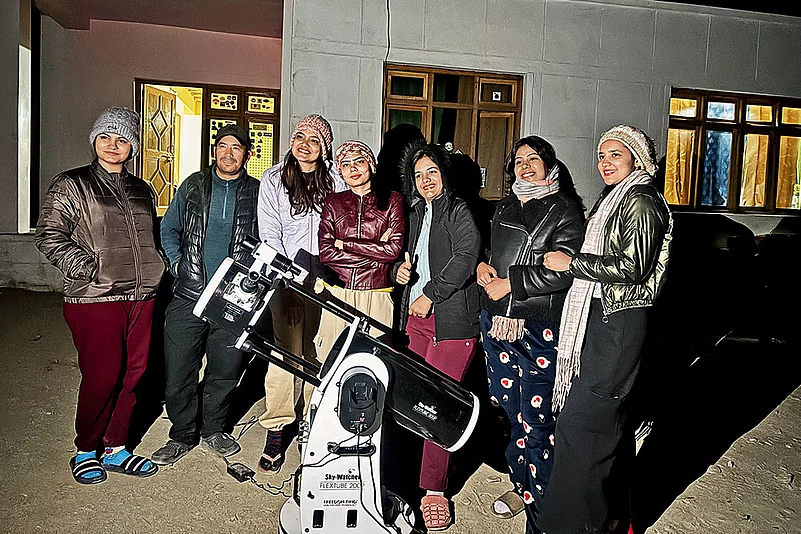

“I was nervous because it was all so new and advanced,” she said. “But I also felt proud and inspired. Seeing the stars and planets so clearly gave me confidence and made me realise that women in Hanle can do far more than we’ve been told.”
Currently, 28 astro-ambassadors work in Hanle, many of them women balancing homestays, households, and night tours. The work has brought financial independence and confidence, while also widening what women in the village imagine possible for themselves.
But long before Hanle’s night skies began drawing astro-tourists, another struggle over space was already unfolding across Ladakh’s mountains.
Reclaiming The High Passes
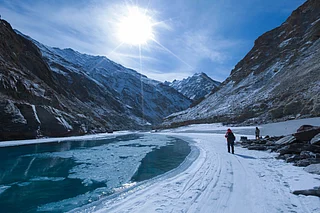
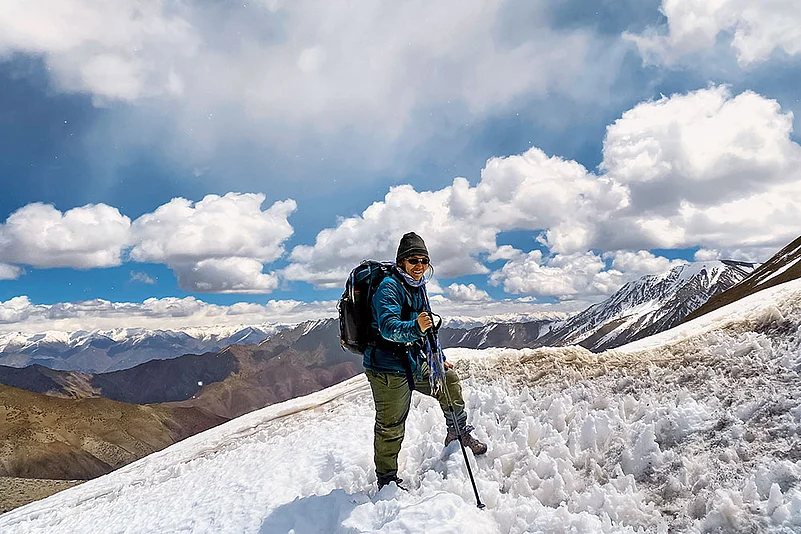
Thinlas Chorol began pushing against Ladakh’s male-dominated trekking industry nearly two decades ago. Back then, many villages in Ladakh were still connected only by foot trails. Treks through places like the Markha Valley, spanning several days, passed through cultivated fields, glacier-fed routes, and settlements that roads had not yet reached.
Yet even in a landscape where knowing the terrain mattered, women were rarely trusted to lead through it.
“It was difficult to be hired as a female guide,” Chorol recalled. “I was rejected by several agencies despite knowing the routes, simply because I was a woman. Meanwhile, men were hired even without proper knowledge.”
In 2009, she founded the Ladakhi Women’s Travel Company. What began with a single guide has since grown into a network of women leading trekkers across high-altitude passes. Today, the company trains local women as guides, cooks, and porters, creating space in an industry that had long excluded them.
Since then, Ladakh’s trekking landscape has changed quickly. Roads now cut through routes that once took days on foot, some older trails have disappeared altogether, and villages that were once lively with schools and cultivated fields are slowly thinning out. Amid those changes, the sight of women leading treks through the mountains has gradually become normalised.

Holding The Current
For Priyanka Rana, watching kayakers cut through the Ganga’s rapids changed how she saw the river, and her place within it. Growing up in Sirasu village on the banks of the Ganga, she had always lived close to the river. But stepping into it as a guide demanded something entirely different.
When people see me confidently guiding a raft or paddling through rapids, it challenges their assumptions about what women can or cannot do
“The transition wasn’t easy,” she said. “Physically, it required strength and endurance—long days on the river, handling rafts, paddling, and swimming in strong currents. Mentally, it was about staying calm under pressure. The river can change quickly, and as a guide, you have to make quick decisions. That responsibility taught me discipline and confidence.”
In the beginning, the resistance was constant. “Being a woman in this field was challenging. People doubted whether I could handle the physical demands or lead on the river,” she said. “Carving my space didn’t happen overnight—it took time, patience, and determination.”
Today, Rana is a certified raft guide and kayaker, guiding rafts through the same currents she once watched from the banks. Through initiatives like Nari Nauka, she now leads all-women crews, helping beginners build confidence on the water. “When people see me confidently guiding a raft or paddling through rapids, it challenges their assumptions about what women can or cannot do,” she said.

Moving With The Land
In the early 1990s, Malika Virdi moved from Delhi to Sarmoli village in Uttarakhand, where she found a region gradually losing its long-standing relationship with its forests. About a decade later, she was elected sarpanch of the Sarmoli Van Panchayat (village forest commons) and began rebuilding that relationship, while also questioning what tourism was beginning to do to the region.
For Virdi, that meant challenging how journeys in the mountains had long been framed.

“Mountain travel is often seen as conquest. It’s performative. That language is not just patriarchal, it’s also extractive—it’s about taking, achieving, claiming,” she said. According to her, tourism often mirrors this mindset through bucket lists and a “been there, done that” approach, moving through places without really engaging with them.
In 2004, Virdi, along with other women with rights in the Sarmoli Van Panchayat, launched a collective of homestays rooted in conservation that grew to become Himalayan Ark, a model community tourism enterprise. “It wasn’t about making our homes into hotels,” she said. “Tourism had to be part of life, not the other way around.”
Guests eat what the household cooks and move with the rhythms of the home rather than consuming a curated version of village life. Part of every stay goes back into maintaining the forest commons the village depends on, while the women who host retain control over their earnings.
“Once women began earning, they became decision-makers, not invisible contributors,” Virdi said.
Today, around 12 families continue to work collectively under Himalayan Ark. As tourism increasingly rewards individual ownership, the collective has had to work harder to hold its ground. What sustains it, according to Virdi, is a principle older than tourism itself: collaboration over competition.
From Hanle’s night skies to the forests of Munsiari, the landscapes themselves remain unchanged. The rivers still move with force, the mountains still demand endurance, and the forests continue to hold their rhythms. But increasingly, the people guiding others through them are women who were once expected to remain in the background.
Looking for more such exciting and meaningful stories? Grab our latest issue on Amazon.