

It begins, as so many of Kolkata's best stories do, with a newspaper and a cup of tea. On the morning of April 4, 2025, a small article in the newspaper caught my eye. The headline was deceptively simple: “Kolkata by Night: Go on the drive to enjoy the glow.” I set my cup down and read it twice. By the time I finished, something had shifted — the city I thought I knew entirely had apparently been quietly learning to shine.
That article led me to Mudar Patherya. And Mudar Patherya, as it turns out, has spent the better part of the last three years doing something extraordinary: systematically, painstakingly, and entirely out of personal conviction, illuminating the architectural soul of this city.
The Man Behind The Light
Mudar Patherya is, by official designation, the CEO of Trisys — one of India's oldest and most respected agencies specialising in corporate financial communications. But spend five minutes with him on any subject beyond balance sheets and annual reports, and something else entirely emerges. A wanderer. A storyteller. A man in love with the crumbling, stubborn, magnificent bones of an old city. He is also the founder of The Kolkata Restorers, a citizen-led heritage conservation and illumination movement that began in late 2023.
His inspiration, he says, came from 'lane walking' — that distinctly Kolkata habit of navigating the city not by its arterial roads but by its narrow, layered bylanes, where every building tells a story that the main road cannot hear. As he walked these lanes over the years, he grew increasingly troubled by what he saw: heritage structures of immense architectural value standing in shadow, unlit, unnoticed, slowly receding from the city's collective memory.
His first instinct was to paint. Under his direction, the Manicktala Clock Tower was repainted — a careful, considered act of restoration. And yet, the impact was limited. The tower looked better by day, but it still disappeared at night. That is when the idea crystallised: illumination. Not floodlighting, not the garish coloured lights of a festival, but thoughtful, architectural lighting — warm tones that would do what daylight alone could never do: reveal, in darkness, what had always been there.
Within thirty months of that realisation, Mudar Patherya and his team had illuminated 112 structures across the city. Today, the project continues to grow.


A City Funded By Its Own People
The question of funding is, perhaps, the most quietly inspiring part of this story. There are no government grants here, no corporate CSR programmes announced at press conferences. The Kolkata Illumination Project runs on crowdfunding — specifically, on the generosity of a growing community of citizens who believe, as Patherya does, that their city's heritage is worth preserving in light as much as in memory.
Patherya began, as most great endeavours do, by asking people he knew. He approached approximately twenty individuals — friends, acquaintances, people who had walked the same lanes he had. Each one extended support. That was the seed. Today, nearly 200 people contribute to the project's crowdfunding effort. None of them, it is worth noting, stand to gain anything beyond the satisfaction of seeing their city glow.
Before any building is illuminated, permission is sought directly from its owner or caretaker. This is not a bureaucratic formality but a genuine act of collaboration — the project's philosophy is restoration, not intervention. It works with the buildings, not upon them.
The selection criteria are specific: priority is given to structures that stand prominently on busy roads, that are architecturally distinct, and that offer high visibility. Typically, buildings around 100 feet long and 200 feet wide are chosen — large enough to create visual impact, significant enough to deserve it.
Going On The Night Drive
Travel Together Everywhere, a Kolkata-based cultural and heritage travel initiative, and The Kolkata Restorers together created what is now the Kolkata Illumination Night Drive — a guided bus tour through the lit-up heritage of north, central, and south Kolkata.
The drive departs in the late afternoon — smart timing, because it lets you watch the city change gear. The sky shifts, the traffic thins, the streets take on that particular Kolkata evening quality: slower, warmer, slightly cinematic. And then the lights begin to come on.

The route begins in north Kolkata and moves with intention through layers of the city’s history. Near Hedua, the Kalachand Jiu Temple on Ramdulal Sarkar Street glows with a quiet authority — both its main building and its soaring spire are now illuminated, revealing architectural details that daylight and decades of indifference had rendered invisible.
A short distance away, on Bidhan Sarani, the Scottish Church School stands lit against the evening sky, its colonial stonework catching the warm light with the composed dignity of a building that has educated generations and asked for nothing in return.
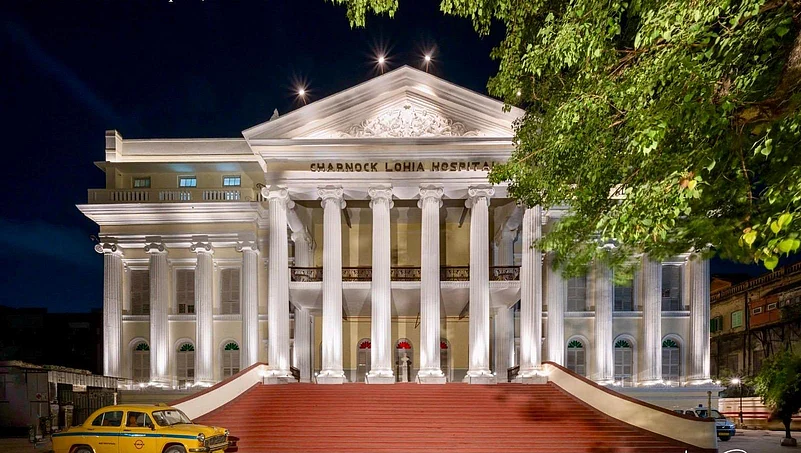
The route then moves to Rabindra Sarani, where Charnock Lohia Hospital — a working institution, lit not as a monument but as a presence in the community that surrounds it — reminds you that this project has never been solely about heritage for heritage’s sake.
Moving into the city’s middle belt, the route takes in the Kapalitala Kali Temple in Bowbazar — a neighbourhood temple that has absorbed the prayers and the noise of its surroundings for well over a century, and which at night, lit and still, offers something it cannot offer by day.
Nearby, the Dollar’s Church at Baithakhana Bazar, Sealdah, stands illuminated — a lesser-known landmark that the light has pulled back into view. The Maulana Azad College at Wellington Square and the Calcutta Technical School on S N Banerjee Road near Janbazar complete this stretch, each one a reminder that the city’s heritage is not confined to the famous and the frequently photographed.
By the time the bus enters Dalhousie — the old administrative heart of the city, now known as BBD Bagh — the crowds are gone. The streets that spend the day buried under traffic fall silent, and in that silence, the illuminated facades begin to reveal themselves properly.

The General Post Office is the first to arrest you: its great dome suffused in gold light, its Corinthian columns precise and proud, its clock face — made by the craftsmen who built London’s Big Ben and installed here in 1896 — still marking the hours above the ground where the original Fort William once stood.
Beside it, Rajbhavan glows with the measured grandeur of a seat of state, and the Standard Assurance Building nearby catches the light across its elaborate facade with the quiet confidence of a structure that has outlasted every era it has witnessed. The Returned Letter Office, also part of this heritage cluster, comes into view after dark as a striking building. Its simple name does not reflect the beauty and grandeur of its architecture.

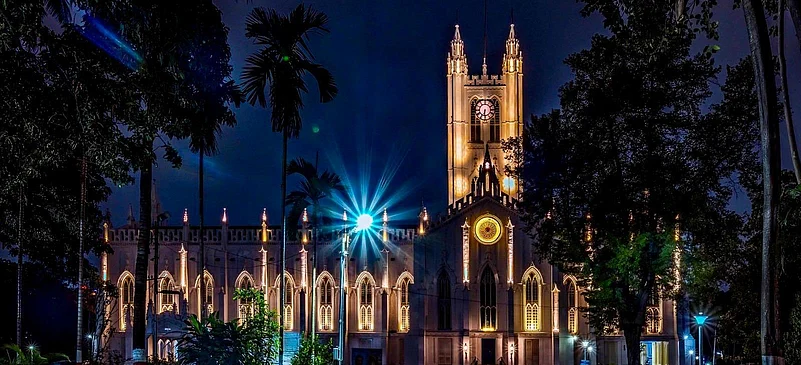
And then, St Paul’s Cathedral near Rabindra Sadan: the former tallest structure in Kolkata, its Gothic spires rising luminous against the night sky, the warm light tracing every buttress and arch with the patient reverence the building has always deserved. All the while, the guide threads the journey together with stories that make the city feel less like a collection of landmarks and more like a living archive.
Yet these are only some of the highlights along the route. As the bus moves through the city, dozens of other illuminated landmarks emerge from the darkness — churches, temples, schools, offices and historic residences — each contributing a chapter to Kolkata’s long and layered story. Together, they transform an evening drive into a journey through a city rediscovering itself.
Four hours. Twenty to twenty-five illuminated sites. One Kolkata you thought you knew, seen in an entirely different light.
What The Tour Offers
The Illumination Night Drive is conducted in an air-conditioned bus with large windows—a deliberate choice that ensures every participant, not just those closest to the glass, has an unobstructed view of the illuminated facades. An in-bus microphone carries the guide's narration throughout the journey: the history of each building, its architectural features, its cultural significance, and how the illumination has changed the space around it.
Light refreshments and tea are served on board. Photography stops are built into the route — because night photography of illuminated heritage structures has, perhaps unsurprisingly, become one of the tour's biggest draws. Photography lovers, history enthusiasts, architecture students, senior citizens, families, and travellers from outside the city have all found a reason to join. Each tour typically accommodates 30 to 35 participants, and each one books quickly.
The Impact And The Questions Worth Asking
The biggest impact, as Travel Together Everywhere puts it, is emotional. “People feel a renewed sense of connection with Kolkata's heritage. The illumination makes the buildings come alive, and the stories make people feel proud.” Areas that once felt deserted after dark now feel welcoming and safe. In some stretches, local businesses have seen improved evening footfall.
The illumination has been done thoughtfully — soft, warm tones that highlight original character rather than overwhelm it. Nothing flashy, nothing out of place. The philosophy has always been to respect the heritage rather than alter it. The buildings are restored first; the lighting follows. That sequence matters.
What Comes Next
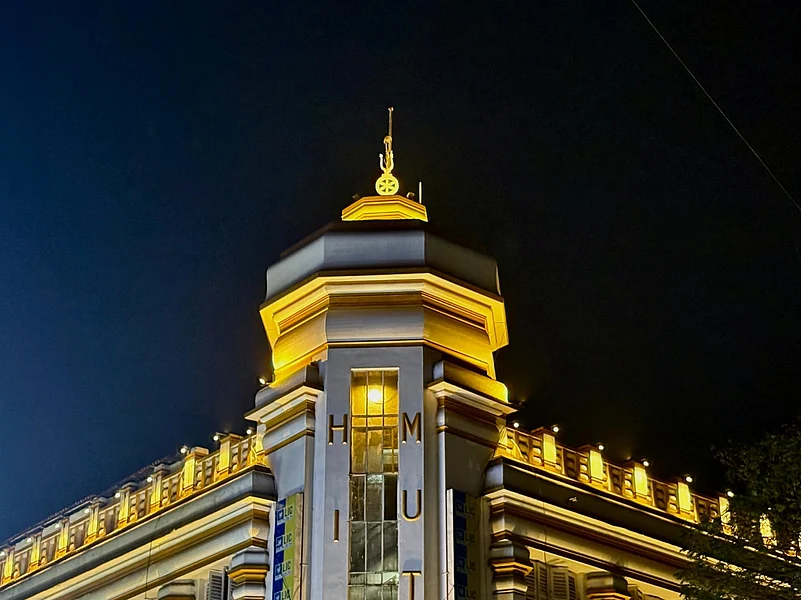
The project's ambitions are growing. Patherya's stated goal is to illuminate more than 200 — possibly 300 — buildings, creating a cohesive, recognisable nightscape across the entire city. More curated tours are being developed, including themed illumination walks and special programmes for architecture colleges, schools, and photography groups.
Travel Together Everywhere and The Kolkata Restorers are expanding the tour experience itself. Planned additions include performances by the East India Dastangos — practitioners of the ancient Urdu oral storytelling tradition — who will bring the histories of buildings alive through the spoken word. Theatre artists are being brought in for performances at illuminated heritage sites. A special performance is planned at the Royal Insurance Building. Permissions are being sought from the Kolkata Police for events at key locations.
Outreach to clubs, associations, schools, and colleges is ongoing, with the intention of bringing the experience to younger and more diverse audiences. It is, in its quiet way, precisely the kind of thing that this project has always been about.
A City Seen Anew
On the bus ride back, I found myself thinking about a line from the tour's own description: “Slowly, people are beginning to connect with this new illuminated form of Kolkata, and the contrast between the past and present appearance of these structures is leaving them deeply moved.”
There is a particular kind of travel that requires no distance at all. It requires only a willingness to look at the familiar, the overlooked, the taken-for-granted — with fresh attention. The Kolkata Illumination Night Drive offers precisely that. It does not take you to a new place. It takes you to the same place you have always known, and shows it to you as though for the first time.
Kolkata, it turns out, has been glowing all along. It just needed someone willing to flip the switch.
The Information
Organiser: Travel Together Everywhere
Contact: +91 98365 30801 / +91 86172 80942
Email: traveltogethereverywhere@gmail.com
Tour Type: Guided night drive in air-conditioned vehicles
Includes: Expert heritage guide, microphone narration, light snacks, tea, and photography stops
Best for: History lovers, photographers, families, architecture enthusiasts, and travellers.
FAQs
1. What is the Kolkata Illumination Night Drive?
The Kolkata Illumination Night Drive is a guided heritage bus tour that showcases illuminated historic buildings across north, central and south Kolkata while narrating their architectural and cultural histories.
2. Who started the Kolkata heritage illumination project?
The initiative was founded by Mudar Patherya through The Kolkata Restorers, a citizen-led movement focused on restoring and illuminating heritage structures across Kolkata.
3. How many buildings have been illuminated under the project?
More than 100 heritage and historic structures across Kolkata have already been illuminated, with plans to expand the project significantly in the coming years.
4. Which landmarks are included in the night drive?
Highlights include the General Post Office, Raj Bhavan, St Paul’s Cathedral, Scottish Church School, Kalachand Jiu Temple, Charnock Hospital, and several other heritage landmarks.
5. Why is the illumination project important?
The project helps revive public interest in Kolkata’s architectural heritage, encourages heritage tourism, improves the night-time cityscape, and strengthens community engagement with local history.