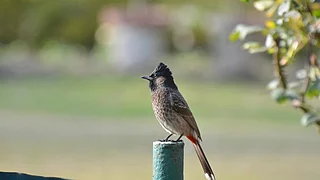


For many people living in the city, the presence of birds feels too distant. Maybe in the evenings, you have stopped to admire the screeching parakeets flying back home, or you find yourself rushing to Sanjay Van on weekends with a pair of binoculars in your hand to spot some of the lesser-known species that dot the Aravallis. Some birds, like the crow or the pigeon, on the other hand, simply fade into the background, burdened by their familiarity.
For artist Rupa Samaria, looking is where the relationship begins. Birds have long been her subjects, but she does not approach them simply as forms to reproduce on canvas. Before she paints one, she studies its posture, movement and behaviour, and researches its habitat, food, distribution and conservation status. “I am not simply trying to reproduce how a bird looks,” she says. “I want to capture something of its character and presence.”
That method has taken her from the birds that share urban spaces with us to the diverse landscapes of the Aravallis. Along the way, some species have made her look differently at the places they inhabit, and at how easily those places can disappear from view.
Start With The Birds You Think You Know
Samaria’s earliest and most personal connection is with the House Sparrow, a bird she grew up seeing. Its familiarity was precisely what made it instructive. She began to recognise that the birds around us have individual behaviours and personalities, even when we have become accustomed to treating them as a natural part of everyday life.
Around Delhi and the Aravallis, she points to House Sparrows, Common Mynas, Rose-ringed Parakeets, Black Kites, Red-vented Bulbuls, Oriental Magpies, Rufous Treepies and crows as birds people regularly encounter but rarely stop to observe. A closer look reveals small differences: the way a parakeet settles on a branch, the alertness of a bulbul or the movement of a treepie. For Samaria, these details are the inspiration for her paintings.
She often asks people to begin with an ordinary bird rather than searching for something rare. Sit quietly for ten minutes and watch. From her own window, she has observed birds building nests, socialising, moving between branches and appearing briefly through foliage. A simple bird bath, she says, can become another way of watching, as different birds begin to arrive and their individual habits become visible.


The exercise sounds simple, but it changes what counts as an encounter with nature. Biodiversity, Samaria points out, is not confined to forests, sanctuaries or distant wildlife destinations. It exists in gardens, balconies, neighbourhoods and city spaces too. The difficulty is often not absence, but attention.
A Bird Is Never Just A Bird
That way of looking becomes more complicated when Samaria turns to Rajasthan. The state is often imagined as a desert, but her work there has brought her into landscapes of grasslands, scrublands, wetlands and forests, shaped in part by the Aravalli Range. The birds she has encountered—from vultures, owls and cranes to flamingos, Indian Pittas and pelicans—have each revealed a different aspect of that landscape.
The Great Indian Bustard, or Godawan, has stayed with her most strongly. Researching the species in Rajasthan made her increasingly aware of the precariousness of its existence and of the connection between the bird and the open grasslands it needs. What began as research eventually became an emotional response to the possibility of loss.
In her painting of the Godawan, that tension is expressed through contrast. The bird is rendered in charcoal, giving it a delicate, almost vanishing quality, while the background is fluorescent. The colours draw from the vivid clothing traditionally worn in Rajasthan, colours that hold their own against the expansiveness of the desert. In the painting, they become something like a warning signal.

The landscape, then, is not decorative scenery behind a bird. It is part of the bird’s story. Samaria says that even when a habitat is not literally depicted, her understanding of where a species lives, how it behaves and what threatens it influences the work.
When Looking Becomes A Form Of Memory
Some of Samaria’s birds carry stories of coexistence; others carry the weight of disappearance. The Siberian Crane, for instance, has become a species of memory for her. The last natural migrating pair was seen in Rajasthan in the winter of 2001–02 at Bharatpur. When she painted a pair with a chick, she deliberately left the background empty, allowing the absence around them to become part of the work.
The Demoiselle Crane offers a different story. Samaria recalls painting a pair after being moved by their annual migration to Khichan and the local community that welcomes and feeds them each winter. The bird becomes, in this context, part of a story about migration and coexistence rather than decline. The House Sparrow, meanwhile, brings the question back to the built environment, prompting her to think about how the way we construct and inhabit cities affects the birds living alongside us.
Her fascination with birds also enters sculpture and interactive art. In one series of owl sculptures, the birds look directly at the viewer, reversing the familiar dynamic of watching wildlife. The moment turns the observer into part of the encounter.
Teaching has reinforced that approach. Samaria begins her workshops by telling participants, “Everyone is an artist.” Knowing the names of birds or having formal training is not a prerequisite. Instead, she asks people to notice colour, shape, posture, movement and behaviour. The questions people ask when they encounter a bird for the first time, she says, have also made her slow down and notice things she might otherwise miss.
And sometimes the most memorable observations are unexpectedly intimate. Once, Samaria found an injured Barn Owl that could not fly and helped get it to Wildlife Rescue. Holding it at close range allowed her to notice the patterns on its wings and the colours of its feathers in a way she had never been able to before. On another occasion, she watched a male Baya Weaver, alongside her late brother Rohit Arora, painstakingly construct a nest. The nest was eventually rejected by the female, but the experience became the basis for her painting A Love Story, dedicated to her brother.
It is this quality of attention that sits at the centre of Samaria’s work. Conservation, in her practice, does not begin only with crisis. It begins earlier, with recognition. Beauty may be what first makes someone stop, but understanding what a bird depends on can make that moment of looking last longer.

A Bird Call—Rajasthan
That idea comes together in Samaria’s exhibition, A Bird Call—Rajasthan, at Bikaner House, New Delhi, from October 8 to 12, 2026. The exhibition turns its gaze towards the resident, migratory, rare and threatened birds of Rajasthan, placing the Great Indian Bustard, or Godawan, at its centre.
Large-scale works use charcoal, painting and mixed media, with intensely fluorescent backgrounds inspired by the vivid colours associated with Rajasthan. Against these bright fields, the Godawan appears delicate and vulnerable, making visibility itself part of the work’s language. Across the exhibition, birds are presented not simply as subjects to be admired, but as part of larger landscapes of grasslands, wetlands, scrub and desert.
For Samaria, noticing a bird is the first step towards understanding that it is there at all and, often, towards becoming more aware of what our interaction with nature might do to the birds’ home.
FAQs
1. Who is Rupa Samaria?
Rupa Samaria is an artist whose work focuses extensively on birds, their behaviour, habitats and conservation.
2. What birds does Rupa Samaria paint?
Her work includes familiar urban birds such as House Sparrows, crows and Rose-ringed Parakeets, as well as species such as the Great Indian Bustard, Siberian Crane and Demoiselle Crane.
3. Why is the Great Indian Bustard important in Rupa Samaria’s work?
The Great Indian Bustard, or Godawan, has become a significant subject for Samaria because of the species’ threatened status and its dependence on open grassland habitats.
4. What is A Bird Call—Rajasthan?
A Bird Call—Rajasthan is an exhibition by Rupa Samaria exploring Rajasthan’s resident, migratory, rare and threatened birds through painting, charcoal, sculpture and mixed media.
5. When and where is A Bird Call—Rajasthan being held?
The exhibition is being held at Bikaner House in New Delhi from October 8 to 12, 2026.