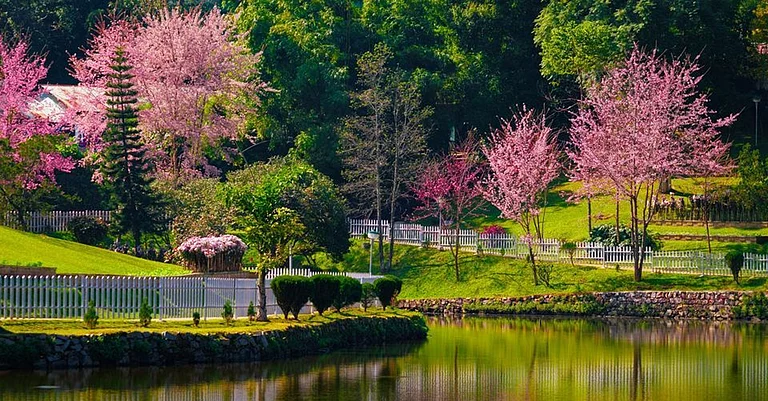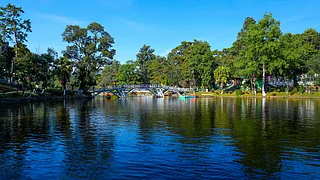


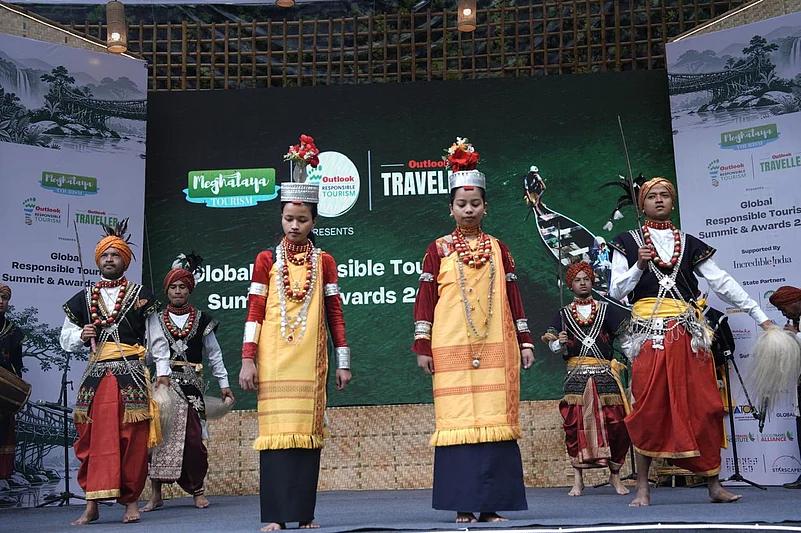
The first Global Responsible Tourism Summit & Awards opened at Ward’s Lake on November 19 with a Shad Mastieh dance performance and a question that ran through the day: who gets to shape a destination? Organised by Outlook Traveller and Outlook Responsible Tourism with the Meghalaya Tourism Department, the two-day gathering brings together 50-plus voices and 150-plus delegates. Its programme is split between The Grove, for keynotes and panels, and The Nook, for workshops, case studies and film screenings.
Why Meghalaya Was The Obvious Host
Anindita Ghosh, Editor of Outlook Traveller and Outlook Responsible Tourism, opened the proceedings. She traced a partnership with the state that began with a 2019 workshop in Shillong and grew into three Meghalaya award editions. The summit’s global turn, she said, rests on a simple test: “We cannot keep measuring success only in arrivals, room nights and revenue. We have to ask what tourism leaves behind.”
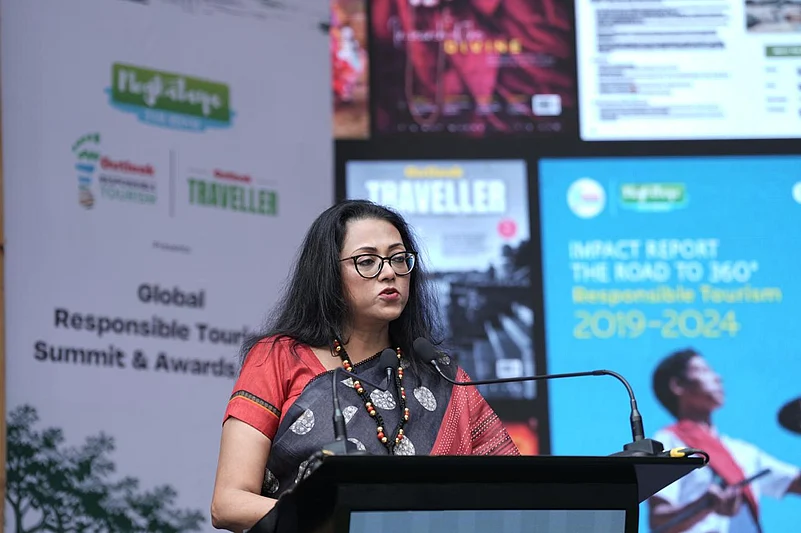

Ghosh also spoke about the role of storytelling. Travel journalism, she said, must do more than inspire people to visit a place: “It must also help them understand it.” That means asking who lives there, whose livelihoods depend on tourism, what is being protected and what is at risk. Outlook, she said, wants to celebrate the people and initiatives making a difference, but also to “ask difficult questions when tourism is not working as it should.”
Tourism Commissioner and Secretary Vijay Kumar admitted that when the idea came up six months ago, he wondered whether a global summit in Shillong was “a little preposterous.” The answer lay in what the state already has: Sixth Schedule protection that keeps land in community hands, and some 7,000 villages he described as semi-autonomous entities, each with a traditional institution that deliberates on decisions. Visitors to India see the Taj Mahal, he said, but “when you come to Meghalaya you should see a root bridge.”
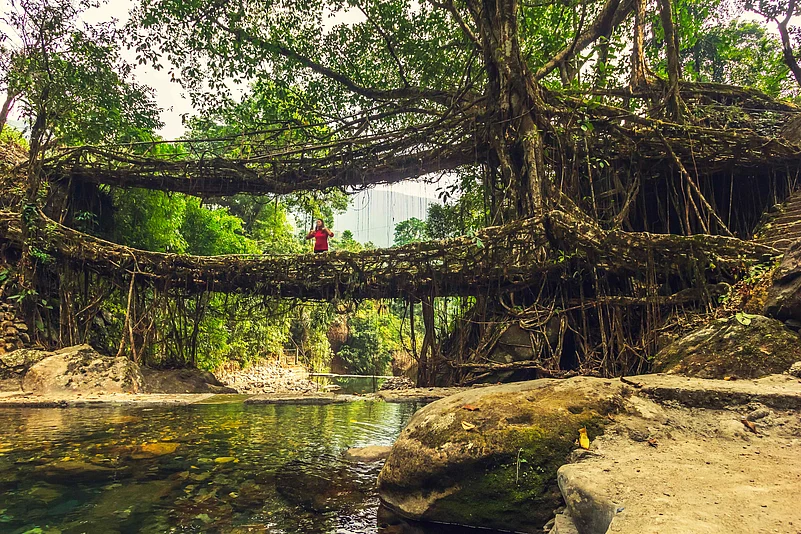
He then walked delegates through the state’s community-first interventions. The root bridges are India’s sole entry for the 2027 UNESCO World Heritage List, in a dossier that took about eight years to prepare. Of more than 120 villages with root bridges, about half dropped out after consultations, and 62 agreed to join. Those villages formed cooperative societies, and an apex society submitted the dossier. UNESCO, Kumar said, was surprised, having never seen one like it.
He also described a “community public-private partnership,” in which communities bring the land, government brings the money and private partners bring market expertise. At Maura near Cherrapunji, a created lake is now run by a Shillong entrepreneur and villagers, with about 20 to 25 community members employed. On conservation, he said, almost 60,000 hectares of forest are under active protection through payments to communities, which he called the country’s largest payment-for-ecosystem-services programme. Communities get a five-year commitment, with plans to link them to carbon markets afterwards.
Chief Secretary Shakil P. Ahammed, the chief guest, drew a distinction: sustainable tourism is the goal, responsible tourism is the practice. His central claim: “A destination belongs first to the people who live there.” He recalled that root-bridge builders may never cross what they grow, so “people who protect it may not even enjoy it.” He added that Meghalaya has 79 community-protected fish sanctuaries and almost 69 community tourism projects.
From Keynote To Policy: What The Grove Debated
The theme carried into Masaru Takayama’s opening keynote, “Who Gets to Shape a Destination?”, which centred on community ownership and stewardship. The Chair of the Global Ecotourism Network put his argument this way: “Every destination should be treated as a natural site. Sustainability must be incorporated from the very beginning, with education and respect at its core. It is not just about tourism; it’s about lifestyle.”
Bodoland’s Tourism Secretary Ansula Basumatary then presented her region’s vision of community-led experiences, culture and nature. Meghalaya Tourism Development Corporation Managing Director Cyril V. Darlong Diengdoh, in conversation with Palladium India’s Anoop Phanse in “From Policy to Practice,” addressed how the state has turned policy into infrastructure and livelihoods. His own formulation of the goal: “High-value tourism and sustainability must go hand in hand, ensuring that the value generated reaches local communities, experiences are shared through local voices, and tourism leaves a smaller environmental footprint while strengthening the relationship between people, culture and nature.”
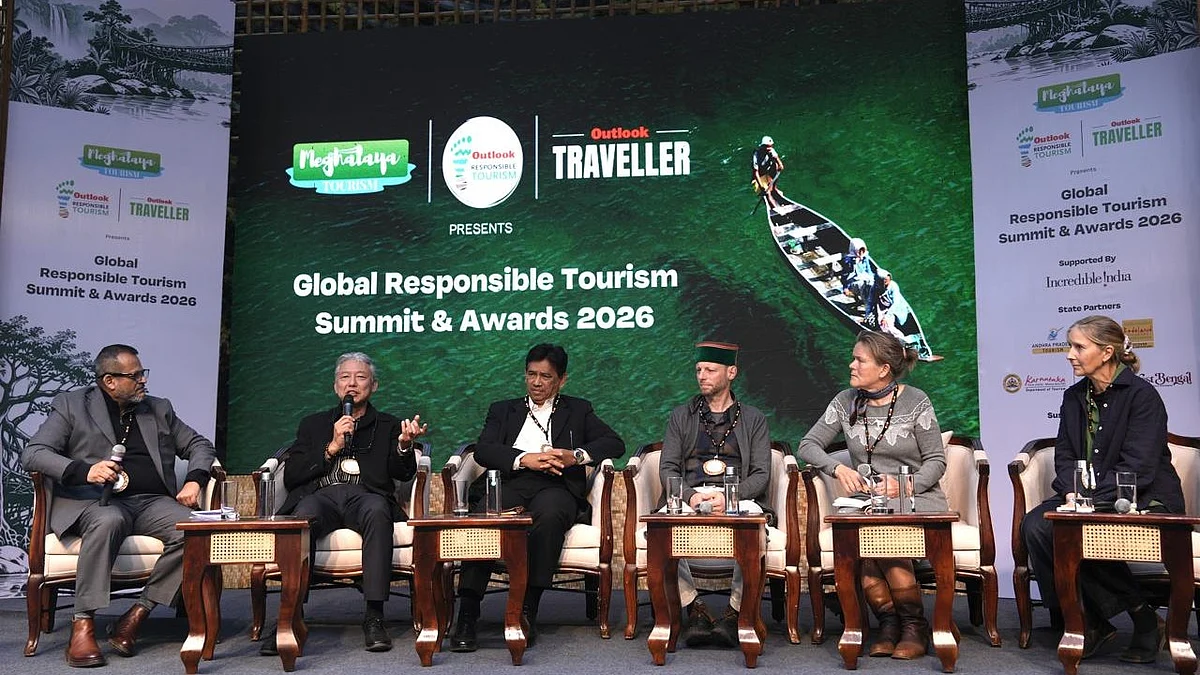
The global panel “What Has Actually Worked?” brought Takayama together with Ary S. Suhandi, Chairperson of the Asian Ecotourism Network and founder of the Indonesian Ecotourism Network (INDECON); Kirsi Hyvaerinen, Europe Coordinator of the Good Travel Alliance; Sophie Hartman, founder of Holidays in Rural India; and Stephan Marchal, founder and director of Himalayan Ecotourism, moderated by Outlook Group CEO Indranil Roy. It was billed as a review of tested models: what worked, what failed and what India can adapt. Suhandi later gave a case study on Indonesian community tourism, covering how models were structured, what communities gained and what implementation taught.
Workshops, Films, And The Question Of Ownership
After lunch, a fireside with environmentalist Peepal Baba, founder of Give Me Trees Trust, in conversation with Ghosh, asked “What Are We Trying to Protect?” from forests to consumption. Hyvaerinen and Dr Mahadevan P., Assistant Professor of Travel & Tourism at GPM Government College, Kerala, and an auditor in environment management and destinations, ran a workshop on standards and indicators that turn green claims into credible outcomes. The day’s closing panel, “Who Owns the Destination?”, moderated by Nishtha Pandey (content lead for Outlook Responsible Tourism), took up local ownership, outside investment, decision-making and revenue flows as destinations grow, with Marchal; Malika Virdi, founder and CEO of Himalayan Ark; Michael Dominic, managing director and CEO of CGH Earth; and Raj Basu, co-founder of Help Tourism.
In The Nook, sessions were practical and varied. Case studies covered Starscapes’ astrotourism, Balasinor’s dinosaur-fossil heritage and Darjeeling’s regenerative TIEEDI project. Three films screened: "Pavazha," "Kumhar’s Magic Clay Weeps Softly," and "Malarin Khoda." Workshops covered building a viable homestay with Virdi, accessibility with Planet Abled’s founder, Neha Arora, and food as living heritage with culinary chronicler and Founder, A Perfect Bite Consulting, Rushina Munshaw Ghildiyal, Chefs Ahmedaki Laloo and Kunzes Angmo. Outside, a marketplace of 35-plus stalls was open to delegates and the public.
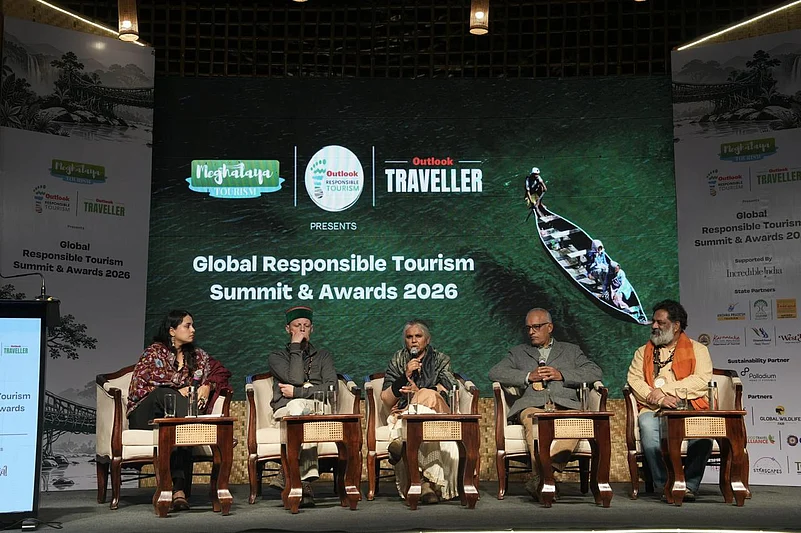
Day two brings the tenth Indian Responsible Tourism Awards, alongside the GRT films. Ghosh’s closing line to the room frames what the summit will be judged on: success “should not be measured only by how many people come to a destination, but by whether the people who call it home are better off because of it.”
FAQs
1. What is the Global Responsible Tourism Summit & Awards 2026?
It is the first global edition of Outlook Responsible Tourism’s summit and awards, held on 19-20 November 2026 at Ward’s Lake, Shillong. Outlook Traveller and Outlook Responsible Tourism organised it with the Department of Tourism, Government of Meghalaya. It brings international expertise into conversation with India’s responsible tourism practitioners, with keynotes, panels, workshops, case studies and film screenings.
2. Why was Meghalaya chosen to host it?
Tourism Commissioner and Secretary Vijay Kumar said Meghalaya is uniquely placed to talk about responsible and community tourism. He cited the Sixth Schedule’s constitutional protection of land, the state’s roughly 7,000 villages with traditional decision-making institutions, and long-standing community conservation traditions such as sacred groves and root bridges.
3. What is the UNESCO bid for Meghalaya’s living root bridges?
According to Kumar, the root bridges are India’s sole entry for the 2027 UNESCO World Heritage List. The dossier took about eight years to prepare. Of more than 120 villages with root bridges, about half opted out after consultations, and 62 agreed to join. Those villages formed cooperative societies, and an apex society submitted the dossier.
4. What is the difference between responsible and sustainable tourism?
Chief Secretary Dr Shakil P. Ahammed said sustainable tourism is the goal, meaning tourism that can continue without exhausting the resources it depends on. Responsible tourism is the practice: the specific choices that travellers, operators, governments and host communities make to reach that goal.
5. What is on the programme beyond Day 1?
Day 2 (20 November) hosts the tenth Indian Responsible Tourism Awards, including the Meghalaya Chapter’s fourth edition, and recognises winning films. The Marketplace, with 35-plus stalls for food, crafts and sustainable enterprises, runs on both days and is open to delegates and the public.