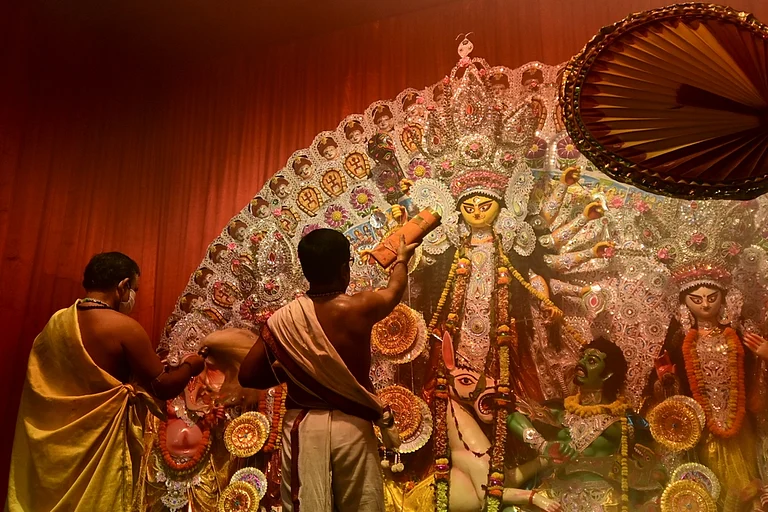


The story goes back more than 300 years. It was the time of Durga Puja, and the priest was chanting mantras according to the scriptures. A sadhak of a certain lineage, who was sitting in the puja after drinking “karan-sudha”, kept repeating, “Salutations to Ganesha on the left, Kartikeya on the right.” This was the opposite of their positions relative to Goddess Durga at the centre. Hearing this, the priest protested, but to everyone’s surprise, the sadhak, through his powers, showed everyone present that Ganesha and Kartikeya had indeed changed places.
This became part of the ritual and is one of the many features that set the Durga Puja of Sadipur village, in the Jamalpur block of East Burdwan, apart. Located on the banks of the Damodar River, the family traces its ancestry to the era of Ballal Sen and Laxman Sen. They began living in Sadipur after facing oppression by the Bargis, the light cavalry mercenaries of the Maratha Confederacy who carried out large-scale depredations across the countryside of western Bengal during the 1740s.
The Legend Of Ganesha And Kartikeya Changing Places
The story of the sadhak is one of many that define the evolution of the Sadipur Durga Puja. Another recounts how, many years ago, a structure bearing the Durga idol on a pedestal was washed away by the Damodar River during a flood. Members of the Bargakshatriya Dhara family from the nearby village of Nakra retrieved it from the river and were taking it to the distant village of Devipur to sell. However, following the orders of Goddess Durga, they donated the structure to Ratanmani Devi, the widow of the Sabhakar family, instead.


Another story dates to the time of Umacharan Babu, when a group of robbers built a temple with mud walls and a straw roof in a single night. The puja subsequently began in that temple. A beautiful brick temple now stands in its place, and every year, as a gesture of gratitude, a special offering is sent to the family from Nakra.
From Goddess Kali To Durga: The Origins Of The Puja
These anecdotes make the history of Sadipur intriguing. However, the story of its worship predates Durga Puja, beginning with Goddess Kali, the presiding deity of the Sabhakar dynasty in the region. After receiving a message from Goddess Durga in a dream, Umacharan Chattopadhyay, the dynasty’s saint, began worshipping Durga at the same altar as Kali. At the time, he was extremely poor and relied on locally available materials for the rituals, including water from a forest pond, forest flowers, pickled elephant apples and banana stems. The tradition began in the Bengali calendar year 1111, and his descendants continue to follow the same rituals to this day.
Although the positions of Ganesha and Kartikeya are reversed, the Navapatrika, or Kalabou (literally, the banana bride), is placed next to Kartik, on the right, in accordance with the prescribed rules. While popular folklore often associates the Kalabou as Ganesha’s wife or consort, it actually represents nine plants, symbolising different forms of Durga. Another distinctive feature of the idol is the goddess’s mount: the lion has a white body and the face of a horse. The Raina Mahesh Pal family has been making this particular idol for generations.

From Sandhi Puja To Immersion In The Damodar
The puja begins with the chanting of the Chandipath, verses from the Markandeya Purana that glorify Durga’s supreme divine feminine energy as she defeats demonic forces to maintain cosmic order. This is followed by aarti and the distribution of the customary bhog. In the past, sacrifices were performed at the house during the Sandhi Puja on Mahashtami upon hearing the sound of cannons fired at the nearby Sarvamangala Temple in the Burdwan Rajbari. Today, however, sacrifices are performed according to the calendar.
On the night of Vijaya Dashami, after the distribution of dadhikarma—a mixture of yoghurt, grains and sweets offered to the deities as farewell prasad—and the customary playing with sindoor (vermilion powder associated with married Hindu women), the idol is immersed in the Damodar River in a procession.
FAQs
1. Where is Sadipur’s Durga Puja held?
Sadipur’s Durga Puja is held in Sadipur village in the Jamalpur block of East Burdwan, West Bengal, on the banks of the Damodar River.
2. What makes Sadipur’s Durga Puja unique?
The puja is distinguished by the reversed positions of Ganesha and Kartikeya, a white-bodied lion with a horse’s face as Durga’s mount, and rituals passed down through generations.
3. Why are Ganesha and Kartikeya placed in reversed positions at Sadipur?
According to local legend, a sadhak once declared that Ganesha should be on the left and Kartikeya on the right. When the priest challenged him, the sadhak demonstrated his powers, showing that the deities had changed places. The arrangement subsequently became part of the ritual tradition.
4. How did the Durga Puja tradition begin in Sadipur?
According to the family’s account, Umacharan Chattopadhyay began worshipping Goddess Durga at the same altar as Goddess Kali after receiving a message from Durga in a dream. The tradition is traced to the Bengali calendar year 1111.
5. Where is the Durga idol immersed after the puja?
On the night of Vijaya Dashami, the idol is taken in a procession and immersed in the Damodar River after the customary farewell rituals and distribution of dadhikarma.