

I had always imagined nature in shades of green. For 25 years, growing up in the mountains, my world was defined by forests, meadows, and flowing streams. Green felt complete, like it held everything nature had to offer. That belief stayed with me until I travelled to Jaisalmer last month and encountered a landscape that reshaped my understanding entirely.


Here, nature revealed itself in gold.
The journey began with a wedding invitation in Jaipur, but it quickly turned into something more personal. Jaisalmer had always fascinated me, perhaps because it stood in complete contrast to my home. In the mountains, I had known abundance: endless greenery, fresh water, and dense life. Yet somewhere within that familiarity was a quiet longing for the opposite. The desert, in all its starkness, had always called out to me.

When I finally arrived, the shift was immediate. The dunes stretched endlessly, shaped by wind into soft, undulating forms. Walking across them felt unfamiliar, each step sinking slightly, the ground shifting beneath me. Yet, there was a strange sense of calm. The desert was not empty; it was expansive. Its silence felt deeper, more absolute than anything I had experienced before.

Through my lens, I found myself drawn to subtleties, the way light fell on sand, the long shadows at dusk, the changing tones of gold from morning to evening. Unlike the mountains, where contrasts dominate, here everything existed within a narrower palette, making every variation more meaningful.

But Jaisalmer is not just its desert. The city carries a vibrant cultural rhythm. In its streets, I encountered musicians whose presence brought the landscape to life. Their music echoed through narrow lanes, adding movement and emotion to an otherwise still environment. Photographing them felt like capturing the human pulse of the desert.
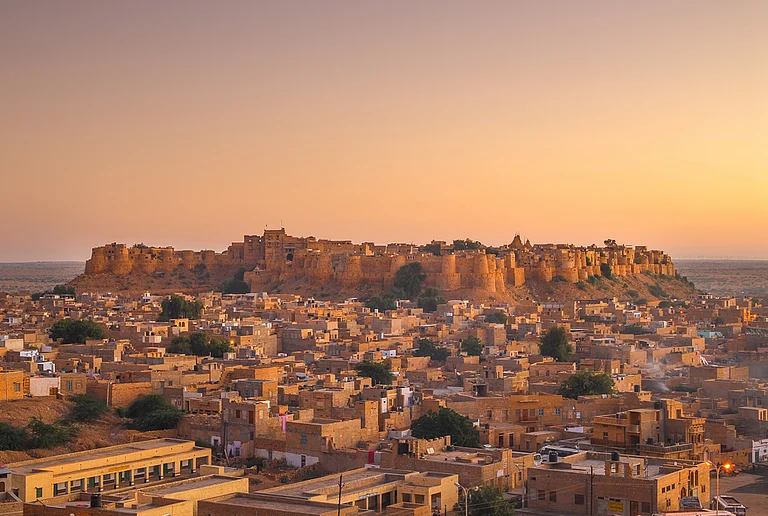
At Jaisalmer Fort, history and daily life coexist seamlessly. Rising from the desert in warm sandstone, the fort feels like an extension of the land itself. Inside, its lived-in spaces (homes, shops, and winding alleys) offer glimpses of continuity, where the past is not preserved but inhabited.

Further out, at Khaba Fort, the experience shifts. The abandoned village surrounding the fort stands silent, yet alive with thousands of peacocks. Their calls echo through the ruins, creating an atmosphere that feels both desolate and strangely vibrant. It is a place where absence speaks as loudly as presence.

The journey ended in an offbeat stretch of desert, far from mapped routes. As night fell, the landscape transformed once again. Under a sky filled with stars, sitting by a bonfire, I realised the desert reveals itself slowly. It does not overwhelm; it invites.
This journey changed how I see nature. What once felt complete now feels expanded. The mountains showed me abundance, but Jaisalmer revealed beauty in openness, in restraint, in gold.

FAQs
1. What makes Jaisalmer’s desert landscape unique?
Jaisalmer’s desert stands out for its golden dunes, shifting light, and vast silence, offering a stark contrast to greener landscapes and creating a more minimal, expansive experience of nature.
2. How is desert travel different from mountain travel?
While mountains offer lush greenery and dramatic contrasts, deserts provide openness, subtle textures, and a quieter, more meditative environment.
3. What are the key places to visit in Jaisalmer?
Highlights include Jaisalmer Fort, the sand dunes, Khaba Fort, and offbeat desert stretches ideal for stargazing and cultural encounters.
4. Is Jaisalmer suitable for slow travel?
Yes, Jaisalmer is ideal for slow travel, allowing visitors to absorb the landscape, culture, and rhythms of desert life at a relaxed pace.
5. What is special about the desert at night in Jaisalmer?
At night, the desert transforms under a clear, star-filled sky, offering peaceful surroundings and a deeper sense of connection with nature.