If a house had a boulder for a roof, you would probably assume it was built that way for a film set. In Monsanto, Portugal, it is simply architecture. Giant granite rocks press into walls, sit above doorways, and, in some cases, form entire roofs. The village appears to have been arranged around the mountain rather than built on it, with narrow lanes threading between stone homes and enormous boulders that have remained exactly where nature left them.
This Village In Portugal Has Houses Built Around Giant Boulders
In Portugal’s Beira Baixa, Monsanto climbs a granite hillside where enormous boulders become walls, roofs and floors. Add a Templar castle, medieval lanes, legends, and sweeping views, and you have one of the country’s most unusual villages

Advertisement
Perched on the steep slopes of Cabeço de Monsanto in the Beira Baixa region, the village rises to around 758 metres and is part of Portugal’s Historic Villages network. Its unusual architecture is only the beginning. Above the houses are the remains of a medieval Templar fortress, while below stretch the plains towards the Spanish border.
A Village Shaped By Granite And War
Monsanto’s history reaches back well before the medieval period. Archaeological evidence points to successive Lusitanian, Roman, Visigothic, and Muslim occupation, helped by the hill’s natural defensive position. One of the village’s best-known stories claims that its inhabitants resisted a Roman siege for seven years in the 2nd century BC. Whether every detail of the tale is historical is another question, but the legend remains central to Monsanto’s identity.
The medieval history is better documented. After the Christian reconquest, King Afonso Henriques gave Monsanto to the Knights Templar in the 12th century. Under Gualdim Pais, the castle was rebuilt and developed as a frontier stronghold. The fortress was designed around the contours of the granite summit, with walls, towers, a cistern and a keep occupying the rocky ground.
Advertisement
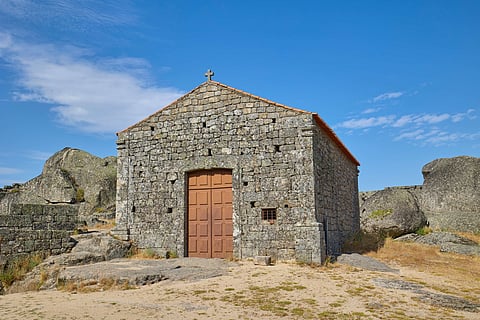
Capela de Santa Mario do Castelo, a small ancient granite chapel located within the grounds of the castle of Monsanto Shutterstock
The settlement below evolved in much the same way. Instead of clearing away the huge granite formations, residents incorporated them into their homes. A boulder could become a wall, another the floor, and an especially large slab could serve as a roof. One house is known as Casa de Uma Só Telha, or the House of One Tile, because a single granite rock forms its roof.
It is this practical relationship with the landscape that makes Monsanto so striking. The village does not have a neat division between geology and architecture. The two are mixed together.
Follow The Lanes To The Castle
The best way to see Monsanto is on foot, preferably without trying to impose too rigid a route. Start among the houses and follow the steep cobbled lanes upwards. Along the way are Manueline doorways, old manor houses, the Pelourinho, the Igreja da Misericórdia and the 14th-century Torre de Lucano, also called the Clock Tower.
Advertisement
Look up at the Torre de Lucano, and you will spot its silver rooster. The rooster is a replica of the trophy Monsanto received in 1938, when it won a national competition naming it the “Most Portuguese Village in Portugal.” The competition helped cement the village's image as a symbol of traditional Portuguese architecture and culture.
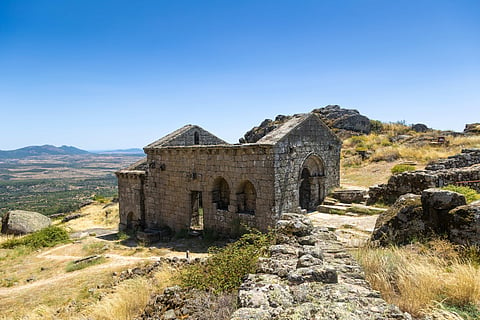
São Miguel Chapel Shutterstock
The climb continues towards the castle. Inside the old walls are the remains of the Torre de Menagem, cistern and Santa Maria do Castelo, a church rebuilt over an earlier Templar religious structure. Beyond the fortifications are the ruins of São Miguel Chapel, a Romanesque building dating to the 12th or 13th century, with graves cut directly into the surrounding rock.
Then there is the view. From the summit, Monsanto opens onto the plains of Beira Baixa and the wider landscape towards the Spanish frontier. The climb is steep, and the uneven stone underfoot makes sensible footwear useful, but the panorama explains why this hill was valuable as a defensive position for centuries.
Advertisement
Back in the village, look for the house associated with the physician and writer Fernando Namora. He lived and practised medicine in Monsanto, and the village later provided inspiration for his novel Retalhos da Vida de um Médico.
The Legends, Festivals, And Screen Fame
Monsanto’s most colourful tradition comes from the old siege legend. According to local lore, when food was running out, the villagers sent a heifer stuffed with grain rolling down the hillside. The besieging forces supposedly took this as evidence that the defenders still had plenty of food and abandoned the siege.

Aerial view of Monsanto, Portugal Shutterstock
The story is remembered every May during the Festa das Cruzes, or Festival of the Crosses. Villagers climb towards the castle accompanied by singing and the sound of adufes, traditional Portuguese frame drums. Decorated clay pots symbolising the heifer are then thrown from the castle walls. The festival takes place on May 3 or the following Sunday.
Advertisement
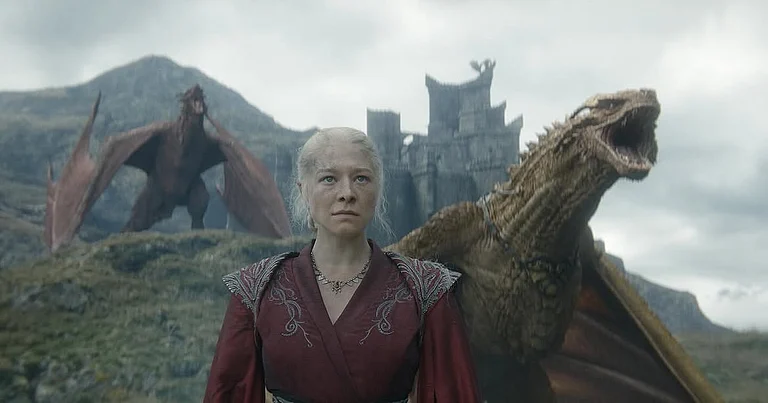
There is another reason the village may look familiar to television viewers. Monsanto was used as a filming location for HBO’s “House of the Dragon,” with the medieval castle providing part of the show’s fantastical landscape. The production was filmed at the Castle of Monsanto in 2021.
Yet the screen connection is almost incidental. What makes Monsanto memorable is something far older and more tangible: the way people built a village without trying to tame the mountain.
Walk a little farther, and another boulder becomes a wall. A doorway appears beneath a slab of granite. A staircase squeezes between two rocks. Above it all, the castle ruins sit on the summit.
In Monsanto, the most impressive building material was already there. The villagers simply learned how to build around it.
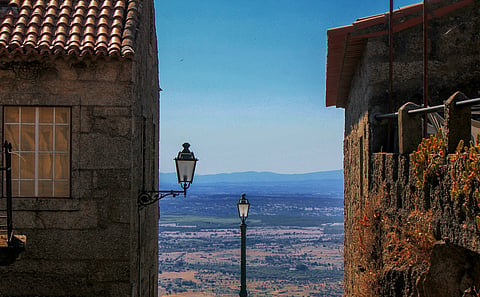
A viewpoint in Monsanto, Portugal Unsplash
The Information
Where To Stay
For a comfortable base near Monsanto, BODE Country House is a good option. Housed in a restored stone building surrounded by olive trees, the property keeps its rural character while adding contemporary rooms, a swimming pool and a restaurant. It is located below the historic village, making it easier to reach by car while still being close enough for a day of exploring Monsanto's cobbled lanes and castle.
Advertisement
For travellers looking for a more historic setting, Quinta de São Pedro de Vir-a-Corça, a former estate near the village, has rooms in a restored rural property surrounded by woodland and gardens.

Inside BODE Country House, Monsanto Official Website/bodecountryhouse.pt
What to Eat
Food in Monsanto is rooted in the cooking of Beira Baixa, with grilled meats, stews, local cheeses, and bread featuring prominently. At O Carlos, look for regional dishes such as posta à Mirandesa, roast kid goat, grilled octopus and cod, along with meats cooked over charcoal. Around the village, small tavernas serve plates of cured meats and sheep's cheese, while chanfana, a slow-cooked goat dish, and cabrito assado, roast kid goat, are among the local specialities to look for. Pair the meal with a wine from the Beira Interior region, whose vineyards spread across the surrounding countryside.
FAQs
1. Why is Monsanto in Portugal famous?
Monsanto is known for its unusual granite architecture, with houses built around, beneath and between enormous natural boulders.
Advertisement
2. Where is Monsanto in Portugal?
Monsanto is in Portugal’s Beira Baixa region, near the Spanish border, and rises on the slopes of Cabeço de Monsanto.
3. What can you see in Monsanto?
Key sights include the boulder-built houses, Torre de Lucano, Pelourinho, historic churches, the medieval castle and the ruins of São Miguel Chapel.
4. Why does Monsanto have a Templar castle?
King Afonso Henriques gave Monsanto to the Knights Templar in the 12th century. The castle was subsequently developed as a frontier stronghold.
5. Was House of the Dragon filmed in Monsanto?
Yes. HBO’s House of the Dragon used Monsanto and its medieval castle as a filming location in 2021.
Published At: