In Lepakshi, a small temple town in Andhra Pradesh’s Sri Sathya Sai district, architecture tells stories that span centuries. Carved into the rocky landscape of Kurmasaila hill, the Sri Veerabhadra Temple brings together intricate stonework, elaborate ceiling paintings, imposing monolithic sculptures, and an architectural feature that continues to puzzle visitors: a pillar that barely touches the ground. Built during the Vijayanagara Empire in the 16th century, the temple complex reflects a period when artistic expression and engineering were closely intertwined. Yet, Lepakshi's appeal extends beyond its principal shrine. From the unfinished mandapas and mythological murals to the enormous Nandi carved from a single block of granite, the town offers an absorbing introduction to South India's architectural and cultural heritage.
Exploring Lepakshi: The Temple Town Famous for Its Hanging Pillar and Stunning Murals
Discover Lepakshi in Andhra Pradesh, home to a 16th-century Vijayanagara temple, a hanging pillar, ancient murals, and a giant Nandi

A Temple Rooted In Vijayanagara History
The centrepiece of Lepakshi is the Sri Veerabhadra Temple, dedicated to Veerabhadra, a formidable manifestation of Lord Shiva. Constructed during the reign of Vijayanagara ruler Achyuta Deva Raya in the 16th century, the temple is associated with two brothers, Virupanna and Viranna. Historical inscriptions found within the complex point to their involvement in its construction, with Virupanna believed to have been an official in the royal administration.
Set atop Kurmasaila, a rocky hill whose contours resemble a tortoise, the temple was designed to accommodate the uneven terrain. Its architecture draws from several South Indian traditions, incorporating elements associated with the Chalukyas, Hoysalas, Pandyas, and Cholas within the broader Vijayanagara style. The result is a complex where sculptural detail, carefully planned spaces, and religious symbolism come together.
The temple is also a centrally protected monument of national importance, recognised for its architectural and artistic significance. Beyond the main shrine dedicated to Veerabhadra, the complex contains several smaller shrines, including those dedicated to Papanasesvara, Raghunatha, Parvati, Ramalinga, and Hanumalinga.
Mandapas That Preserve Stories In Stone And Paint
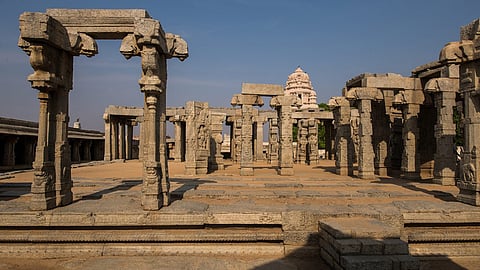
One of the most striking sections of the temple is the Natya Mandapa, or dance pavilion. Supported by intricately carved pillars, this expansive hall is known for its elaborate sculptures and ceiling murals. The paintings depict episodes from the Ramayana, Mahabharata, and Puranas, offering visitors a visual introduction to India's mythological traditions. Among the subjects represented are the divine marriage of Lord Shiva and Goddess Parvati, scenes from the life of Lord Krishna, and the encounter between Arjuna and Shiva, popularly associated with the Kiratarjuniyam.
A particularly notable feature is the monumental mural of Veerabhadra, which is regarded as one of the largest depictions of the deity. Other paintings portray different manifestations of Shiva, adding to the religious and artistic richness of the pavilion. Executed using the fresco-secco technique, the murals retain traces of the natural pigments and painting traditions of the Vijayanagara period.
The artistic continuity extends into the Ardha Mandapa, the passage leading towards the sanctum. Here, painted surfaces and carved details complement the adjoining pavilion, creating a connected visual narrative. The unfinished Kalyana Mandapa, believed to have been intended for the celestial wedding of Shiva and Parvati, is another important feature of the complex. Its incomplete state has inspired a local legend involving Virupanna and Viranna. According to folklore, Virupanna was accused of misappropriating royal funds for the temple's construction. Punished by the emperor, he was allegedly blinded, and reddish stains on the nearby walls are traditionally associated with the blood from his eyes. While the story remains part of local lore, the unfinished structure continues to offer a glimpse into the temple's history.
The Hanging Pillar And Other Architectural Curiosities
No visit to Lepakshi is complete without seeing its famous hanging pillar. Located within the temple's pillared hall, it appears to remain suspended just above the floor, with a small gap beneath its base. Visitors often demonstrate the feature by sliding a piece of cloth or paper underneath it. The pillar has long attracted attention from architects, historians, and travellers interested in the engineering techniques employed by Vijayanagara builders.
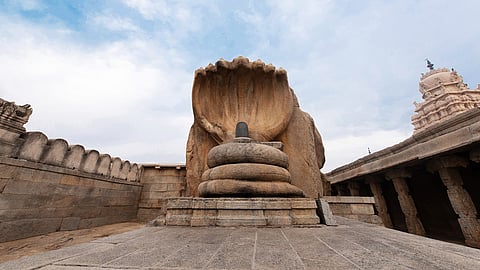
Another distinctive feature is the giant footprint carved into the temple floor, traditionally believed to belong to Sita. Local belief holds that its big toe remains perpetually wet, adding another layer of mythology to the site. Nearby stands the Nagalinga, a massive Shiva lingam sheltered by a seven-hooded serpent carved from a single piece of stone. Its scale and detailing make it one of the temple's most recognisable sculptural features.
The complex also contains carvings of Ganesha and a depiction of a spider, serpent, and elephant worshipping a Shiva lingam, recalling the legend of Sri Kalahasti. Numerous inscriptions, including those in Kannada, further reflect the cultural and administrative connections between the Vijayanagara kingdom and the neighbouring regions.
The Monolithic Nandi That Guards The Temple
A short distance from the main temple stands another of Lepakshi's celebrated creations: a colossal Nandi, the sacred bull associated with Lord Shiva. Carved from a single block of granite, the sculpture measures approximately 15 feet in height and 27 feet in length, making it one of India's largest monolithic Nandi figures.
Seated with its head turned towards the Nagalinga within the temple complex, the sculpture is adorned with an elaborate necklace, decorative bells, and other finely carved ornaments. Its proportions, polished contours, and attention to detail demonstrate the sculptors' command over stone. The Nandi is also an important landmark in its own right, drawing visitors beyond the main temple precinct.
Where History Meets The Ramayana

Lepakshi's cultural identity is closely associated with the Ramayana. According to local tradition, this is where the wounded Jatayu fell after attempting to rescue Sita from Ravana. When Lord Rama encountered the injured bird, he is believed to have said, "Le Pakshi," meaning 'Rise, bird' in Telugu. The expression is traditionally regarded as the origin of the town's name.
The earliest literary reference to Lepakshi is also associated with the Skanda Purana, which mentions the site as Lepakshya-Papanasanah, a sacred destination dedicated to Lord Shiva. These religious associations, together with its historical inscriptions and architectural remains, give the town a significance that extends beyond its celebrated temple.
Today, Lepakshi continues to draw architecture enthusiasts, history lovers, and pilgrims. The annual Lepakshi Utsavam, generally held around March, adds to its cultural calendar through celebrations of regional art, music, and dance. With its combination of Vijayanagara craftsmanship, mythological narratives, and remarkable stonework, Lepakshi offers an opportunity to explore a chapter of South Indian history through the buildings and artworks that have survived it.
FAQs
1. Where is Lepakshi located?
Lepakshi is a temple town in Andhra Pradesh's Sri Sathya Sai district.
2. What is Lepakshi famous for?
Lepakshi is known for its 16th-century Sri Veerabhadra Temple, hanging pillar, intricate murals, and monolithic Nandi sculpture.
3. Who built the Lepakshi Temple?
The temple was built during the reign of Vijayanagara ruler Achyuta Deva Raya, with inscriptions associating its construction with Virupanna and Viranna.
4. What is special about the hanging pillar at Lepakshi Temple?
The pillar appears to hang slightly above the floor, allowing visitors to pass a thin object beneath its base.
5. What is the best time to visit Lepakshi?
The cooler months between October and March are suitable for exploring Lepakshi. Visitors can also plan around the annual Lepakshi Utsavam, generally held in March.
