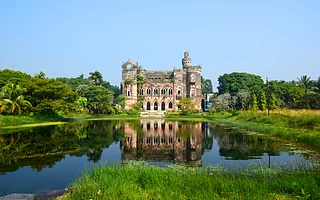


On his third attempt to photograph a temple in Halishahar, Sanjay Das found it almost swallowed by vegetation. The walled compound was difficult to enter, and a woman living nearby warned that snakes could appear without warning. But trees were pressing against the already fragile structure. Das had postponed the picture twice; in 2023, he finally went in. “I knew that the temple might disappear in a couple of years,” he said. “I did not want to miss the opportunity to document it.”
This urgency has shaped the Delhi-based photographer’s work since 2011, when he first travelled to Kolkata for an exhibition and began exploring Bengal beyond the city. He had not set out to photograph temples; he discovered them while travelling through the state. Once he began studying their architecture, he realised they needed sustained documentation. He returned again and again, driving from Delhi, planning routes around temples identified through research and photographing as many as 20 in a day.
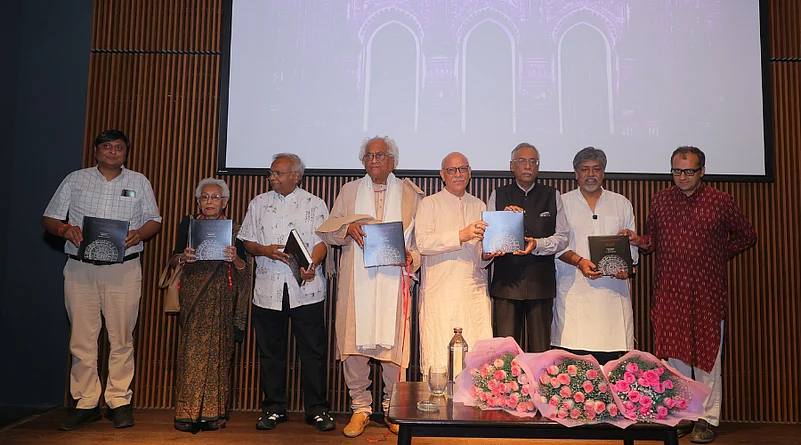
His work has now been published in "Terracotta Temples of Bengal," a 400-page book featuring his photographs, with text by Subhra Mazumdar and published by Niyogi Books. Still, Das said the volume holds only about a tenth of the material he has documented. The book is less a guide to a single temple circuit than a record of a widely dispersed architectural tradition, with examples across 11 districts of Bengal.

The Art In Clay
Bishnupur remains the best-known destination for Bengal’s terracotta temples. But away from its better-recognised complexes, temples survive in family courtyards, near homes, behind estates and beneath vegetation in villages across districts such as Bardhaman, Murshidabad, Krishnanagar, and Purulia. Many were built between the 16th and 19th centuries, when local patrons adapted familiar building forms into temples decorated with fired-clay panels.
The architecture is rooted in place. Chala temples echo the sloping roofs of Bengal’s huts; ratna forms add towers or spires; dalan temples have flat roofs. Brick and baked clay offered an alternative to stone, while giving artisans a surface for detailed reliefs. The panels depict episodes from the Ramayana and Mahabharata, Krishna’s life, gods and goddesses, but also musicians, animals, warriors, traders and scenes of everyday life. Read together, they preserve not only religious belief but fragments of the social world that surrounded the shrines.
The architectural tradition also reflects centuries of cultural exchange. Local building practices evolved alongside influences from Islamic and later European architecture, producing forms that vary across districts and patronage settings. These temples are therefore more than religious structures: their walls offer glimpses of the artistic choices, social hierarchies and everyday experiences of the communities that built them.

Between Faith And Decay
For Das, the temples are not only structures under threat; they are places whose meaning often outlasts the condition of their buildings. One temple, almost hidden by vegetation, hosts what he describes as the region’s biggest Shivaratri celebration. At other sites, worship has continued in a different form: when the original structure became unusable, families moved the deities into their homes. “Why? Because of faith,” he said. In some places, elaborate rituals continue in imposing structures; elsewhere, the brickwork is crumbling.
Yet faith alone cannot hold up a roof or prevent the loss of terracotta panels. The conservation picture is uneven. Only a few temple complexes are protected by the Archaeological Survey of India, while some structures under state protection suffer from poor upkeep. Vegetation can crack walls, and badly judged repairs, including synthetic paint over carved surfaces, can obscure the details they are meant to preserve.
The difficulties are not always architectural. At Kolkata’s Boro Rajbari, Das found 12 chala temples behind the main building, each now occupied by someone as their makeshift home. At another site, the land behind a temple had become a public toilet. These are not monuments entirely removed from contemporary life. Their upkeep can depend on people who may not have the resources, agreement or incentive to restore them.

Das does not foreground every sign of neglect in his photographs. He approaches the temples as an artist, considering composition, light and shadow, and wants viewers to see them as works of art rather than simply records of decay. It is a deliberate choice, but it also points to the limits of visual archiving: an image can make a temple visible without documenting every social problem around it.
Preserving Through The Lens
He is not the first to undertake such work. Photographers and researchers, including Mukul Dey and David McCutchion, documented Bengal’s temples in earlier decades, leaving behind important records of structures that have since changed. Das’s work continues that tradition, but its urgency raises a difficult question: what does it mean to repeatedly photograph a heritage that conservation systems have not consistently protected?
Das said he has received support, though less than he had hoped for. “If you keep waiting for this kind of support, you end up delaying your work,” he said. He has continued to travel and document, supported by his family and encouraged by people who recognised the value of the project.
For travellers, following this trail means looking beyond Bishnupur’s celebrated temples to a much wider heritage across Bengal. But these structures should not be treated simply as hidden finds or picturesque ruins. Das’s photographs offer a way to see their detail, variety and vulnerability. They can preserve a visual record. Keeping the temples themselves standing will take sustained conservation, informed repairs and attention to the communities that still live with them.
FAQS
1. What are Bengal’s terracotta temples?
Bengal’s terracotta temples are religious structures decorated with intricate fired-clay panels depicting mythological stories, deities, animals, musicians, warriors and scenes from everyday life. Many were built between the 16th and 19th centuries.
2. Where can you find terracotta temples in Bengal?
Bishnupur is the best-known destination for terracotta temples, but examples are also found across districts such as Bardhaman, Murshidabad, Krishnanagar and Purulia, often in villages, family courtyards and old estates.
3. Who is Sanjay Das, and what is his book about?
Sanjay Das is a Delhi-based photographer who began documenting Bengal’s terracotta temples in 2011. His 400-page book, Terracotta Temples of Bengal, published by Niyogi Books, features his photographs alongside text by Subhra Mazumdar.
4. What architectural styles are found in Bengal’s terracotta temples?
Common styles include chala temples, inspired by the sloping roofs of Bengal’s traditional huts; ratna temples, characterised by towers or spires; and dalan temples, which feature flat roofs. Their terracotta panels often combine religious imagery with scenes of social and cultural life.
5. What are the main conservation challenges facing Bengal’s terracotta temples?
Many temples face neglect, vegetation damage, crumbling brickwork and poorly executed repairs that obscure their terracotta details. Some remain in active use or are occupied by local residents, making conservation dependent on sustained upkeep, appropriate restoration and engagement with the communities around them.