A journey between Paris and Milan could soon become considerably shorter, thanks to an ambitious railway project taking shape beneath the Alps. France and Italy are jointly building the 57.5-kilometre Mont Cenis Base Tunnel, an engineering project that will connect the two countries through one of Europe's most challenging mountain ranges. Once operational, it is expected to become the world's longest railway tunnel, overtaking Switzerland's Gotthard Base Tunnel, which currently holds the record at 57 kilometres.
France And Italy Build World's Longest Railway Tunnel To Transform European Train Travel
The Mont Cenis Base Tunnel will become the world's longest railway tunnel. Here's how the France-Italy project will transform European train travel

Advertisement
Part of the larger Lyon-Turin railway project, the tunnel is designed to make cross-border travel faster and more efficient, for both passengers and freight. The development is also expected to strengthen Europe's rail network by providing a more direct connection between major cities, reducing dependence on road transport, and improving connectivity along an important east-west trade route.
Beneath The Alps
The Mont Cenis Base Tunnel will run beneath the Alps, linking Saint-Jean-de-Maurienne in France with Susa in Italy. At 57.5 kilometres, it will be slightly longer than the Gotthard Base Tunnel in Switzerland, making it the longest railway tunnel in the world once completed.
The infrastructure will comprise two parallel tubes, with each carrying a single railway track to facilitate train movement in both directions. This arrangement is intended to accommodate both high-speed passenger services and freight trains, while also incorporating provisions for passenger safety. The two main tunnels will be connected by 204 emergency cross-passages, positioned at intervals of 333 metres. These passages will allow passengers and railway personnel to move between the tubes in case of an emergency.
Advertisement
The tunnel forms the central component of the approximately 270-kilometre Lyon-Turin railway corridor, which will pass through France for around 70 per cent of its length and Italy for the remaining 30 per cent. The corridor will also become an important section of the Mediterranean Corridor, a railway network spanning approximately 3,000 kilometres across Europe. This wider transport route is intended to improve connections between several major European cities and facilitate the movement of goods across national borders.
Faster Cross-Border Journeys
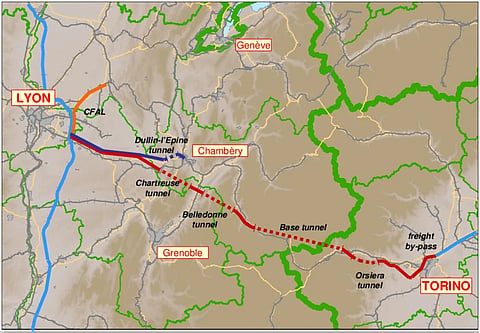
Faster cross-border journeys could reshape travel between France and Italy researchgate
For travellers, one of the biggest advantages of the new railway connection will be the reduction in journey times between France and Italy. The proposed route is expected to bring major cities closer, making international rail travel a more convenient alternative to longer journeys by road.
A non-stop train journey between Turin and Lyon, which currently takes approximately three hours and 47 minutes, is projected to take just one hour and 47 minutes once the new connection becomes operational. The Paris-Milan journey could see an even more significant reduction, with travel time expected to fall from around seven hours to four hours and 30 minutes. This represents a saving of approximately two-and-a-half hours.
Advertisement
The Turin-Paris journey is also expected to become faster, with the projected travel time dropping to around four hours, saving approximately 90 minutes. These improvements could make cross-border trips more accessible for tourists, business travellers, and commuters, while encouraging more people to consider trains for journeys between the two countries.
Freight transportation is another major focus of the project. A single freight train using the new corridor will be capable of carrying cargo equivalent to approximately 60 heavy trucks. By shifting a greater volume of goods from roads to railways, the project aims to improve transport efficiency and reduce the pressure of heavy vehicle traffic on European highways.
Construction And Completion
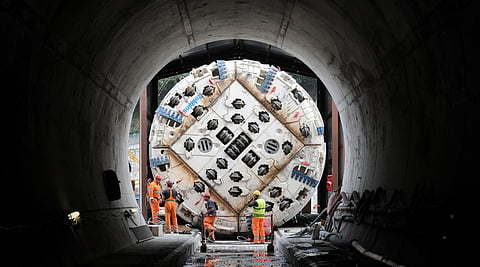
The ambitious project connecting two major European travel destinations systra
Building a railway tunnel of this scale through the Alps involves extensive excavation and complex underground engineering. The wider Lyon-Turin project includes approximately 164 kilometres of underground tunnels, comprising the two main railway tubes, four access tunnels, and emergency passages.
Advertisement
Excavation is currently progressing across 14 different construction sites. By mid-October 2026, more than 50 kilometres of the total 164 kilometres of underground tunnels had been excavated. Work is being carried out across multiple sections, with construction teams advancing through different parts of the mountainous terrain.
The project was designed in 2015 and received its construction permit in 2018. While the Mont Cenis Base Tunnel remains the most significant component, completing the larger railway corridor will also require the development of connecting infrastructure on both sides of the border.
Construction and railway connections are targeted for completion by 2033, after which train services are expected to begin operating. Once ready, the corridor could significantly change the way people and goods move between France and Italy, offering shorter journeys and strengthening railway connectivity across Europe. For travellers planning a European holiday, the prospect of reaching Milan from Paris in four-and-a-half hours could make the train an increasingly appealing way to cross the Alps.
Advertisement
FAQs
1. What is the Mont Cenis Base Tunnel?
It is a 57.5-kilometre railway tunnel being built beneath the Alps to connect France and Italy.
2. Will the Mont Cenis Base Tunnel be the world's longest railway tunnel?
Yes. At 57.5 kilometres, it will surpass Switzerland's 57-kilometre Gotthard Base Tunnel.
3. How much time will the tunnel save on the Paris-Milan journey?
Travel time is expected to fall from around seven hours to four hours and 30 minutes, saving approximately two-and-a-half hours.
4. When will the Mont Cenis Base Tunnel be completed?
Construction and railway connections are targeted for completion by 2033, with train services expected to begin thereafter.
5. What is the Lyon-Turin railway project?
It is a 270-kilometre railway corridor connecting France and Italy, with the Mont Cenis Base Tunnel as its central component.

Published At: