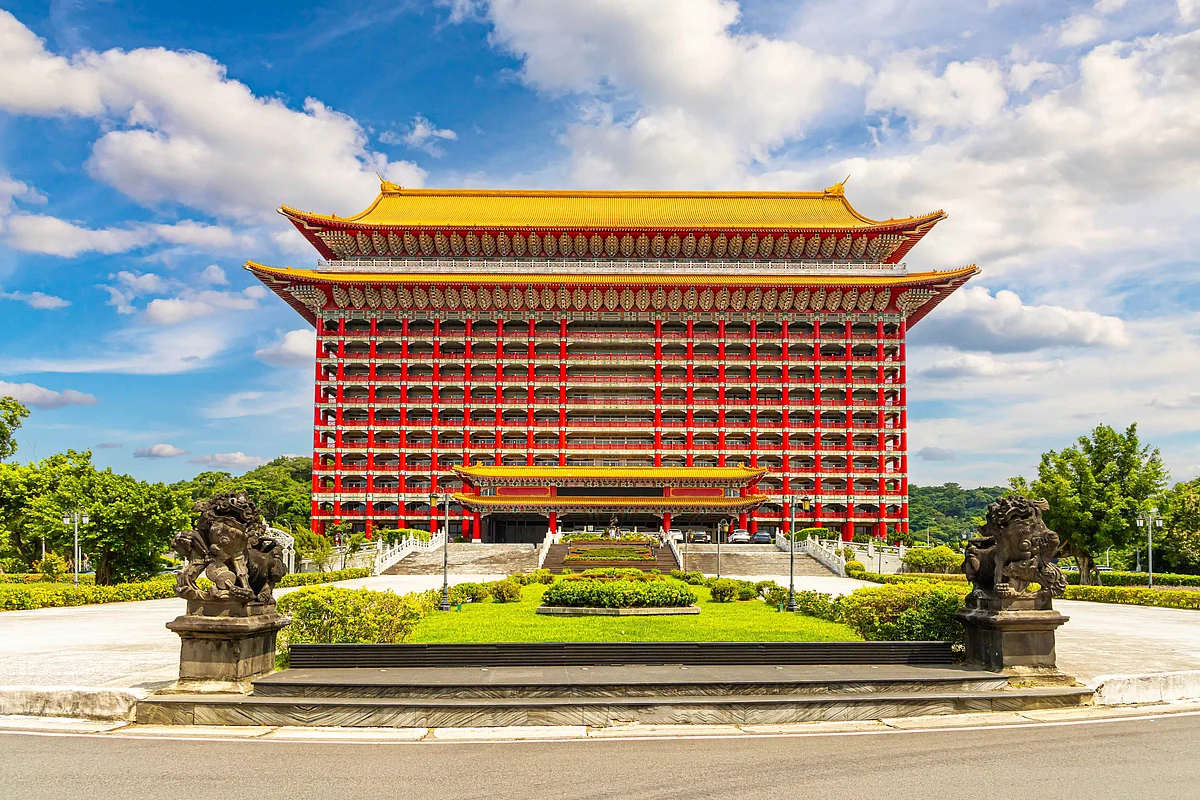
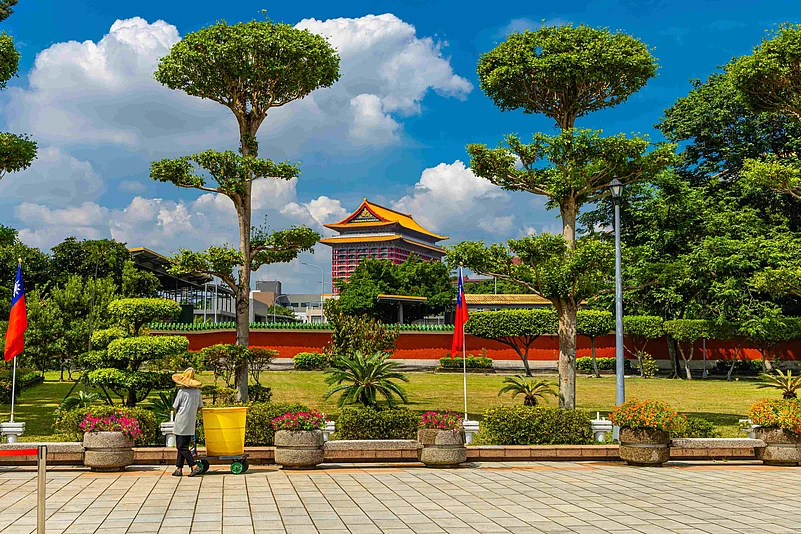
The Grand Hotel Taipei is the sort of building that makes an impression before you even step inside. Perched on Yuanshan Mountain, the landmark rises above the city with its sweeping golden roof, red columns, and ornate Chinese palace-style architecture. It looks every bit the grand hotel it was meant to be, built to welcome foreign dignitaries and give visitors a glimpse of Chinese culture and craftsmanship.
But there is more to the building than its elaborate interiors and imposing façade. Beneath the hotel lies a pair of secret evacuation tunnels, built during a period of political uncertainty and designed to help Taiwan's leaders escape in the event of an air raid or military attack. One of them even has a concrete slide intended to speed up the evacuation of elderly leaders.
The tunnels remained largely out of public view for decades. Today, they offer a different way to understand one of Taipei's most recognisable landmarks, taking visitors from the grandeur above ground into a quieter, more secretive chapter of its history.
A Hotel Built To Impress
The story of The Grand Hotel Taipei began in 1952, when Soong Mei-ling, better known as Madame Chiang Kai-shek, established the property to accommodate visiting foreign dignitaries and other important guests. At the time, Taiwan was keen to strengthen its international relationships, and a hotel of this scale offered a way to showcase Chinese architectural traditions and hospitality.
The main building, completed on October 10, 1973, stands 14 storeys tall and rises about 87 metres above the surrounding landscape. Its design draws from traditional Chinese palace architecture, with a sweeping golden roof, vermilion columns and intricate decorative details. Dragons, considered symbols of power and good fortune in Chinese culture, appear throughout the property.
The result is a building that feels closer to an imperial palace than a conventional hotel. Its position on Yuanshan Mountain adds to the effect, with views over Taipei and a sense of distance from the busy streets below.
Yet the same building that was designed to project grandeur also had a more practical purpose. In an era marked by Cold War tensions, it needed to offer protection should the political situation take a dangerous turn.
The Secret World Beneath The Hotel

For years, the tunnels beneath The Grand Hotel Taipei remained largely unknown to the public. Their existence became more widely discussed following a fire in 1995, which led to reconstruction work at the property and renewed attention to its hidden infrastructure.
The tunnels were designed as emergency escape routes for important figures, including Chiang Kai-shek, Taiwan's former leader. Their purpose was straightforward. If the hotel came under attack, its occupants needed a way to leave without relying on the main entrances or exposed stairways.
There are two tunnels, each with its own route and design. The West Tunnel measures approximately 85 metres, while the East Tunnel stretches for around 67 metres. Both feature winding passages intended to make movement less direct and offer protection in an emergency.
Their construction also reflects the security concerns of the time. Reinforced concrete, carefully planned corridors and specialised lighting were intended to make the routes more resilient during an attack. The tunnels were reportedly designed to accommodate large numbers of people, although their exact capacity and technical specifications are best understood through the hotel's historical interpretation.
The West Tunnel And Its Unusual Concrete Slide
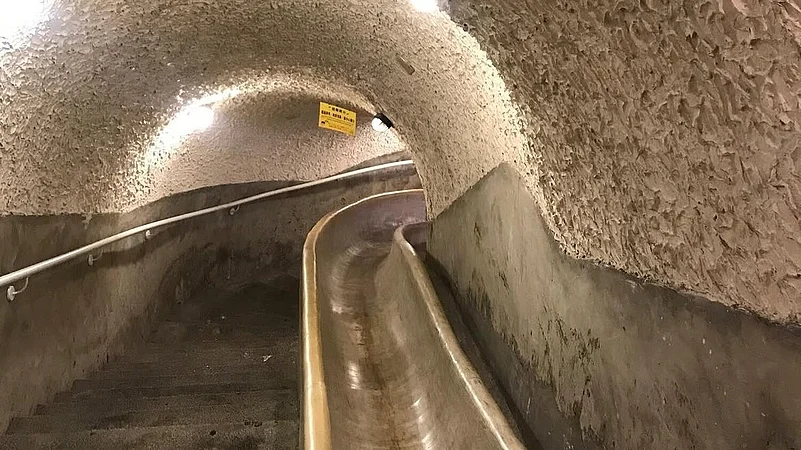
Of the two routes, the West Tunnel is perhaps the more intriguing, thanks to a feature that sounds almost out of place in an emergency bunker. It contains a concrete slide measuring about 20 metres in length.
The slide was designed to help elderly or less mobile leaders evacuate quickly. Rather than attempting to navigate a staircase during an emergency, an occupant could use the sloping route to descend towards the exit near Jiantan Park.
The tunnel's winding layout also helped limit direct lines of sight through the passage. This was important in a setting where the threat of gunfire or an attack could not be ruled out.
Visitors can learn about the slide during guided tours, although using it is not permitted. It remains a historical feature rather than an attraction to try out.
The East Tunnel Takes A Different Route
The East Tunnel offers a contrasting experience. At approximately 67 metres long, it features winding corridors and steep concrete steps rather than the West Tunnel's distinctive slide.
Its design was intended to make the passage more difficult to navigate directly from outside, while the walls and bends helped reduce sound transmission and obstruct a clear line of sight. The route leads towards an exit in the direction of Beian Park and the surrounding grounds.
Walking through the passage offers a sense of how much thought went into planning an escape route that would remain concealed from the outside. Unlike the hotel above, where symmetry and ornamentation are central to the design, the tunnels prioritise function.
How To Visit The Secret Tunnels
The tunnels can be explored through guided historical tours organised by The Grand Hotel Taipei. These visits provide a closer look at the hotel's history, its security arrangements and the engineering behind the underground routes.
Tour arrangements, access to individual tunnels and available timings can change, so it is worth checking the hotel's official website before planning a visit. The West Tunnel's slide is not open for public use, and visitors should follow the hotel's safety instructions throughout the tour.
Depending on the tour programme, visitors can also see other historical features within the property, including its celebrated golden dragon sculpture, finished with 24-karat gold gilding, and displays connected to the hotel's past.
For anyone interested in architecture, history or the stories hidden inside familiar landmarks, the experience offers something beyond a conventional hotel visit.
The Information
Address: No. 1, Section 4, Zhongshan North Road, Zhongshan District Taipei City, 104427
Tariff: Approximately NT$5,360 (approx. INR 16,000) per night, depending on the season, room type and booking date.
Contact: +886-2-2886-8888; Email: grand@grand-hotel.org
Official Website: grand-hotel.org
Guided Tunnel Tour: NT$250 (INR 758) per adult and NT$100 (INR 303) per child aged 6–12; advance reservations are generally recommended, with tours typically scheduled at 10:00, 14:30 and 15:30.
FAQs
1. Does The Grand Hotel Taipei have secret tunnels?
Yes. The Grand Hotel Taipei has two historic evacuation tunnels beneath the property, designed as emergency escape routes during a period of political uncertainty.
2. Why were the tunnels beneath The Grand Hotel Taipei built?
The tunnels were intended to help important figures evacuate the hotel in an emergency, including in the event of an air raid or military attack.
3. How many secret tunnels are beneath The Grand Hotel Taipei?
There are two tunnels, known as the West Tunnel and the East Tunnel. The West Tunnel measures approximately 85 metres, while the East Tunnel is around 67 metres long.
4. What is unusual about the West Tunnel?
The West Tunnel contains a concrete slide approximately 20 metres long, designed to help elderly or less mobile leaders descend quickly during an emergency. Visitors cannot use the slide.
5. Can visitors tour the secret tunnels beneath The Grand Hotel Taipei?
Yes. The hotel organises guided historical tours that provide insight into the tunnels and their construction. Visitors should check the hotel's official website for current timings, availability and reservation requirements.