

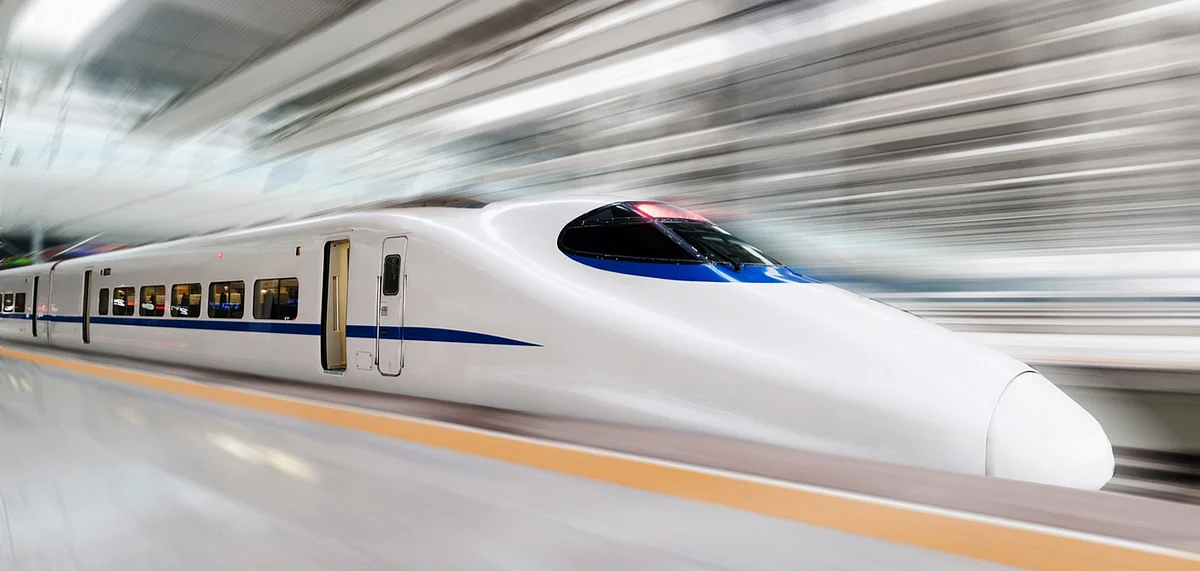
India’s much-anticipated bullet train project is finally approaching a significant milestone, and the first glimpse of high-speed rail travel in the country could be just months away. After years of construction, engineering work and infrastructure development, the Mumbai–Ahmedabad bullet train corridor is preparing for its first major round of trials in May 2027.
The initial testing will take place on a 50-km elevated stretch between Surat and Bilimora in Gujarat. The development follows the completion of electrification work on this section, bringing India’s first high-speed rail project closer to testing its indigenous bullet train. If the proposed schedule holds, the trials will pave the way for passenger services on an initial section of the corridor later in 2027.
Surat–Bilimora Stretch Gets Ready For India's First Bullet Train Trials
The 50-km Surat–Bilimora section has become the first part of the Mumbai–Ahmedabad High Speed Rail (MAHSR) corridor to achieve a major electrification milestone. On November 20, 2026, the Overhead Equipment (OHE) system was successfully energised on both the Up and Down tracks of the elevated alignment, the Ministry of Railways announced.
The section uses an advanced 2 × 25 kV overhead traction system, which supplies electricity to high-speed trains. The entire 508-km corridor will have 14 traction substations to draw power from the national grid and feed the overhead electrical network. The first traction substation at Bilimora, in Gujarat's Navsari district, has also completed the installation of its key equipment, including transformers, circuit breakers and control panels.
There is more work underway before the tracks can welcome the trainsets. Signalling-related work on the Surat–Bilimora section is expected to be completed by January 2027, after which the track will be prepared for trials. The testing programme is expected to begin around April–May 2027, with railway minister Ashwini Vaishnaw indicating that May or June is the likely window.
The 50-km section also includes bridges across four rivers and a steel bridge over National Highway 53. Around 94,000 noise barriers have been installed along the elevated viaduct to reduce the impact of train operations on nearby communities.
Meet The Made-In-India B28 Bullet Train
Another significant development is the manufacturing of India's first indigenous bullet train. The B28 trainset is being developed by BEML at its Bengaluru facility, with the Integral Coach Factory (ICF) in Chennai involved in the project.
Designed for Indian weather conditions, the train has a maximum test speed of 280 kmph and a planned operational speed of 249 kmph. According to the Ministry of Railways, the train will measure approximately 202 metres and feature eight coaches, comprising four motor cars and four trailer cars.
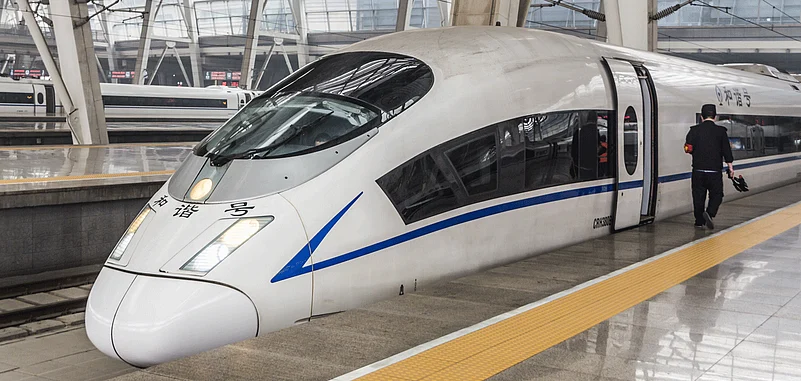

The train is being designed with passenger comfort in mind. Its proposed features include fully air-conditioned chair cars, reclining and rotatable seats, onboard infotainment systems and facilities for persons with disabilities. The eight-coach configuration is expected to accommodate approximately 560 passengers.
The indigenous train is an important step towards developing India's own high-speed rail manufacturing capabilities. The country had initially planned to use Japanese Shinkansen technology for the Mumbai–Ahmedabad corridor. However, the current project is progressing with domestically manufactured B28 trainsets, while the government is also looking at a future B35 train designed for speeds of up to 350 kmph.
When Will India's First Bullet Train Carry Passengers?
The 50-km Surat–Bilimora trial section is part of a much larger 508-km Mumbai–Ahmedabad high-speed rail corridor. The route will connect 12 stations: Mumbai, Thane, Virar, Boisar, Vapi, Bilimora, Surat, Bharuch, Vadodara, Anand, Ahmedabad, and Sabarmati. It will pass through Maharashtra, Dadra and Nagar Haveli, and Gujarat.
The government plans to introduce passenger services in phases rather than wait for the entire corridor to be completed. The first passenger operations are expected on an approximately 100-km stretch between Surat and Vapi, with August 2027 being the targeted launch period. The exact opening date will depend on the completion of the remaining infrastructure and mandatory safety clearances.
Once the full corridor becomes operational, the Mumbai–Ahmedabad journey is expected to take approximately 1 hour and 58 minutes, considerably reducing the current travel time between the two cities.
Construction has also progressed across other sections. As of September 2026, approximately 456 km of pier work and 371 km of viaduct construction had been completed. Work is continuing on the Maharashtra section, which includes a 21-km tunnel, with around 7 km passing beneath Thane Creek. This will be India's first undersea rail tunnel.
For travellers, the prospect of boarding India's first bullet train is becoming more tangible. The May 2027 trials will be an important test of the country's high-speed rail ambitions, with the Surat–Bilimora section expected to provide the first indication of what the new journey could look like.
FAQs
1. When will India's first bullet train trials begin?
Trials are expected to begin in May 2027 on the 50-km Surat–Bilimora stretch in Gujarat.
2. Which route will host India's first bullet train trials?
The initial trials will take place between Surat and Bilimora in Gujarat, along the Mumbai–Ahmedabad High Speed Rail corridor.
3. When will India's first bullet train begin passenger services?
Passenger services on an initial section of the corridor are targeted for August 2027, subject to infrastructure completion and safety approvals.
4. What will be the speed of India's indigenous bullet train?
The B28 trainset is designed for a maximum test speed of 280 kmph and a planned operational speed of 249 kmph.
5. Which cities will the Mumbai–Ahmedabad bullet train connect?
The 508-km corridor will connect Mumbai, Thane, Virar, Boisar, Vapi, Bilimora, Surat, Bharuch, Vadodara, Anand, Ahmedabad and Sabarmati.