

Before Mata Ni Pachedi became a collector’s textile or a work of art displayed on gallery walls, it served a more fundamental purpose: to make space for a goddess where her devotees could not always enter a temple. Painted by generations of artisans in Gujarat, these cotton cloths carry a history shaped by faith, caste and the determination of a community to sustain its own forms of worship. The textile is proof that a shrine can be built without stone, its walls drawn in black ink and its sanctum painted in red.
Practised by artisan families in and around Ahmedabad, this distinctive form of textile painting is closely associated with the Devipujak community, also historically known as Vaghri. The cloth's original purpose as a backdrop for the deity is described by its name, which is generally translated as "behind the Mother Goddess." Larger panels, known as Mata no Chandarvo, could be arranged to create a temporary shrine or canopy. Together, these textiles offered a form of worship that could be assembled wherever a community gathered.
A Shrine Outside The Temple


The origins of Mata Ni Pachedi are closely linked to accounts of the Devipujak community’s exclusion from certain established temples because of caste discrimination. In response, community members developed their own settings for worship, painting the goddess on cloth and creating shrines that could be assembled wherever they gathered. This history is central to understanding the textile. Its portability was not simply a matter of convenience, but rather enabled worship to take place within community-controlled spaces.
The cloth became both an image of the divine and a means of establishing a place for the divine. The precise date at which the tradition began is difficult to pinpoint, and its origin story is best understood through the historical accounts associated with the community. What remains clear is the relationship between the textile and a form of religious expression shaped by social exclusion. Mata Ni Pachedi reflects not only what a community worshipped, but also how it adapted its practices in the face of caste-based barriers.
The Hands That Keep Faith Alive

The continuity of Mata Ni Pachedi rests on specialist knowledge passed between generations of artisans. The artisans behind the textile, also known as Chitara makers, understand the techniques of textile preparation, the behaviour of dyes and the iconography that gives each composition its religious meaning. The work requires more than the ability to reproduce a pattern: it involves knowing how figures relate to one another and how the goddess should occupy the cloth.
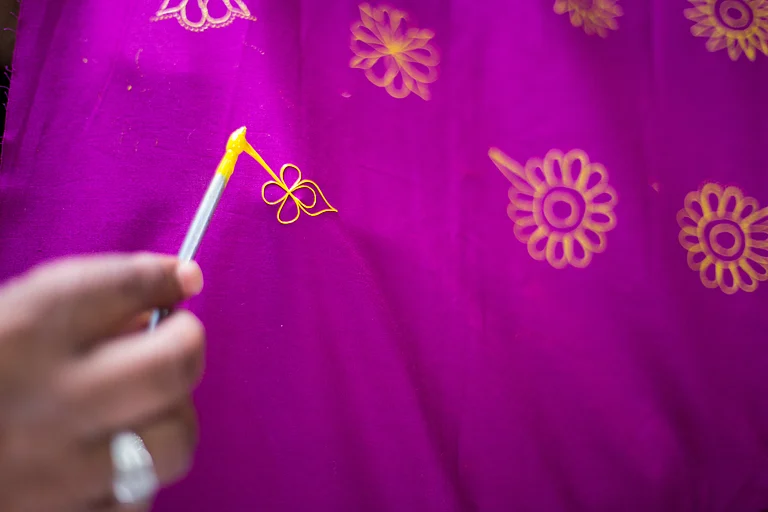
Cotton is prepared before the design is transferred onto it. Artisans draw the principal figures by hand, using wooden blocks where repeated motifs and borders call for consistency. The traditional palette centres on red and black, contrasted against white or the natural colour of the fabric. Historically, natural dyeing methods were used, including iron-based preparations for black and dye processes involving alum for red. Techniques and materials continue to vary, particularly as contemporary practitioners adapt their work. The finished textile brings together the visual discipline of drawing, the practical understanding of dyeing and the cultural memory carried by religious imagery.
A Goddess In Red And Black

The goddess usually dominates the composition, surrounded by attendants, devotees, animals and motifs drawn from religious stories and local traditions. Borders frame the scene, while smaller figures populate the spaces around the central deity. The cloth becomes a visual narrative, with the goddess at its centre and the surrounding imagery giving the composition its wider religious context. Red and black lend traditional examples their striking appearance, but the imagery is not simply ornamental.
These are sacred figures and stories embedded in a living tradition. The cloth’s original purpose was to facilitate worship, and its visual language developed within that context. Today, Mata Ni Pachedi is also produced for exhibitions, collectors and domestic interiors. This wider audience has created new opportunities for the craft, while changing the settings in which it is encountered. A piece intended for ritual use and one created as a decorative work may share techniques and motifs, but they do not necessarily serve the same purpose.
Keeping The Craft Alive

In 2023, Mata Ni Pachedi was registered as a Geographical Indication, acknowledging its regional character and connection to Gujarat. The recognition helps establish the textile’s provenance, but safeguarding a living craft involves more than protecting its name. It also means sustaining artisan livelihoods, encouraging the transmission of specialised skills and preserving the cultural context in which the work developed.
For travellers, engaging with Mata Ni Pachedi means looking beyond its appeal as a piece of traditional art. Learning about the makers, asking about the imagery and understanding the distinction between ritual and decorative textiles can offer a more considered encounter with the craft. The significance of Mata Ni Pachedi lies in what its makers have carried across generations. It offers a way of drawing the sacred, and a history of creating space where it was denied. Its cotton panels can be folded, transported and raised again.
The significance of Mata Ni Pachedi lies in what its makers have carried across generations. It offers a way of drawing the sacred, and a history of creating space where it was denied. Its cotton panels can be folded, transported and raised again. The shrine's tradition has found a way to make sacred spaces portable and inclusive, while also keeping its stories and history alive.
FAQs
1. What is Mata Ni Pachedi?
Mata Ni Pachedi is a traditional textile art from Gujarat featuring hand-painted images of the Mother Goddess and associated religious imagery. The cloth was traditionally used as a backdrop for worship and to create temporary shrines.
2. Why is Mata Ni Pachedi associated with caste-based exclusion?
Historical accounts link the tradition to the Devipujak community’s exclusion from certain established temples. Painted textiles allowed community members to create their own spaces for worship and sustain their devotional practices.
3. Who makes Mata Ni Pachedi?
The craft is associated with Chitara artisans, whose families have passed down the specialist skills of drawing, dyeing and painting the textiles. The tradition is closely linked to the Devipujak community in and around Ahmedabad, Gujarat.
4. What techniques and colours are used in Mata Ni Pachedi?
Traditional Mata Ni Pachedi uses cotton fabric, hand-drawn figures, wooden blocks and dyeing techniques. Red and black are characteristic colours, often contrasted against white or the natural colour of the cloth.
5. Does Mata Ni Pachedi have a Geographical Indication (GI) tag?
Yes. Mata Ni Pachedi received Geographical Indication registration in 2023, recognising its regional identity and association with Gujarat. The craft’s continuity also depends on artisan livelihoods and the transmission of traditional skills.