


In Hampi, where enormous granite boulders frame the remains of a once-flourishing empire, the Tungabhadra River has long been part of the region's cultural and everyday life. One of the oldest ways to experience this landscape is aboard a coracle, a traditional round boat that has ferried people and goods across the river for centuries. Today, these basket-like vessels offer travellers a chance to experience Hampi from the water while getting a glimpse of a river tradition that has endured through generations.
The History Behind The Coracle


The coracle is among the oldest forms of watercraft used in different parts of the world, with its own distinctive history along the Tungabhadra. Traditionally, it was made using a circular framework of interwoven bamboo or cane, covered with buffalo hide to make it watertight. Lightweight yet sturdy, the vessel was used to ferry people, animals and goods between the riverbanks. Its presence in Hampi dates back several centuries. Portuguese traveller Domingos Paes, who visited the Vijayanagara kingdom in the 16th century, documented these unusual basket-shaped boats in his account of the region. He described vessels with cane interiors and leather coverings that were large enough to carry groups of people, horses and oxen across the river.
While the basic circular design has endured, contemporary coracles have adapted to changing materials. Many now use plastic sheets and bitumen for waterproofing instead of animal hide. The boats are generally propelled using a single paddle, with the boatman steering through a combination of paddling and turning movements. Their ability to rotate on the water is one of their most distinctive characteristics.
What Is A Coracle Crossing Like?

A ride on the Tungabhadra offers a different perspective of Hampi, away from the walking trails that lead visitors through its temples and archaeological remains. Sitting low inside the rounded vessel, passengers watch the riverbanks unfold as a boatman navigates the water with a paddle. The surrounding landscape is particularly distinctive, with enormous granite boulders, rocky outcrops, stretches of vegetation and the occasional glimpse of ancient structures. The coracle's circular shape allows it to turn on the water, and some boatmen demonstrate this by gently spinning the vessel during the ride.
Popular boarding points around Hampi include the ghats near Virupaksha Temple, Kodandarama Temple and the Vittala Temple area. Depending on the route and river conditions, crossings can also connect visitors to settlements and attractions on the opposite bank. Karnataka Tourism lists typical rides as lasting around 20–40 minutes, although shorter crossings are also possible.
Across The River To Anegundi

One of the most interesting reasons to cross the Tungabhadra is to explore Anegundi, a historic settlement on the opposite bank. Predating the Vijayanagara Empire, the village is regarded as an early capital of the kingdom and retains traces of its long architectural and cultural history. Anegundi is also associated with Kishkindha, the mythical kingdom from the Ramayana believed to have been ruled by Sugriva. Nearby Anjanadri Hill is revered as the birthplace of Hanuman and remains an important pilgrimage destination.
Beyond its mythology, Anegundi offers a glimpse of a living heritage landscape. Its old houses, carved wooden pillars, temples and traditional streets sit amid a setting of rocky hills, agricultural fields and the river. The Kishkinda Trust, established in 1997, has worked with local communities on heritage conservation, traditional crafts and sustainable livelihoods. Its banana-fibre initiative, for example, has supported women artisans by developing products from locally available natural materials. Travellers can extend their visit by walking through the village, exploring its heritage structures and supporting local craft initiatives. This makes the crossing an opportunity to engage with the communities and cultural landscape beyond Hampi's more frequently visited monuments.
When To Go And How To Experience It
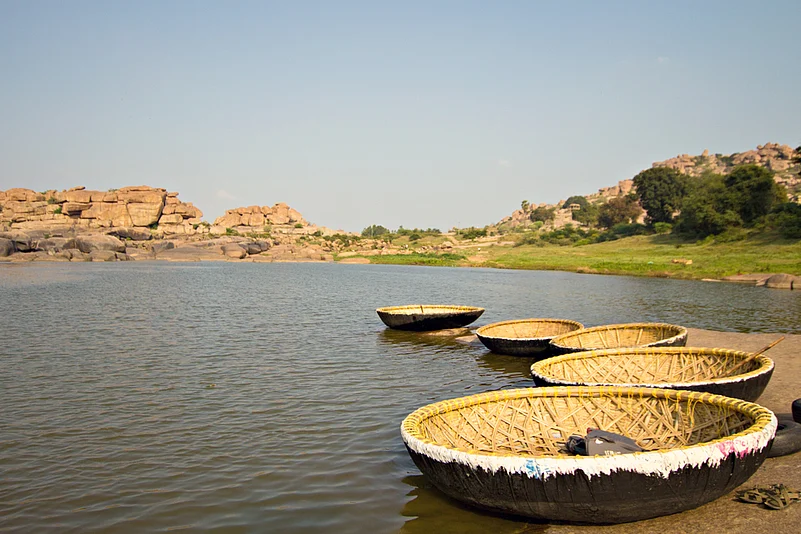
October to February is generally a pleasant time to explore Hampi, with early mornings and late afternoons offering softer light across the Tungabhadra and its boulder-strewn banks. However, coracle crossings depend on the river's temperament. During the monsoon, heavy rainfall and water released from the Tungabhadra Dam can raise water levels and create strong currents, leading to temporary suspensions. Travellers should check local conditions and operating permissions before setting out.
Choosing authorised local operators and wearing a properly fitted life jacket are essential. The river is also an ecologically significant landscape, with a 34-km stretch designated as the Tungabhadra Otter Conservation Reserve. Avoiding litter, respecting wildlife and keeping away from sensitive riverbank habitats are small but meaningful ways to protect it. Taking time to explore Anegundi and support local craft initiatives can further extend the experience beyond the crossing, connecting visitors with the communities whose heritage is intertwined with the river.
Hampi's history is often read through its stone monuments, temple corridors and the remains of an empire that once flourished along the Tungabhadra. Yet, the river tells another story, one that belongs as much to the communities living along its banks as it does to the region's celebrated past. The coracle is a part of that continuing history. A crossing is therefore worth experiencing beyond the novelty of sitting in a circular boat. It offers a closer look at the relationship between Hampi, its river and the settlements that have grown around it.
FAQs
1. What is a coracle ride in Hampi?
A coracle ride is a river crossing in a traditional circular boat, traditionally made using a woven bamboo or cane frame and a waterproof covering.
2. Where can you take a coracle ride in Hampi?
Coracle crossings operate from designated points along the Tungabhadra River near Hampi, depending on local permissions and river conditions.
3. How long does a coracle ride across the Tungabhadra take?
A typical ride may take around 20–40 minutes, depending on the route and river conditions. Shorter crossings may also be available.
4. What is the best time to experience a coracle ride in Hampi?
October to February is generally a pleasant period to visit. Early mornings and late afternoons are ideal, although rides depend on water levels and operating conditions.
5. Can you visit Anegundi during a coracle crossing?
Yes. Anegundi lies across the Tungabhadra from Hampi and is known for its historic settlement, temples, traditional houses and connections to the Ramayana.


