


Few places offer a glimpse into the life of a lost empire quite like Hampi. Once the capital of the powerful Vijayanagara Empire, this historic landscape in Karnataka was a centre of trade, culture, and religion, drawing merchants and travellers from across the world. Its markets bustled with precious stones, silk, spices, and horses, while grand temples and public streets brought people together.
At the heart of this once-thriving city was Hampi Bazaar, also known as Virupaksha Bazaar. Stretching out in front of the Virupaksha Temple, the historic marketplace is now lined with weathered stone pavilions that hint at its former glory. Though much of its commercial life has faded, the street remains an evocative place to explore the empire's trading history, architecture, and traditions.
A Marketplace At The Heart Of Vijayanagara
Hampi Bazaar flourished between the 14th and 16th centuries, when Vijayanagara was a major political, cultural, and commercial centre in South India. The marketplace was an important part of the city's urban life, bringing together traders, travellers, local residents, and visitors arriving for religious festivals.
Its location was significant. The street begins near the Virupaksha Temple, one of Hampi's most important religious landmarks, and extends towards the foothills of Matanga Hill. This close connection between commerce and religion was central to the city's layout. People came here not only to buy and sell goods but also to take part in temple festivities and other public gatherings.
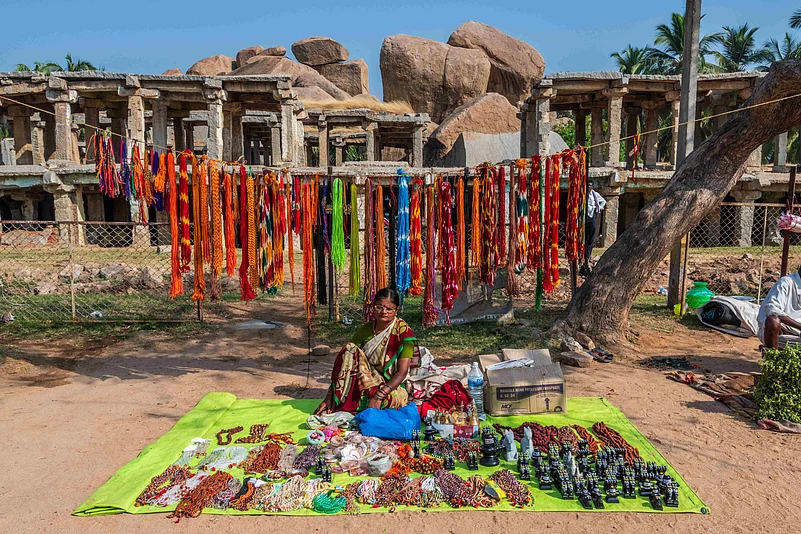

Historical accounts of Vijayanagara describe a thriving economy that attracted merchants from different parts of the world. Traders from Portugal, Persia, and Arabia, among other regions, travelled to the empire to exchange goods. Hampi Bazaar was part of this wider network, connecting the city's local economy to international trade.
What Was Hampi Bazaar Known For?
The marketplace was known for the range and value of goods traded here. Precious stones, including diamonds, rubies, and pearls, were among the luxury items associated with Vijayanagara's markets. Gold jewellery, fine textiles, Chinese silk, Persian carpets, spices, and perfumes were also part of the trade.
Horses were particularly important. Arabian and Persian horses were sought after by the empire's rulers for their military use, making the horse trade a valuable part of Vijayanagara's economy. Their arrival from overseas markets also reflected the connections between the empire and trading networks across the Indian Ocean.
It is easy to imagine how different the street must have looked at the height of its prosperity, with merchants displaying their goods, buyers negotiating prices, and travellers moving between the shops. The stone structures that stand here today offer a physical reminder of that busy commercial life.
The Stone Pavilions And Their Architecture

One of the most striking features of Hampi Bazaar is its long stretch of stone colonnades. Rows of pillared pavilions line the street, creating a layout that is very different from the markets most visitors encounter today.
These granite structures served as commercial spaces, with open-fronted sections that could be used as shops and storage areas. Some were associated with wealthy merchants and other prominent members of society. The remains suggest how commerce was organised along a broad, carefully planned street rather than within a collection of enclosed buildings.
The bazaar also formed part of a larger architectural and religious landscape. Its wide boulevard was suited to public gatherings and ceremonial processions, including those connected to temple festivals. The street's alignment with the Virupaksha Temple reflects the close relationship between urban planning, trade, and religious life in Vijayanagara.
At the western end, the temple's towering gateway dominates the view. Walking east, the ruins gradually lead towards the foothills of Matanga Hill, where the large stone statue of Nandi, the sacred bull associated with Lord Shiva, marks another important landmark.
What To See And Do At Hampi Bazaar

Walk Along The Ancient Colonnades
Start by exploring the length of the street and looking closely at the surviving stone pavilions. Their repeated pillars and open spaces offer a sense of how the marketplace once functioned. Take your time here. The ruins are best appreciated on foot, when you can notice the details of the stonework and the scale of the street.
Visit The Monolithic Nandi
At the eastern end of the bazaar, look for Yeduru Basavanna, a large Nandi statue carved from a single piece of stone. The sculpture faces towards the Virupaksha Temple and is an important landmark in this part of Hampi.
Explore The Surrounding Hills
If you have more time, head towards Hemakuta Hill, close to the western end of the bazaar. The hill has several ancient temples and offers wide views of Hampi's rocky landscape. Matanga Hill, at the other end, is a popular choice for sunrise, although the climb can be steep in places.
You can also explore the paths leading towards Achyuta Raya Temple, a large temple complex that is often quieter than some of Hampi's better-known attractions. Check the condition of the walking routes before setting out, particularly in hot weather.
Best Time To Visit Hampi Bazaar
The cooler months between October and March are generally the most comfortable for exploring Hampi on foot. Temperatures can rise considerably during the summer, making long walks across the exposed ruins tiring.
Early morning is a good time to arrive, especially if you want to photograph the stone pavilions in softer light before the day gets hot. Late afternoon is another option, with the changing light bringing out the textures of the granite structures.
How To Plan Your Visit
Hampi Bazaar is easy to combine with a visit to the Virupaksha Temple, Hemakuta Hill, and the Nandi statue. If you are exploring the historic centre on foot, you can use the bazaar as a starting point before moving on to the surrounding temples and viewpoints.
Allow at least an hour to explore the street at a relaxed pace, and set aside more time if you plan to visit the nearby hills or continue towards Achyuta Raya Temple. Remember that Hampi is a large archaeological landscape, so travelling between monuments elsewhere in the historic site may require additional time.
How To Get There
To reach Hampi Bazaar, travel to Hosapete Junction (HPT), the nearest major railway station, located around 13 km south of the ruins. Hosapete is accessible by train and long-distance sleeper buses from cities such as Bengaluru, Hyderabad, and Goa. Alternatively, you can fly to Jindal Vijaynagar Airport (VDY), around 35 km away. From Hosapete, local government buses and private auto-rickshaws are available for the onward journey to Hampi Bazaar.
FAQs
1. What is Hampi Bazaar famous for?
Hampi Bazaar is known for its historic stone pavilions and its association with the Vijayanagara Empire. Located in front of the Virupaksha Temple, the marketplace was once part of a thriving commercial centre.
2. What was sold at Hampi Bazaar?
Historical accounts of Vijayanagara describe trade in precious stones, gold jewellery, fine textiles, silk, spices, perfumes and horses. Hampi Bazaar formed part of the city's wider commercial network.
3. Where is Hampi Bazaar located?
Hampi Bazaar is in Hampi, Karnataka, in front of the Virupaksha Temple. The historic street extends towards the foothills of Matanga Hill and is surrounded by temples and archaeological remains.
4. What can you see at Hampi Bazaar?
Visitors can explore the surviving stone colonnades, visit the Virupaksha Temple, see the monolithic Nandi known as Yeduru Basavanna, browse local vendors' stalls and explore nearby Hemakuta Hill.
5. How long does it take to explore Hampi Bazaar?
A walk along Hampi Bazaar generally takes around 30–45 minutes, depending on how often you stop. Allow at least an hour for a relaxed visit, with additional time for nearby temples and hills.


