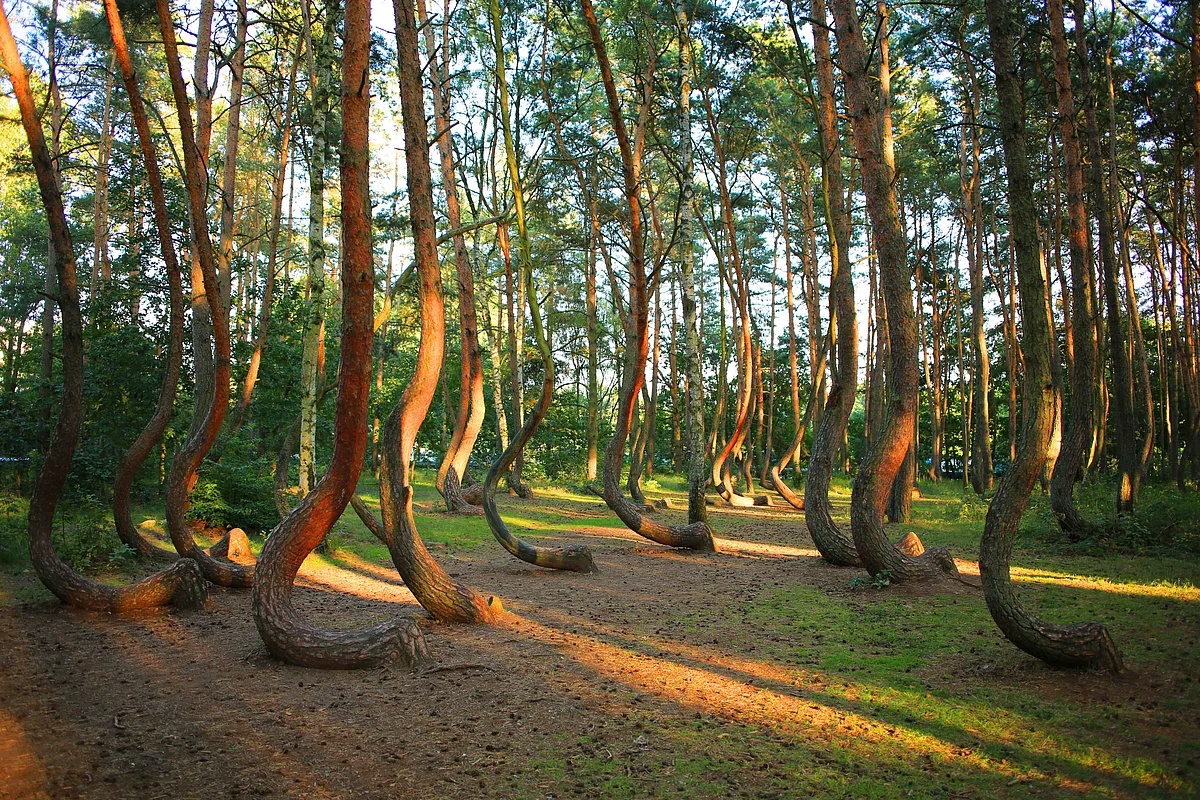
Just outside the village of Nowe Czarnowo in West Pomerania, the forest suddenly changes character. Straight pines give way to a cluster of trees that appear to bow in unison, each trunk bending low and sweeping north before lifting back upright. It feels deliberate, almost choreographed. And that is exactly what makes the Crooked Forest so difficult to explain.
The Crooked Forest, known locally as Krzywy Las, is not ancient woodland. It began as a plantation. Around 1930, foresters planted roughly 400 Scots pines in neat rows near the town of Gryfino.
Something happened to these trees early in their lives. Each trunk bends sharply just above the ground, sometimes by as much as a right angle, before curving back upward and continuing to grow straight. The sideways stretch can run up to three metres before the tree corrects itself and heads skyward again.
What stands out is the precision. Every tree leans in the same direction. Every bend begins at roughly the same height. And beyond this small patch, the surrounding forest grows perfectly straight, as if nothing unusual ever occurred.
The uniformity rules out most natural explanations. Wind, gravity, or uneven terrain would have created randomness. Here, there is none.
War, Woodcraft, And A Lost Intention
The most convincing theory points to human intervention. Foresters may have deliberately bent the saplings when they were still flexible, using stakes or weights to hold them in position. Over time, the wood hardened into that shape.
Why go to such trouble? Curved timber was valuable. Shipbuilders, furniture makers, and craftsmen often needed naturally bent wood for frames and structural supports. Producing it artificially would have saved time and labour.

Then history intervened. In 1939, Nazi Germany invaded Poland. The region around Gryfino was devastated, and many local residents fled or were displaced. Whatever project had begun in the forest simply stopped.
The trees were never harvested. The people who shaped them never returned. And with them went the knowledge of exactly how and why the forest was created.
Other explanations continue to circulate. Some suggest heavy snow flattened the young trees. Others blame military vehicles rolling through the saplings during the war. But none of these theories explains the consistency. Snow and machinery leave chaos behind. This forest shows careful planning.
How The Trees Survived And What Visitors Find Today
What makes the Crooked Forest even more remarkable is that the trees did not simply collapse under the strain. After being bent, they continued to grow upward, correcting their orientation through a natural process known as gravitropism.
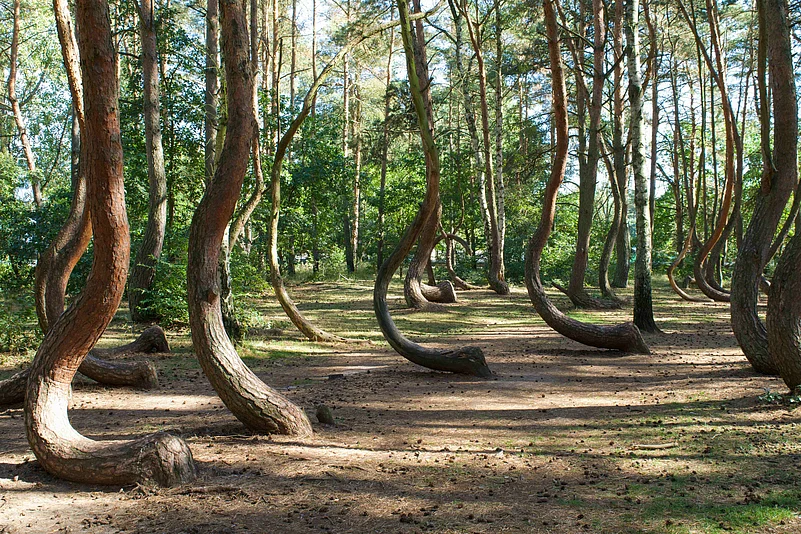
Today, many of these trees stand about 15 metres tall. Near the ground, their trunks still hold those sharp, sweeping bends, but higher up, they straighten out and grow as any pine would. Walking through the grove, the repetition of those curves creates a rhythm that feels almost deliberate.
The forest grows in the temperate conditions of northwestern Poland, where winters turn cold, and summers stay mild, with enough rain through the year to keep the pines healthy. Over time, the grove has settled into its surroundings like any other woodland. Only the shapes of the trees hint at a past that no one has fully been able to piece together.
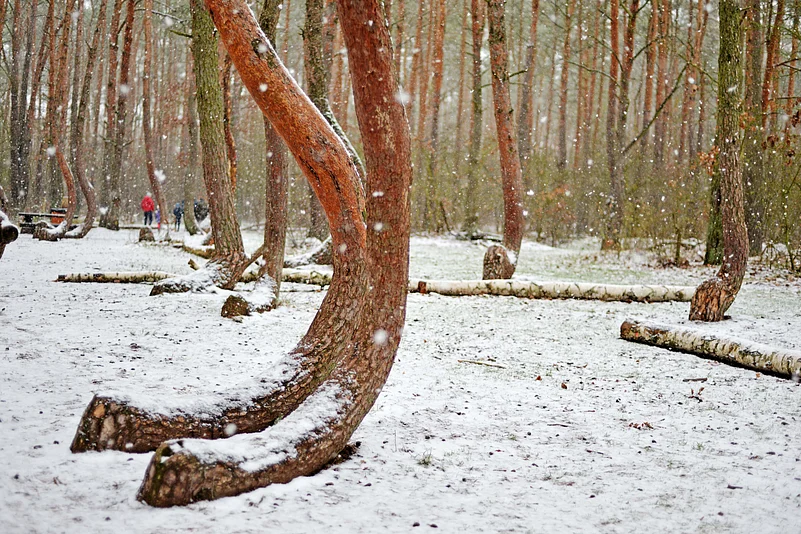
It is now protected as a natural monument and draws travellers from across Europe. Visitors walk through rows of curved trunks that resemble frozen waves or bent ribs in the earth. In winter, snow settles along the arcs, emphasising their shape. In summer, light filters through the canopy and casts long, curved shadows across the forest floor.
There are no fences, no dramatic signage, and no final explanation waiting at the end of the trail. Just a quiet stand of trees that carries a decision made nearly a century ago, then abandoned.
FAQs
1. What is the Crooked Forest in Poland?
The Crooked Forest is a grove of around 400 pine trees near Gryfino, where each tree bends sharply in the same direction before growing upright.
2. Why do the trees in Crooked Forest bend?
The most widely accepted theory suggests human intervention, where saplings were deliberately bent for timber use, though no theory is confirmed.
3. When was the Crooked Forest planted?
The forest was planted around 1930 as a managed plantation of Scots pine trees.
4. Is the Crooked Forest a natural phenomenon?
While natural causes have been suggested, the uniformity of the bends points more strongly toward human influence.
5. Can you visit the Crooked Forest?
Yes, the Crooked Forest is open to visitors and is protected as a natural monument, attracting travellers interested in unusual landscapes.