A chimp using a stick to reach what it wants. A dolphin changing the way it moves through fish. An octopus rearranging shells and stone on the sea floor. These are not isolated curiosities, but moments from very different lives where animals seem to work things out in their own way. In forests, oceans and open ground, behaviour shifts, adapts, and sometimes looks less like instinct than invention.
Vogelkop Bowerbird


A small olive-brown bird from the montane forests of New Guinea’s Vogelkop Peninsula, the male Vogelkop Bowerbird does not rely on colour or song alone. Instead, it builds and tends structures on the forest floor that function as spaces of display and selection.
Unique Behaviours
The male gathers sticks to form a roofed, hut-like bower, often over a metre tall, then places berries, petals, fungi, and insects around it. These are not scattered but sorted and adjusted, sometimes shifted repeatedly over days. The structure changes with time, shaped by repeated attention rather than a fixed design.
Habitat And Status
It lives in the high mountain forests of West Papua, Indonesia, usually between 1,500 and 2,000 metres above sea level. Within this restricted range it remains locally common and is currently listed as Least Concern. Its main vulnerability lies in the slow loss and fragmentation of forest habitat over time.
Chimpanzee

Chimpanzees are our closest living relatives, sharing most of their DNA with humans. They move through forests and savannah edges in flexible groups, where alliances shift and knowledge is built through watching others. Across Africa, different communities develop their own ways of doing things, even within the same species.
Unique Behaviours
Chimpanzees use found objects as tools: sticks for termites, stones for nuts, leaves for drinking water. In some groups these actions are combined into short sequences; in others, sticks are reshaped for hunting. The pattern is uneven—what is common in one place may be absent in another, learned by watching rather than inherited. Social life shows similar differences. Grooming styles vary, some groups return to the same trees where stones accumulate on the ground without clear purpose, and gestures shift subtly between communities. These habits persist locally, forming small, shared routines.
Habitat And Status
Chimpanzees live across West and Central Africa in forest and savannah landscapes. Their range has steadily shrunk. They are listed as Endangered on the IUCN Red List, with populations declining due to habitat loss, hunting, and disease.
Elephants

Elephants live in parts of Africa and Asia, usually in family groups that stay together for long periods. They move through forests, open plains, and drier scrubland, following routes tied to water and seasonal change. Much of their life is built around familiarity—places, individuals, and shared movement.
Unique Behaviours
Their trunk is used in small, adaptable ways. A branch may be pulled down, stripped, and used to brush insects from the skin or reach areas they cannot easily access. Sometimes the same piece of wood is kept and used again. When faced with simple obstacles, they adjust nearby objects—shifting, lifting, or placing them—to get at food or space that would otherwise be out of reach. There are also accounts of elephants shaping water points, covering them with earth or plant matter and returning later to them. Within herds, attention to others is constant; individuals that are hurt or weak are not left behind most times, and the group’s pace often changes to match them.
Habitat And Status
Elephants are found across parts of sub-Saharan Africa and South and Southeast Asia. Their presence shifts with landscape—thick forest, open grassland, and drier ground near seasonal water. In many areas their range is no longer what it once was. African forest elephants are listed as Critically Endangered, while African savanna elephants and Asian elephants are both classed as Endangered on the IUCN Red List, with loss of habitat and poaching continuing to drive the decline.
Octopus
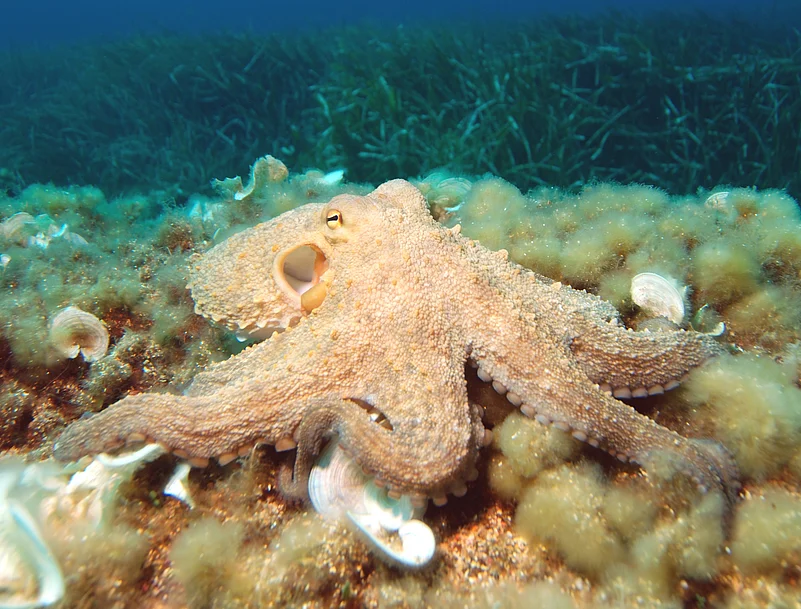
Octopuses live on the seabed in oceans worldwide. Most keep to themselves, slipping through rocks, shells, and narrow gaps. Their bodies are soft and change shape easily, which lets them move in ways few other animals can.
Unique Behaviours
Some carry shells or coconut halves and use them as shelter while moving. Others pull stones and scraps towards their hiding places, shaping small barricades with gaps left for entry. Hunting shifts from place to place—sometimes by changing colour and texture, sometimes by waiting and touching. Each arm can act on its own, feeling and moving separately, so several things can happen at once. There are even reports of them pushing objects around or repeating small movements with no clear purpose in captivity.
Habitat And Status
Octopuses are found in seas from shallow coasts to deeper offshore areas. Most only live for a short time, often a couple of years. Some species are doing fine, while others are under pressure in certain places, especially where fishing is heavy or coastal waters are disturbed.
Dolphin

Dolphins are found in seas around the world. They move in groups that are not fixed, often breaking apart and coming back together as they travel. At times they stay close, rising and turning in the water in loose coordination.
Unique Behaviours
Some dolphins place sea sponges over their snouts while searching over rough ground. Others herd fish using sand, bubbles, or tight circling, then take advantage when the fish scatter. In a few places, fish are pushed into shells or small gaps and carried upward before being eaten. These habits are not shared by all dolphins and tend to stay within certain groups, learned by watching rather than taught directly.
They also rely on sound in a way that carries personal identity—certain calls are recognised by others and used to keep track of individuals. Movement is often matched within the group, with animals following each other closely through turns and shifts in speed. In some coastal areas, dolphins appear around fishing activity and take fish that escape nets.
Habitat And Status
Dolphins turn up in seas almost everywhere. Some hug the coast, others drift far out where land is out of sight. There isn’t one pattern that fits all of them. In some waters they seem steady in number, in others they are harder to find than before. Fishing gear, engine noise, and altered shorelines are the main reasons things shift.
FAQs
Why do humans often underestimate animal intelligence?
Because we tend to measure intelligence in human terms—language, tools, technology—and overlook abilities shaped for survival in other environments.
Are animals actually intelligent in different ways?
Yes. Many species show problem-solving, memory, navigation, and social awareness that are specialised for their own habitats rather than abstract reasoning.
Why is animal communication hard for humans to understand?
Most animal communication is non-verbal, subtle, or sensory-based, which doesn’t translate easily into human language systems.
Do we misinterpret animal behaviour?
Often. Humans tend to read animal actions through a human lens, which can miss the meaning those behaviours have within the animal’s own context.
Is human intelligence the “standard” for comparison?
Not really. It’s just one form of intelligence. Other species have different kinds, shaped by the problems they need to solve to survive.