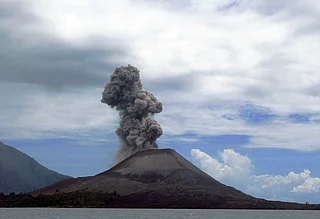
Travel rarely unfolds exactly the way we imagine it. In professional spaces, it often begins with a clearly defined purpose: something deeply goal-oriented, structured, even predictable. Our journey to Indonesia was primarily to engage in intellectual discourse at the esteemed Asia Liberty Forum in Jakarta. Yet somewhere between conference halls, crowded markets, rain-soaked ferry rides, and quiet moments by the sea, the trip transformed into something far more layered. It became a series of encounters: with people, with landscapes, and with parts of ourselves that rarely surface in familiar surroundings. Indonesia does not simply present itself as a destination; it unfolds as an experience that demands participation. And once you step into it fully, it leaves you altered in ways that are subtle but lasting.
Jakarta: A City Of Ideas And Contrasts
Jakarta was where everything began, both intellectually and experientially. The Asia Liberty Forum, organised by Atlas Network, brought together a remarkable mix of thinkers, reformers, and policy advocates from across Asia and beyond. The conversations were rigorous and wide-ranging, touching on governance, economic freedom, and the evolving challenges of the region. Engaging with figures like Tom G Palmer added depth to the discussions, while interactions with regional voices such as Anton Rizki and Anthea Haryoko of the Center for Indonesian Policy Studies, Bishnu Timalsena from Language of Liberty Institute, and Angela Arnate from Foundation for Economic Freedom grounded these ideas in lived realities.


But Jakarta itself was as instructive as any panel discussion. It is a city that feels perpetually in motion, its skyline rising rapidly, mirroring its ambitions. Glass towers dominate the horizon, yet they do not erase the presence of older neighbourhoods that carry the weight of history. A visit to Kota Tua revealed a striking juxtaposition: Dutch colonial architecture standing alongside vibrant cafés, street performances, and the unmistakable energy of a young, evolving city. The streets feel alive, not curated, but organic in their movement.
Nearby, the Jakarta Cathedral offered a contrasting experience. Its Gothic spires and intricately designed interiors created a space of calm reflection amid the city’s constant motion. Walking through its halls felt like stepping briefly outside time, a reminder that even the most dynamic cities hold spaces of stillness.
Shopping in Jakarta added another layer to our understanding. Indonesian batik, with its intricate patterns and symbolic meanings, is far more than a textile—it is a cultural expression. Browsing through markets and malls, we saw how seamlessly Jakarta blends tradition and modernity. It does not attempt to resolve the tension between the two; instead, it thrives in that coexistence. Jakarta, ultimately, is not a city that lends itself to easy definitions. It is complex, restless, and deeply alive.
Bali: Beyond Beauty, Into Experience
From Jakarta’s intensity, the journey moved to Bali, a place often reduced to postcard imagery but far richer in reality. Bali does not simply impress—it engages. It challenges preconceived notions and invites a deeper kind of participation.
For a traveller who rarely revisits destinations, Bali creates an unexpected shift. It lingers. Its appeal is not just visual but atmospheric, rooted in a blend of spirituality, artistry, and everyday ritual. The island’s beaches are undeniably beautiful, but what stays with you is the rhythm of life that unwinds around them—the offerings placed outside homes, the quiet presence of temples, the seamless integration of tradition into daily existence.

One of the most immediate lessons came through the act of shopping. Markets in Bali are vibrant, dynamic, and deeply interactive. Prices are rarely fixed, and bargaining becomes an essential skill. What begins as a transaction quickly transforms into a performance—an exchange that requires humour, patience, and a willingness to engage. The shopkeepers’ persistence, often delivered with charm, turns negotiation into a memorable part of the experience. For budget travellers, this is not merely optional; it is necessary.
Yet beyond the markets, Bali reveals itself in subtler ways. It is in the quiet moments—the early morning stillness, the scent of incense, the sound of distant chants—that the island’s character becomes most apparent. Bali does not demand attention; it rewards those who choose to notice.
Nusa Penida: Where Fear Meets Wonder
The journey to Nusa Penida began under heavy rain, as we made our way to Sanur Port. It was not the ideal start, but travel rarely adheres to ideal conditions. Boarding the ferry despite the weather felt like a small act of commitment—a decision to embrace the experience rather than wait for perfection.

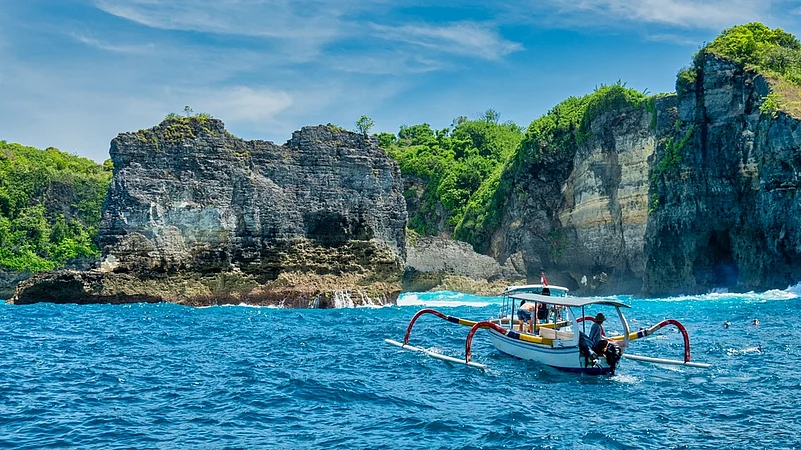
Nusa Penida itself felt markedly different from mainland Bali. Less commercialised and more rugged, it carried a sense of raw authenticity. Its landscapes are dramatic, almost overwhelming in their scale. At Kelingking Beach, the land curves sharply into the sea, forming a shape so distinctive it feels intentional. Standing at the edge, looking out at the vast expanse of turquoise water, one is reminded of the immensity of the natural world.
But the most transformative moment came beneath the surface. Snorkelling near Manta Point was, by any rational measure, an unlikely choice—especially for someone who cannot swim and harbours a genuine fear of water. Yet travel often places you in situations where curiosity overrides hesitation.
The ocean offers no reassurances. It does not adapt to human fears; it simply exists. Entering it requires acceptance. Beneath the surface, a different world emerges—quiet, colourful, and unexpectedly calming. Marine life moves with effortless grace, creating a sense of harmony that is difficult to articulate. In that moment, fear does not disappear, but it shifts. It becomes something manageable, something that coexists with awe.
This experience was not about conquering fear in a dramatic sense. It was about learning to exist alongside it, to move through it rather than away from it. And in that, it offered one of the most profound lessons of the journey.
Ubud And Uluwatu: Culture, Stillness, And Connection
Returning to the main island, the journey took us to Ubud, where the pace slows, and the experience deepens. Ubud is often described as the cultural heart of Bali, and it lives up to that reputation not through spectacle, but through subtlety.
At Uluwatu Temple, perched high above the Indian Ocean, the landscape unfolds in dramatic simplicity. Waves crash against the rocks below in a steady, rhythmic pattern that feels almost meditative. For someone experiencing the ocean from such a vantage point, it becomes less about visual grandeur and more about emotional resonance—the sense of being connected to something vast and continuous.

Evenings brought one of the most memorable cultural experiences of the trip: the Kecak Fire Dance. Set against the backdrop of a setting sun, the performance retells the story of the Ramayana through chant, movement, and fire. It is immersive, powerful, and deeply rooted in tradition. Watching it unfold, one feels not like a spectator, but a participant in something enduring.
Equally meaningful were the quieter moments. Staying in a homestay, hosted by a woman whose warmth transcended language, introduced a different dimension of travel—one grounded in human connection. Morning breakfasts, prepared with care, became small rituals that anchored each day.
The rice terraces surrounding Ubud added yet another layer to the experience. Carefully cultivated and visually striking, they reflect a relationship between people and land that is both practical and artistic. They are a reminder that beauty is often the result of patience and intention, rather than chance.
Beyond Bali: Indonesia’s Expanding Story
To understand Indonesia fully, one must look beyond Bali. It is a country defined by both historical depth and rapid transformation. Landmarks such as Borobudur Temple stand as enduring symbols of its cultural richness, while natural wonders like Mount Bromo highlight its geological dynamism.
Indonesia is also one of Southeast Asia’s fastest-growing regions, its cities expanding and evolving at a remarkable pace. Yet amid this growth, traditions remain deeply embedded in daily life. From art and dance to rituals and cuisine, the country maintains a continuity that feels both authentic and adaptive.
Food, inevitably, becomes part of that narrative. Dishes like Nasi Goreng and Mie Goreng capture the essence of Indonesian cuisine—bold, flavorful, and deeply satisfying. At the same time, the occasional familiarity of KFC serves as a reminder that, even amid exploration, comfort has its place.

In the end, what Indonesia offers is not a single lesson but a collection of them. It teaches that the world does not reveal itself to those who observe from a distance. It reveals itself to those who engage—who negotiate in unfamiliar markets, board ferries in uncertain weather, and step into oceans despite their fears.
Travel, then, is not about the places themselves, but about the boundaries they expand within us. Indonesia, in all its complexity, does precisely that. And Bali, unexpectedly and insistently, leaves behind a rare certainty: that some journeys are not meant to end after a single visit, because what they offer cannot be exhausted in one experience alone.
Amal Chandra is an Indian author, political analyst and columnist. His debut book, The Essential (2023), was launched by Dr Shashi Tharoor and features a foreword by former External Affairs Minister of India, Adv. Salman Khurshid. His research and commentary regularly appear in leading scholarly and popular publications. He posts on ‘X’ at @ens_socialis.
Ichchha Khatiwada is the Program and Operations Coordinator at the Ladies of Liberty Alliance (LOLA) and serves as its Asia Regional Leader, where she passionately champions the intersection of liberty and women's empowerment. A Project Arizona Fellow, she deepened her advocacy for rights-based governance by studying the U.S. Constitution under Justice Clint Bolick at the Arizona Supreme Court. Her contributions are enriched through extensive international travel and training.
FAQs
What are the best places to visit in Indonesia?
Popular destinations in Indonesia include Jakarta, Bali, Nusa Penida, Ubud, Borobudur Temple, and Mount Bromo, each offering a mix of culture, history, nature, and adventure.
Is Bali worth visiting beyond its beaches?
Yes, Bali offers much more than beaches, including temples, traditional dance performances, rice terraces, local markets, spiritual culture, and immersive homestay experiences.
What is Nusa Penida famous for?
Nusa Penida is known for dramatic coastal cliffs, turquoise waters, Kelingking Beach, manta ray snorkelling, and rugged landscapes that feel far less commercialised than mainland Bali.
What makes Jakarta unique for travellers?
Jakarta blends modern skyscrapers, colonial-era neighbourhoods, vibrant markets, historic landmarks, and a fast-evolving cultural and intellectual scene.
What food should travellers try in Indonesia?
Travellers should try Indonesian classics such as Nasi Goreng, Mi Goreng, satay, seafood dishes, and local Balinese cuisine known for bold spices and rich flavours.