


Before hotels, highways, and carefully timed itineraries, long-distance travel depended on a network of places where merchants could eat, sleep, store their goods, and wait out the road. Across Azerbaijan, caravanserais served this purpose along the routes that connected the Caucasus with Persia, Central Asia, and the wider Eurasian world. Built around enclosed courtyards and protected by thick stone walls, these roadside inns became essential infrastructure for the movement of silk, spices, textiles, and other goods.
Azerbaijan's position between Europe and Asia made it an important link in these trading networks. The Silk Road was never one road, but a web of routes that shifted with politics, geography, and commerce. Towns such as Sheki, Baku, and Shamakhi grew around this movement, and their caravanserais offered merchants something essential after long days on the road: security. Today, the surviving buildings provide a tangible way to understand how trade shaped the country's cities, architecture, and culture.
What Was A Caravanserai?
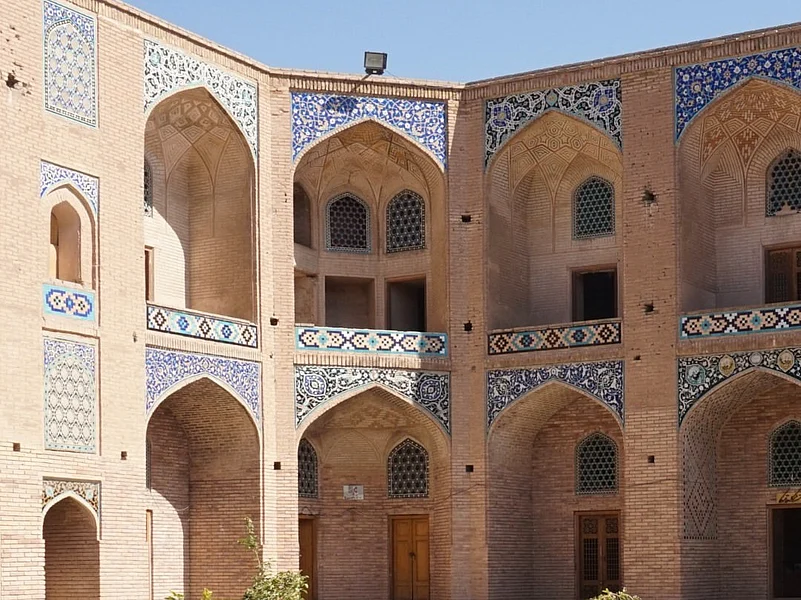

A caravanserai was part inn, part warehouse, and part secure trading compound. Merchants travelling with pack animals and valuable cargo needed somewhere to rest without leaving their goods exposed, so these buildings were designed around large enclosed courtyards, with rooms and storage spaces arranged along the perimeter. Animals could be brought inside, merchandise stored securely, and travellers accommodated within the same complex.
The architecture was largely dictated by this practical purpose. Thick masonry helped regulate temperatures and offered protection, while vaulted passages, stone arches, and controlled entrances created a building that could be secured at night. The courtyard was also a social and commercial space, where merchants exchanged information, negotiated prices, and arranged onward journeys. News travelled alongside silk and spices, making caravanserais important points of cultural exchange as well as commerce.
Sheki: Where Silk Built A City

The best place to understand this legacy is Sheki, in the foothills of the Greater Caucasus. The historic city became wealthy through sericulture and silk production, with mulberry trees, silkworm breeding, cocoon trading, and craft production forming an important part of its economy. Merchants arrived to buy and sell silk, while local craftsmen produced goods for markets beyond the region.
The city's caravanserais were built to support this thriving commercial life. Historical records indicate that Sheki once had five major caravanserais during the 18th and 19th centuries. Two large examples, the Upper and Lower Caravanserais, survive today. They form part of the Historic Centre of Sheki with the Khan's Palace, which was inscribed on the UNESCO World Heritage List in 2019.
Inside The Upper Caravanserai
Known as Yukhari Karvansaray, the Upper Caravanserai is the most impressive of Sheki's surviving caravanserais. Dating to the 18th century, the complex is built around a large internal courtyard and occupies a sloping site near the Gurjana River. Its architecture responds to the terrain, creating different levels and perspectives as visitors move through the building.
Covering roughly 6,000 square metres, the complex was designed on a substantial scale, with historic descriptions recording more than 300 rooms and storage spaces. Its monumental entrance leads into a courtyard framed by arcaded galleries, stone walls, and vaulted sections. The effect is immediately functional: this was a building intended to bring people, animals, and merchandise inside a protected space.
Look beyond the arches, and the building's original purpose becomes clearer. Merchants needed rooms to sleep in, storage areas for cargo, and a secure place where animals could be kept. The courtyard provided room for movement and commerce. Once the gates closed, an otherwise exposed caravan was enclosed within a fortified commercial compound.
From Merchant Inn To Modern Stay

The Upper Caravanserai retains an unusual connection with its original function. Parts of the complex operate as a hotel, allowing travellers to stay inside a building that was itself designed to accommodate travellers centuries ago. The experience is less about recreating medieval life than understanding how radically the practicalities of travel have changed.
Even for visitors staying elsewhere, the caravanserai is worth exploring. A courtyard walk followed by Azerbaijani tea makes for an easy way to spend time inside the historic complex. Tea is traditionally served in armudu, or pear-shaped, glasses, and can be accompanied by sweets, nuts, or preserves. In Sheki, pairing it with the city's famous halva adds another layer to the visit.
Baku's Caravanserais Tell Another Story

In Baku, caravanserais survive within the narrow streets of Icherisheher, the city's historic walled centre. The Bukhara and Multani Caravanserais reflect Baku's position as a meeting point for merchants arriving from different parts of the trading world. Their more compact scale and fortified urban setting offer a contrast to the sprawling caravanserai complexes of Sheki.
The Multani Caravanserai is associated with merchants from Multan in present-day Pakistan, while the Bukhara Caravanserai reflects connections with Central Asia. Together, they point to the international character of Baku's medieval commercial life. Today, the buildings have found new uses within the Old City, but their courtyards and masonry still provide clues to the trade networks that once passed through them.
Beyond Sheki And Baku
Caravanserais were not limited to Azerbaijan's best-known destinations. Shamakhi and Ganja were also part of the country's historic network of commercial routes, with caravan facilities supporting movement between the Caucasus, the Caspian region, and neighbouring territories. Many of these structures have not survived as completely as those in Sheki, but they belong to the same larger story of movement and exchange.
What makes Azerbaijan's caravanserais particularly interesting is the way they connect architecture with the country's economic history. The stone buildings were shaped by the needs of merchants, but the trade that passed through them also influenced the development of towns, crafts, and local culture. In Sheki, for instance, the silk economy can still be traced through traditional crafts such as shabaka and kelaghayi, linking historic production with living traditions.
Follow The Route Through Sheki

The Upper Caravanserai makes most sense when visited as part of Sheki's wider historic centre. Begin at the Palace of the Sheki Khans, where the wealth of the ruling elite is expressed through painted interiors and intricate shabaka, then walk through the historic streets towards the caravanserai. The contrast is revealing: the palace speaks of political power and artistic patronage, while the caravanserai represents merchants, movement, and the commercial economy that helped sustain the city.
From here, local craft workshops and the Khan Mosque offer further glimpses into Sheki's past. A visit to a kelaghayi workshop is particularly relevant to the city's silk story, while tea and Sheki halva provide an easy way to end the walk.
The caravanserais of Azerbaijan are ultimately less about ruins than about the infrastructure of travel. Their courtyards once brought together people who had crossed mountains and borders, carrying merchandise, languages, stories, and news with them. Centuries later, standing beneath the same arches offers a rare opportunity to see the Silk Road not as an abstract historical route, but as a network sustained by very real places where travellers stopped, traded, ate, and slept.
FAQs
1. What is a caravanserai?
A caravanserai was a secure roadside inn where merchants could rest, store goods, accommodate animals, and trade.
2. Which is the most famous caravanserai in Azerbaijan?
The Upper Caravanserai in Sheki, also known as Yukhari Karvansaray, is among Azerbaijan’s best-known surviving caravanserais.
3. Why is Sheki important to the Silk Road?
Sheki became an important trading centre through its silk production, craft industries, and connections with routes across the Caucasus and Eurasia.
4. Are there caravanserais in Baku?
Yes. The Bukhara and Multani Caravanserais in Baku’s Icherisheher reflect the city’s historic connections with Central and South Asian merchants.
5. Can you stay in a caravanserai in Azerbaijan?
The Upper Caravanserai in Sheki currently functions partly as a hotel, allowing visitors to experience historic accommodation within the complex.


