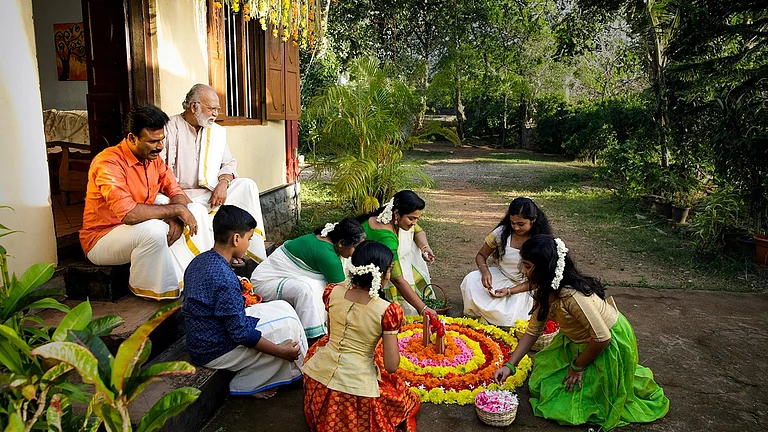


Onam is often associated with colourful Pookalams, elaborate Sadya feasts and boat races, but the festival has many lesser-known traditions. Across Kerala, old customs and folk practices continue to bring the story of King Mahabali into homes, temples and village streets.
In 2026, Onam celebrations run from August 16 to August 26, with Thiruvonam, the main day of the festival, falling on August 26. While the celebrations are now enjoyed across Kerala and beyond, some of the most interesting traditions remain closely tied to particular communities and regions. Here are a few lesser-known Onam customs that are still practised.
Onapottan, The Silent Messenger


In North Kerala, particularly in parts of Kannur and Kasaragod, Onapottan is one of the most striking sights of the Onam season. A folk character associated with Theyyam, Onapottan, is believed to represent King Mahabali and visits homes around Uthradam and Thiruvonam.
Dressed in face paint, a large headgear, a beard and colourful costume, he carries a traditional palm-leaf umbrella and a bell. But there is one unusual rule – he does not speak. He moves from house to house, offering blessings for prosperity and well-being.
The performer traditionally observes a period of abstinence before taking on the role. At the homes he visits, people offer him rice, clothes and money. The silence is an important part of the ritual, making his arrival feel quite different from the usual noise and energy of Onam celebrations.
Onavillu, Painted Bows With A Sacred Purpose

At the Sree Padmanabhaswamy Temple in Thiruvananthapuram, Onam brings a centuries-old tradition featuring beautifully painted wooden bows known as Onavillu or Pallivillu.
These are not musical bows. They are ceremonial objects painted with scenes from Hindu mythology, including Ananthasayanam, Dashavatara, Sri Rama Pattabhishekam and Krishna Leela. The right to make them has traditionally belonged to the Vilayil Veedu family of Karamana.
The bows are offered to the temple deity on Thiruvonam. Made using woods such as kadambu or mahogany, they are painted in a distinctive palette of five colours. The tradition is closely connected to the story of Mahabali and his wish to see the different forms of Lord Vishnu.
Kummattikali, When Masked Dancers Take Over The Streets

If you happen to be in Thrissur or parts of Palakkad during Onam, you may come across a rather unusual procession. Kummattikali is a lively mask dance in which performers dressed in grass and leaves move through the streets and visit homes.
The masks can depict gods, goddesses, animals and other characters, with Shiva, Krishna, Ganesha, and Kali among the figures commonly represented. The performers cover their bodies with Kummatti grass and wear colourful wooden masks. In many places, the dancers also collect small gifts from households along the way.
In Thrissur, Kummattikali is largely a community celebration and a form of entertainment, with performers dancing through neighbourhoods and bringing the festival into the streets. The tradition is also associated with welcoming Onathappan.
Thumbi Thullal, A Folk Dance Led By Women
Thumbi Thullal is another Onam tradition that is easy to miss amid the bigger celebrations. Traditionally performed by women, it involves a group sitting or moving in a circle around one central performer.
The woman in the centre holds a bunch of thumba leaves or flowers, while the others sing and clap in rhythm. As the tempo increases, the central performer begins to sway and move like a dragonfly, or thumbi. In traditional performances, the rhythm can build into an intense, trance-like state.
Once a more common village custom, Thumbi Thullal is now mainly seen during Onam celebrations, making it a fascinating glimpse into Kerala's older folk traditions.
Onathallu, An Onam Tradition That Involves Combat

Onam is not all about music, food and flowers. In some parts of Kerala, the festival also includes Onathallu, an old martial art tradition involving two performers.
The game uses the hands and body, with palm strikes and blocks forming the main movements. Punching and kicking are not allowed. The performers enter a marked arena, greet each other and then begin a controlled display of strength and agility under the watch of a referee.
Onathallu is particularly associated with parts of Thrissur and northern Kerala. While it appears to be a fight, it is rooted in martial training, physical skill, and community celebration.
Onathappan And The Offering Of Nendran Bananas

On Pooradam, the eighth day of Onam, families gather to make Onathappan, miniature pyramid-shaped figures out of red clay. They represent Mahabali and Vamana and are placed at the centre of the Pookalam. The clay figures are decorated with rice flour lines and small Mukkutti flowers, and are associated with Thrikkakara Appan, representing Lord Vishnu in his Vamana avatar as well as King Mahabali.
The ritual also includes Kazhcha Kula, the offering of bunches of Nendran plantains. Families offer large, carefully selected bunches of bananas, reflecting Onam's connection with the harvest and prosperity. The clay figures remain at the centre of the Pookalam through the final days of the festival.
These customs may not be as instantly recognisable as a Pookalam or Sadya, but they reveal another side of Onam. From a silent figure walking through the villages of Malabar to masked dancers taking over the streets and ceremonial bows being offered at a temple in Thiruvananthapuram, the festival continues to be shaped by local traditions. And that is perhaps what makes experiencing Onam in Kerala so interesting – the celebration can look completely different from one part of the state to another, while still carrying the same story of welcoming Mahabali home.
FAQs
1. When is Onam 2026?
Onam celebrations in 2026 run from August 16 to August 26, with Thiruvonam, the main day of the festival, falling on August 26.
2. What are some lesser-known Onam traditions in Kerala?
Some lesser-known traditions include Onapottan, Onavillu, Kummattikali, Thumbi Thullal, Onathallu and the offering of Nendran banana bunches through Kazhchakula.
3. What is Onapottan?
Onapottan is a folk character associated with Theyyam in parts of North Kerala. Traditionally believed to represent King Mahabali, the silent figure visits homes around Uthradam and Thiruvonam to offer blessings.
4. What is Onavillu?
Onavillu, also known as Pallivillu, refers to ceremonial wooden bows painted with scenes from Hindu mythology. They are traditionally offered to the deity at Sree Padmanabhaswamy Temple in Thiruvananthapuram during Thiruvonam.
5. What is Kummattikali?
Kummattikali is a traditional masked dance associated with Onam, particularly in parts of Thrissur and Palakkad. Performers wear colourful masks and costumes made from grass and leaves while moving through streets and visiting homes.