Some places do not make loud announcements. They wait—on the rim of a valley, shrouded in mist and guarded by myths older than memory. Saptashrungi Gad, located around 60 km from Nashik, is one such location. It's not glamorous, and it doesn't try to compete with Maharashtra's more well-known pilgrim routes. Instead, it provides something unique: a seamless blend of myth, mountain, and mood. Come for faith if you must, but stay for the scenery, legends, and the unexpected peace that creeps into your bones as the city noise subsides.
High Above Nashik, This Mountain Still Listens To Myth
Encircled by seven peaks, Saptashrungi Gad is where mythology, monsoon clouds, and quiet devotion come together high above Nashik

Advertisement
Perched at nearly 4,700 feet above sea level, Saptashrungi Gad takes its name from the seven mountain peaks that cradle it. Sapta for seven, shrungi for horns or peaks. Together, they form a natural amphitheatre where clouds drift in like uninvited guests and sunlight spills generously across stone steps and forested slopes. This is an Ardha Shakti Peetha, one of the revered “three and a half” Shakti Peethas of Maharashtra, believed to be the site where the right arm of Sati fell. But even if mythology isn’t your compass, the journey here—especially during the monsoon—feels undeniably sacred.
A Mountain Abode
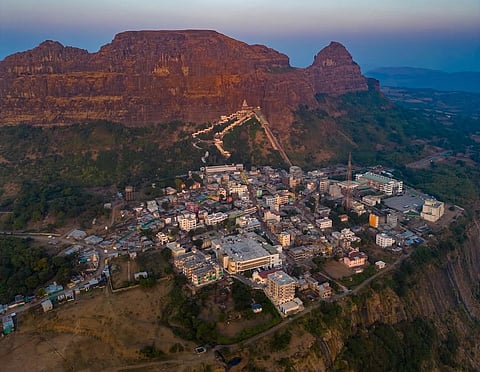
Saptashrungi Gad is believed to mark the spot where Sati’s right arm fell vedant.jpeg/Instagram
The road to Saptashrungi Gad winds through Kalwan tehsil, gradually shedding urban clutter for greener, quieter vistas. Nanduri village marks the foot of the hill, where buses idle, pilgrims pause for tea, and the climb begins. From here, the temple reveals itself slowly. You ascend through nearly 500 steps carved into the mountain, flanked by smaller shrines, stalls selling coconuts and flowers, and occasional clearings that open out to sweeping valley views.
Advertisement
The temple itself sits dramatically on a cliff face, hewn into a natural cave. There is something profoundly grounding about this architecture—less constructed, more discovered. Inside, the goddess Saptashrungi Nivasini appears not as an idol placed by human hands, but as a swayambhu form emerging from the rock itself. About eight feet tall, her figure is smeared in sindoor, her presence commanding yet maternal. She has eighteen arms, each holding a different weapon or symbol—trishul, chakra, conch, mace—an iconography that speaks of protection, power, and balance.
The mountain around the shrine is alive in quieter ways too. The Saptashrungi hills are known for their medicinal flora, dense forests, and a network of sacred water bodies. Kalikund, Suryakund, and Dattatraya Kund are among several kunds scattered across the slopes, each tied to ritual bathing and local lore. On clear days, you can see Markandeya Hill across a deep ravine to the east, believed to be the abode of sage Markandeya, who is said to have recited the Puranas here for the goddess herself.
Advertisement
Myths And Memory
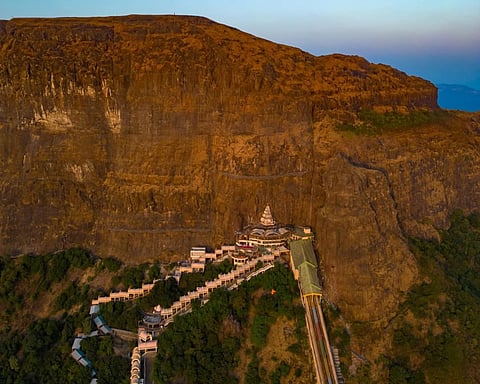
The swayambhu idol of Goddess Saptashrungi emerges from natural rock vedant.jpeg/Instagram
Saptashrungi is steeped in stories that have travelled centuries without losing their emotional charge. One of the most enduring legends links the site to the battle between Goddess Durga and the demon Mahishasura. It is believed that the goddess assumed her fierce Mahishasura Mardini form here, vanquishing the buffalo demon and restoring cosmic balance. At the entrance of the temple complex, a stone buffalo head stands as a symbolic reminder of that victory—subtle, powerful, and unmissable.
Another layer of belief connects Saptashrungi to the Shakti Peetha tradition. Counted among the 51 Shakti Peethas across the subcontinent, the temple holds particular importance in Maharashtra alongside Kolhapur’s Mahalakshmi, Tuljapur’s Bhavani, and Mahur’s Renuka Devi. Together, these sites are believed to represent the cosmic sound Om, broken into its elemental components. It’s theology woven with geography, faith mapped onto land.
Festivals bring these legends vividly to life. During Chaitra and Ashwin Navratri, the usually serene complex transforms. Nearly a million devotees arrive for Chaitrotsav, which begins on Ram Navami and concludes on Chaitra Purnima. Days start before dawn with aartis, bells, and chants that echo across the peaks. Even for a casual traveller, the energy is impossible to ignore—intense, emotional, and strangely uplifting.
Advertisement
Beyond The Shrine
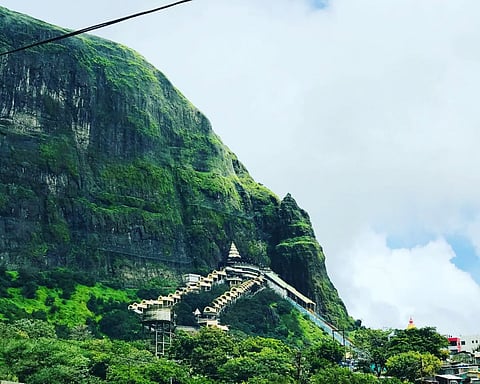
During Navratri and Chaitrotsav, Saptashrungi Gad draws thousands of devotees nashik_around_nature/Instagram
While devotion draws most visitors here, Saptashrungi Gad quietly rewards those who linger. Step away from the main shrine and the landscape takes over. Monsoon turns the hills into a living canvas—green valleys, drifting fog, sudden shafts of sunlight breaking through cloud cover. There are viewpoints near the temple from where the entire range unfurls below, offering moments that feel cinematic without trying too hard.
Accommodation remains simple but sufficient, with lodges and rooms managed by the temple trust and a handful of local hotels. Wake up early, and you might find the entire hill wrapped in fog so thick that visibility drops to a few feet, the world reduced to bells, footsteps, and breath. By afternoon, the mist often lifts, revealing layers of hills fading into the horizon.
Saptashrungi also makes for an easy extension from Nashik, a city already rich in religious and cultural landmarks. Combine your visit with Ramkund, Kalaram Temple, or Panchvati, where mythology and daily life intersect along the banks of the Godavari. Nearby shrines like Kalika Devi and Dandeshwar offer quieter detours for those keen on slow exploration.
Advertisement
In a state blessed with dramatic forts, busy pilgrim towns, and headline-grabbing landscapes, Saptashrungi Gad remains refreshingly understated. It doesn’t shout for attention. It simply exists—rooted in rock, wrapped in cloud, and held together by belief. For travellers willing to look beyond the obvious, this hidden gem of Maharashtra offers something deeply rare: a sense of calm that lingers long after the descent, like a blessing you didn’t know you were seeking.
Published At: