Matches, they say, are made in heaven. Weddings, though, are celebrated on earth, and what is remembered for years is often the meal.
From The Latest Issue: Feasts Of Forever
From Kashmir’s distinct wedding tables and Himachal’s sacred dhaam, India’s wedding feasts reveal how geography, faith and history shape celebration

Advertisement
India’s wedding feasts are records of landscape, belief, migration and memory. Their ingredients reveal what a region grows, while their cooking methods reflect its climate and history.
Kashmir offers a striking example of how one geography can produce two very different ceremonial tables. Kashmiri Pandits, who otherwise relish non-vegetarian food, turn strictly vegetarian when the bride is handed over to the groom. Lotus stems, morels, haak, slow-cooked potatoes, paneer, gourds and pumpkins are transformed with fennel, dry ginger and asafoetida into a spread of remarkable depth.
The Kashmiri Muslim wedding feast, the wazwan, moves in the opposite direction. It is an elaborate succession of predominantly meat dishes prepared by professional cooks called wazas, traditionally over wood-fired chulhas. Rice is served on a copper trami (large, hand-engraved platter) shared by four guests, followed by seekh kebab, tabak maaz, rogan josh, rista, yakhni and gushtaba. The final gushtaba—meatballs in a yoghurt gravy—signals that the feast is nearing its end. Naan, kulcha and katlam emerge from the tandoor.
Advertisement
The contrast is striking, but so is the kinship. Both tables draw on rice, yoghurt, slow cooking and the Valley’s spice vocabulary. The climate explains the rich gravies and preserved ingredients; the waterways account for lotus stem; and the forests yield morels. Faith determines what may be eaten, but geography supplies the pantry.
In neighbouring Himachal Pradesh, the dhaam turns the wedding meal into a sacred community feast. The word dhaam also signifies a holy abode or pilgrimage centre. The meal is prepared by Brahmin cooks known as botis, traditionally without onion, garlic or meat, so that even the most orthodox may eat without hesitation.
An oral tradition traces the feast to Chamba, where a ruler is said to have asked his cooks to create a vegetarian ceremonial meal inspired by Kashmir’s wazwan. Whether legend or history, it captures the dhaam’s character: a sequenced banquet made from the resources of the hills. Rice is accompanied by madra, in which rajma or chickpeas are cooked in yoghurt, along with dals, khatta and a sweet concluding dish. The repertoire changes across valleys, but pulses, rice, yoghurt and ghee remain central because grains and legumes could be stored and cattle supplied dairy.
Advertisement
The meal is traditionally served in rows on leaf plates, with families and villagers often helping with its preparation and service. These are the rewards of ingenuity: humble ingredients transformed through skill and collective labour into a ceremonial feast.
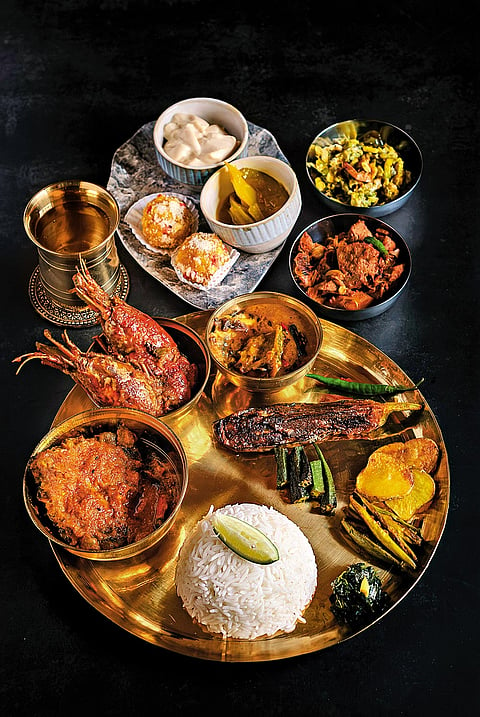
Bengali wedding feast with fish, sweets, and traditional dishes Shutterstock
Courtly repasts
If the mountain table is shaped by climate, storage and ritual purity, the Muslim walima of Bhopal, Hyderabad and Rampur bears the marks of migration, royal patronage and local adaptation. The tables may share kebabs, qormas, rice and sweets, but their differences reveal how courtly food changed as it entered new landscapes.
In Bhopal, the walima table developed within a princely culture shaped by Afghan roots and the kitchens of the Begums. Its signatures include rezala, an emerald-hued chicken curry enriched with coriander, and aflatoon, a dense baked confection.
Hyderabad is where north and south, east and west converge. It is here that the Persian and Central Asian techniques met the produce and tastes of the Deccan. Besides kacchi dum biryani, accompanied by mirchi ka salan and bagara baingan, the feast may include patthar ka gosht, cooked on heated stone, and sweets such as qubani ka meetha and gil-e-firdaus, made with milk, bottle gourd, rice and sago. The Hyderabadi walima is the culinary history of the Deccan served as a banquet.
Advertisement
Rampur tells a related but distinct story. Founded by Rohilla Afghans, Pashtun tribesmen who migrated from the mountains of Afghanistan to northern India in the 1700s, the principality was later enriched by cooks and master craftspersons from neighbouring Awadh. Its wedding dastarkhwan may include taar qorma, assorted kebabs, khamiri roti and a large deg of pulao or biryani. Confections such as adrak ka halwa reveal the ingenuity of a courtly kitchen, where an everyday ingredient could become a delicacy. Here, as in Bhopal and Hyderabad, the walima became a record of movement, patronage and place.
Rice, Fish And The Coastal Leaf
From the courtly dastarkhwan, the story returns to Bengal, where marriage is celebrated through a series of rituals, each marked by its own meal rather than a single grand feast. Aiburo bhaat is the bride’s or groom’s last ceremonial meal before marriage. After the wedding is bou bhaat, hosted by the groom’s family after the bride enters her new home. The morning meal is traditionally satvik, centred on ghee-bhaat and vegetable dishes, while the evening brings a larger reception for the bride’s family.
Advertisement
The meal unfolds in courses: maacher cutlet, mocha croquettes and bhetki fry may precede sorshe bata rui, bhapa ilish, mutton or chicken, Basanti pulao or Kolkata biryani, followed by rosogolla, sandesh and mishti doi.
Fish is central for more than culinary reasons. Bengal’s riverine landscape made it an everyday source of nourishment, but in many Bengali Hindu wedding customs, it is also an auspicious symbol of prosperity and fertility. A whole rohu or ilish, decorated like a bride, may form part of the tattva sent by the groom’s family.
The strongest wedding feasts welcome the guest in the present while passing a region’s tastes and stories to the next generation
If Bengal’s wedding feast maps a riverine culture, Kerala’s charts a coastal one. Among many Hindu communities, the sadya is a vegetarian banquet served on a banana leaf, with every item occupying a designated place and arriving in sequence. Rice anchors the meal, surrounded by avial, olan, thoran, pachadi, pickles, plantain chips and curries, before payasam brings it to a close. Coconut, rice, plantain, yam, and seasonal vegetables firmly locate the feast in Kerala’s humid, fertile landscape.
Advertisement
Yet there is no definitive Kerala wedding meal. Mappila Muslim celebrations in Malabar may centre on biryani and include muttamala, strands of egg yolk cooked in sugar syrup. Syrian Christian feasts bring meat, duck, fish, coconut-milk stews and roasts to the table. Each community draws from the same coastal pantry but arranges it according to its own history, faith and ritual codes. Until quite recently, many such feasts were prepared at home with help from relatives and neighbours, making the meal as much a collective act as a culinary one.
Across India, wedding meals have evolved according to climate, local produce and the need to preserve or celebrate what is available. At the same time, dishes have travelled through courts, trade, migration and neighbouring regions. An exotic delicacy may be added to the menu to underscore the importance of the occasion, while an heirloom recipe survives because it carries a family's memory.
Advertisement
The strongest wedding feasts do both. They welcome the guest in the present while passing a region’s tastes and stories to the next generation. To partake of one is to join a conversation between landscape and belief, community and memory, the living and those whose recipes remain at the table.
Looking for more such exciting and meaningful stories? Grab our latest issue on Amazon.
Published At: