The Pallas’s cat is built to disappear. Low to the ground, thick-furred and solitary, it has survived for centuries by avoiding notice in Ladakh’s open terrain. That strategy is proving less effective against packs of feral dogs, whose expanding presence is now putting pressure on one of the region’s most elusive carnivores.
Rare Pallas’s Cat Faces New Peril In Ladakh’s Fragile Wildlands
After a Pallas’s cat was hunted by feral dogs in Ladakh, conservationists are questioning how unchecked canine populations are altering predator–prey balance in one of India’s most sensitive landscapes

Advertisement
Conservationists and wildlife authorities in Ladakh have raised alarms after multiple confirmed incidents in which packs of free-ranging dogs have killed Pallas’s cats and other native carnivores. These events are symptomatic of a larger ecological imbalance driven by human activity across this high plateau region.
The Rising Shadow Of Feral Dogs
Once loosely tethered to human habitations, feral dogs are proliferating across Ladakh, supported by abundant waste from tourist facilities, army camps, and villages. Estimates suggest there may now be tens of thousands of these canines roaming freely, far outnumbering native predators that evolved for millennia in isolation from such competitors.
Outlook Traveller spoke to wildlife conservation experts, posing questions that will shed some light into this growing ecological concern.
“This is not a problem limited to Ladakh; it exists across India,” said Lobzang Visuddha. “But unfortunately, Ladakh tops the graph when you look at the ratio of human population to dog population.” Citing available statistics, he added, “there are approximately 149 dogs per 1,000 humans in Ladakh. That figure was from last year, and it is extremely high. In fact, it is the highest in India.”
Advertisement
Lobzang Visuddha represents the Wildlife Conservation and Birds Club of Ladakh, an organisation founded by a group of like-minded volunteers from the region. “Initially, we focused on conservation and awareness programmes related to avifauna, mainly birds,” he said. “But as we continued our work, we realised that there were equally serious issues affecting mammals and wildlife across Ladakh. Over time, we came across many incidents of poaching, particularly involving ungulates such as blue sheep,” Visuddha said. “That prompted us to take a deeper interest in highlighting wildlife issues in general, not just birds.”
One of the most alarming concerns today, according to him, is the unchecked growth of feral dog populations.
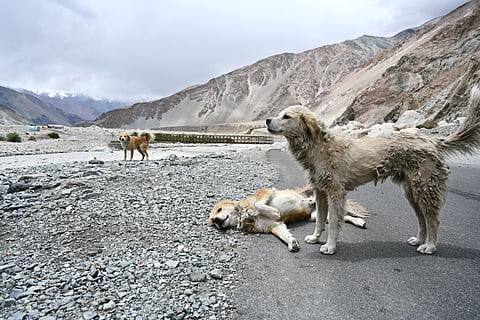
A pack of stray dogs in Ladakh Shutterstock
The feral dog issue, Visuddha emphasised, affects both wildlife and people. “This is not only a threat to wildlife. It is a threat to humans as well, especially if the situation continues to be exploited or left unmanaged,” he said. While clarifying that he is not an expert on feral dog management, he added that “even a common citizen can understand through basic common sense that the explosion has already happened. The feral or stray dog population explosion is very real.”
Advertisement
Referring to recent developments, he noted, “when Maneka Gandhi visited Ladakh to inaugurate an animal welfare shelter, she stated that there are around 40,000 dogs in Ladakh.” While actually, he said, “earlier, we believed the number was between 25,000 and 30,000, about two or three years ago. If the figure is now 40,000, it is very likely even higher.” According to him, government departments are making sincere efforts. “The administration, the wildlife department, the department of animal husbandry and the veterinary department are all trying their best,” Visuddha said. The reality, however, is that “the issue is now out of control.”
The impact of this surge on wildlife is severe. “Pallas’s cats, Eurasian lynx and even snow leopards are being chased by packs of feral dogs,” Visuddha said. “Ungulates such as blue sheep, Ladakh urial, and Tibetan argali are also regularly chased.”
He stressed that this is not a natural ecological interaction. “This is not a natural predator-prey relationship,” he added. “In the wild, predators and prey coexist in a way that maintains balance. But dogs are not native predators here. They have been introduced by humans.” Emphasising human responsibility, he noted that “we are responsible for the damage caused to wildlife and nature because we introduced dogs into their habitat.”
Advertisement
Sharing specific incidents involving Pallas’s cats, Visuddha cited eyewitness accounts from local volunteers and wildlife watchers. “Between Nyoma and Hanle, in a vast pastureland stretch of around 45 to 50 kilometres, a Pallas’s cat was seen being killed by dogs,” he said. “This was witnessed by local wildlife volunteers, including one of our members.”
Another incident occurred within Hanle village itself, which has recently become a popular tourist destination due to the Umling La Pass. “A local teacher saw three dogs attacking a Pallas’s cat while she was walking, possibly on her way to or from school,” he recounted.

Umling La Pass, Ladakh Shutterstock
What Is The Pallas's Cat?
The Pallas’s cat (Otocolobus manul) is a small wild feline native to Central Asia’s cold deserts, steppes and rocky plateaus, including parts of Ladakh. It appears more robust than it truly is, thanks to its extremely dense, woolly fur, which insulates it against arctic-like temperatures. Adapted to sweeping, open terrain with sparse vegetation, the manul’s flat face, low-set ears, and round pupils help it blend into rocky outcrops and ambush prey. Its diet consists largely of small mammals, especially pikas and rodents, along with occasional birds. The species typically shelters in rock crevices, abandoned burrows or caves, spending daylight hours hidden and emerging at dawn or dusk to hunt.
Advertisement
Explaining why the species is particularly vulnerable, Lobzang Visuddha said, “Pallas’s cats are very agile and active, but they are extremely small. They are not larger than a big domestic cat.” He further added that “they weigh barely three to four kilograms. Because of their thick, spongy fur, they look bigger than they are, but in reality, they are among the smallest wild cats in the world. Against a pack of three dogs, they cannot survive.”
He confirmed that these incidents are based on eyewitness records, though photographic evidence is limited. “We do not currently have photographs of these specific killings,” he said. “But we were keeping a close watch on the area, and these accounts are reliable.”
Visuddha also acknowledged other pressures on wildlife habitats. “Human activities such as road construction, power lines, electrification wires and mobile towers are also affecting wildlife,” he said. “These developments disturb habitats, but they are not directly killing animals in the way feral dogs are.”
Advertisement
According to him, addressing the crisis requires sustained, large-scale intervention. “This cannot be solved overnight,” he said. “We need a mission-mode approach, with at least one or two years dedicated entirely to mass sterilisation.” He added, “every village and hamlet in Ladakh must be covered. Only then, over 10 to 15 years, will we begin to see meaningful results.”
Reiterating the root cause, Visuddha said, “think of it this way: we have brought someone into another’s courtyard without permission. We introduced dogs into wildlife territory.” He concluded saying “dogs operate in powerful packs. The damage they cause is immense. Ultimately, humans must take responsibility for what happens next.”
Intesar Suhail, former assistant wildlife warden, Leh Division, said he personally witnessed the impact of feral dogs on wildlife during his tenure in the region in 2013–14. “When I was posted there, I saw feral dogs attacking even the black-necked crane,” he said. The black-necked crane is now the Union Territory bird of Ladakh and was earlier the state bird of Jammu and Kashmir.
Advertisement
He explained that the species is particularly vulnerable because of its nesting habits. “They nest on marshy lands, and their nests are easily accessible to dogs,” Suhail said. “Dogs would approach the nests and prey upon the eggs as well as the young ones. This has been a long-standing problem.” According to him, the threat posed by feral dogs extends to much larger animals as well. “Even in the Changthang area, I have seen dogs chasing animals as big as the Tibetan wild ass,” he said. “So the issue is not limited to small species alone.”
Suhail noted that attacks on Pallas’s cats are a relatively recent concern. “In 2013, sightings of Pallas’s cat were very rare,” he said. “But over the last five to six years, there have been several sightings, particularly in the Hanle area and eastern Ladakh.” He added that this resurgence was encouraging. “People were sighting and photographing these cats. For the first time, good-quality photographs became available because sightings had become more frequent.”
Advertisement
However, he warned that the increasing feral dog population poses a serious threat to this rare species. “As the number of feral dogs increases, they tend to attack anything that is accessible to them,” Suhail said. “This case is especially significant because Pallas’s cat is a threatened and very rare species.” He added that the cat has a limited and restricted range of distribution, making it even more vulnerable.
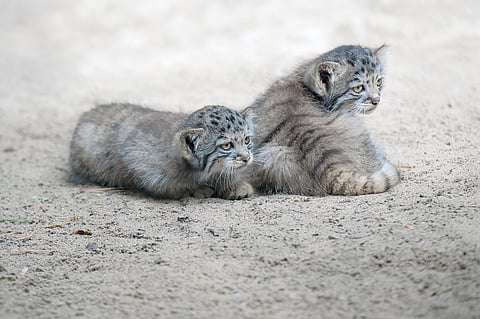
Pallas's cats in Ladakh Shutterstock
Expert On Feral Dog Behaviour
Seasonal factors worsen the problem. “In winter, food availability for feral dogs reduces significantly,” Intesar Suhail explained. “They largely survive on food scraps left behind by tourists, who are present mainly during summer.” As a result, he said, “during winters, when scraps are not available, dogs tend to attack wildlife more frequently. That is particularly concerning.”
When asked about measures to address the problem, Suhail pointed to waste management as a major root cause. “It is largely due to improper disposal of kitchen waste,” he said. “This includes waste from tourists, the tourism boom that Ladakh has witnessed, and also from army camps.” He explained that open garbage dumps containing food waste allow dogs to thrive. “Their population has increased tremendously because of this.”
Advertisement
For Suhail, feral dogs represent one of the most serious threats to Ladakh’s wildlife. “Otherwise, wildlife is actually thriving in Ladakh,” he said. “But dog populations need to be controlled. He referred to recent legal developments, saying, “The Supreme Court has given certain directives regarding stray dogs, but more needs to be done.” He stressed that wilderness areas should not host feral dogs at all. He also highlighted the risk of disease transmission. “Feral dogs are disease carriers, and the transmission of diseases from dogs to wildlife is very imminent.”
“Dogs do not play the same role in ecology and ecosystems as wildlife does,” he concluded. "Wildlife is a far more significant part of ecology. We have to balance this."
FAQs
1. What is the Pallas’s cat and where is it found in India?
The Pallas’s cat, also known as the manul, is a small wild cat native to Central Asia. In India, it is found in high-altitude regions of Ladakh, especially in areas like Hanle and eastern Ladakh.
Advertisement
2. Why are feral dogs a threat to Pallas’s cats in Ladakh?
Feral dogs hunt in packs and are not native predators in Ladakh’s ecosystems. Their growing population allows them to overpower small, solitary species like the Pallas’s cat, disrupting natural predator–prey balance.
3. How large is the feral dog population in Ladakh?
Estimates suggest Ladakh may now have around 40,000 feral and stray dogs, one of the highest dog-to-human ratios in India, largely sustained by unmanaged waste from tourism, villages and army camps.
4. Are other wildlife species affected by feral dogs in Ladakh?
Yes. Conservationists report dogs chasing and killing species such as blue sheep, Ladakh urial, Tibetan argali, black-necked cranes, Eurasian lynx and even harassing larger animals like the Tibetan wild ass.
5. What solutions are being proposed to control the crisis?
Experts stress long-term, mission-mode interventions including mass sterilisation of dogs, strict waste management, removal of dogs from wilderness areas and sustained administrative coordination over several years.
Published At: