As world leaders, senior officials, and international delegations prepare to arrive in New Delhi for the BRICS Summit, the capital’s luxury hotel market is already feeling the pressure. With the 18th BRICS Summit scheduled for September 12 and 13 this year at Bharat Mandapam, hotel rooms in some of the city’s most sought-after addresses are becoming harder to find, while rates for the rooms still available have climbed sharply.
Delhi Hotels See Sharp Rise In Room Rates Ahead Of BRICS Summit
BRICS Summit 2026 is driving hotel demand in Delhi, with luxury properties reporting limited rooms and sharply higher tariffs

Advertisement
A check of hotel booking platforms for September 11 to 13 showed limited or no availability at several prominent luxury properties in central Delhi. The Taj Mahal and Taj Palace New Delhi were showing no rooms for the period, while The Oberoi, New Delhi, had limited availability. The Leela Palace New Delhi was not accepting bookings for the dates checked. At hotels where rooms were available, including ITC Maurya, New Delhi and Shangri-La Eros New Delhi, tariffs were running into six figures for a night.
The squeeze is not unusual for a city hosting a major international gathering. The Summit itself spans two days, but its impact on hotel demand stretches beyond September 12 and 13, as delegations, business travellers and other visitors arrive ahead of the event and extend their stays. For Delhi’s already concentrated supply of luxury rooms, that can translate into a particularly tight few days.
Demand Meets Limited Supply
Advertisement
The current spike also offers a glimpse into a larger challenge facing India’s hospitality industry. Major international events can generate a sudden burst of demand, but they also expose the limitations of room inventory in key destinations.
According to KB Kachru, president of the Hotel Association of India and Chairman – South Asia, Radisson Hotel Group, India currently has only around 200,000 to 220,000 branded hotel rooms. For a country of India’s scale, he argued, that remains inadequate, particularly as demand for branded accommodation is expected to grow at 8 to 10 per cent CAGR through FY28.
The pressure is no longer confined to metros. Tier-2 and tier-3 cities are becoming increasingly important to India’s tourism economy, driven by pilgrimage travel, leisure, weddings, and infrastructure-led business demand. These destinations, too, need more branded accommodation as travel patterns expand beyond the traditional gateway cities.
“The BRICS Summit alone will put considerable focus on room inventory and that spotlight is exposing a hard truth: our hospitality infrastructure has not kept pace with our tourism ambition,” Kachru said.
Advertisement
At the same time, India’s hotel development pipeline is gathering pace. Kachru points to more than 550 new hotels signed by major hotel chains in 2025 alone, marking a record year for management contracts. HVS ANAROCK data cited by HAI shows that 14,199 branded rooms were added across 176 properties in 2025, while another 64,118 branded keys have been signed across 586 properties for future development.
Rates Reflect The Rush
For travellers planning a Delhi visit around the Summit, the immediate concern is more straightforward: finding a room without paying a steep premium.
The latest rate movement is being driven by a combination of limited inventory, concentrated demand and shorter booking windows. Luxury and MICE properties are particularly exposed because large international events require not just accommodation but meeting spaces and associated hospitality infrastructure.
Radisson Hotel Group is also seeing stronger momentum in September. Nikhil Sharma, managing director & COO, South Asia, Radisson Hotel Group, said average room rates across its portfolio are pacing more than 25 per cent higher year-on-year.
Advertisement
“September is showing stronger momentum, with average room rates across our portfolio pacing more than 25 per cent higher year-on-year. The upcoming BRICS Summit in New Delhi is contributing to heightened demand, particularly in the days around the event, with shorter booking windows further supporting rate growth,” Sharma said.
He expects the momentum to continue as the Summit approaches, with more travellers potentially making last-minute bookings. Demand, he added, is not being driven by the Summit alone. Corporate travel, MICE, social events, conferences and domestic leisure travel are also supporting hotel performance beyond the event.
That broader demand matters because the BRICS effect is landing at a time when Indian hotels are increasingly relying on domestic travel, corporate movement and events to maintain momentum amid a more challenging international travel environment.
A Pipeline Waiting
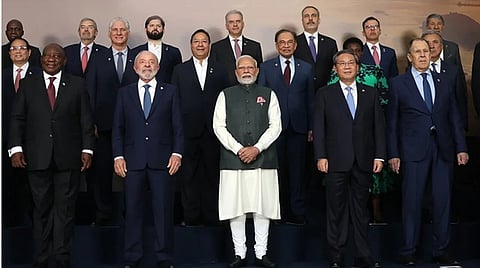
A glimpse from previous year's BRICS Summit in Brazil mygovindia/Instagram
The rush around BRICS is therefore more than a temporary hotel-price story. It is also a reminder of why India needs to translate its growing tourism ambitions into actual rooms, particularly in destinations expected to host major events and rising visitor numbers.
Advertisement
The good news is that investment appetite is no longer the biggest obstacle. According to Kachru, capital has increasingly begun flowing into hospitality, with investor confidence reflected in the number of hotel projects being signed. The challenge now is getting those projects from contracts and plans to completed properties.
He believes the next phase requires government support to focus on execution, including faster clearances, genuine single-window approvals and more rationalised state-level taxes and levies. Industry Status, uniform Infrastructure Status across hotel categories and city tiers, and enhanced Floor Space Index in space-constrained metros could all help accelerate development.
For Delhi, the BRICS Summit provides a very immediate illustration of what happens when international demand converges on a limited pool of premium accommodation. For India as a whole, however, the bigger question is what happens after the delegations leave.
If the current pipeline translates into functioning hotels at speed, the next major international event may find a city better prepared to accommodate it. Until then, travellers heading to Delhi around September 12 and 13 may need to book well ahead, look beyond the traditional luxury addresses or adjust their dates. Hotel tariffs and availability remain dynamic and can change with new bookings, cancellations and inventory released by properties.
Advertisement
FAQs
1. When is the BRICS Summit 2026 being held?
The 18th BRICS Summit will be held on September 12 and 13, 2026, at Bharat Mandapam in New Delhi.
2. Why are Delhi hotel rates rising ahead of the BRICS Summit?
Demand from international delegations, officials, business travellers and other visitors is putting pressure on limited hotel inventory.
3. Are luxury hotels in Delhi sold out for the BRICS Summit?
Several luxury properties have limited or no availability for key dates around the Summit, while others are charging significantly higher rates.
4. How much have hotel rates increased in Delhi?
Radisson Hotel Group said its average room rates across its portfolio are pacing more than 25 per cent higher year-on-year in September.
5. Does India have enough branded hotel rooms?
According to the Hotel Association of India, India currently has around 200,000 to 220,000 branded hotel rooms, with demand expected to grow further.
Advertisement
Published At: